occult
Saturn & the Black Cube
The geometry of time, lead, and limitation.
Attributed Saturnian
The flagship · browse by sight
Every glyph you've held and never read. Enter by sight, or narrow by category, tradition, and how the reading is sourced.
58 symbols
Hiding in your wallet
occult
The Bible's most feared number, still totaled on the Sun's magic square.
alchemical
The chain of being from God to ape, drawn whole.
occult
Lévi's drawing of opposites in balance — not a devil, a diagram.
sacred-geometry
Every shape matter can take, drawn from thirteen circles.
occult
The geometry of time, lead, and limitation.
solar-astro
The halo behind every saint is a disk of the sun.
civic-national
The few who see, hidden on the money in your pocket.
solar-astro
Egypt's word for life: a loop of sun rising over a cross.
corporate
The media conglomerate that wore the watching eye as a logo.
corporate
A single bite taken from the fruit of knowledge, carried in a billion pockets.
occult
An inner, invisible sun — and a symbol whose history cannot be separated from its origin.
fraternal-masonic
The star at the center of the lodge floor is not decoration — it is the point.
alchemical
Hermes' twin-serpent wand, read as energy rising up the spine.
civic-national
The legislature's ceiling shows a president ascending to godhood.
corporate
A broadcaster's eye, open and unblinking, watching forty million households since 1951.
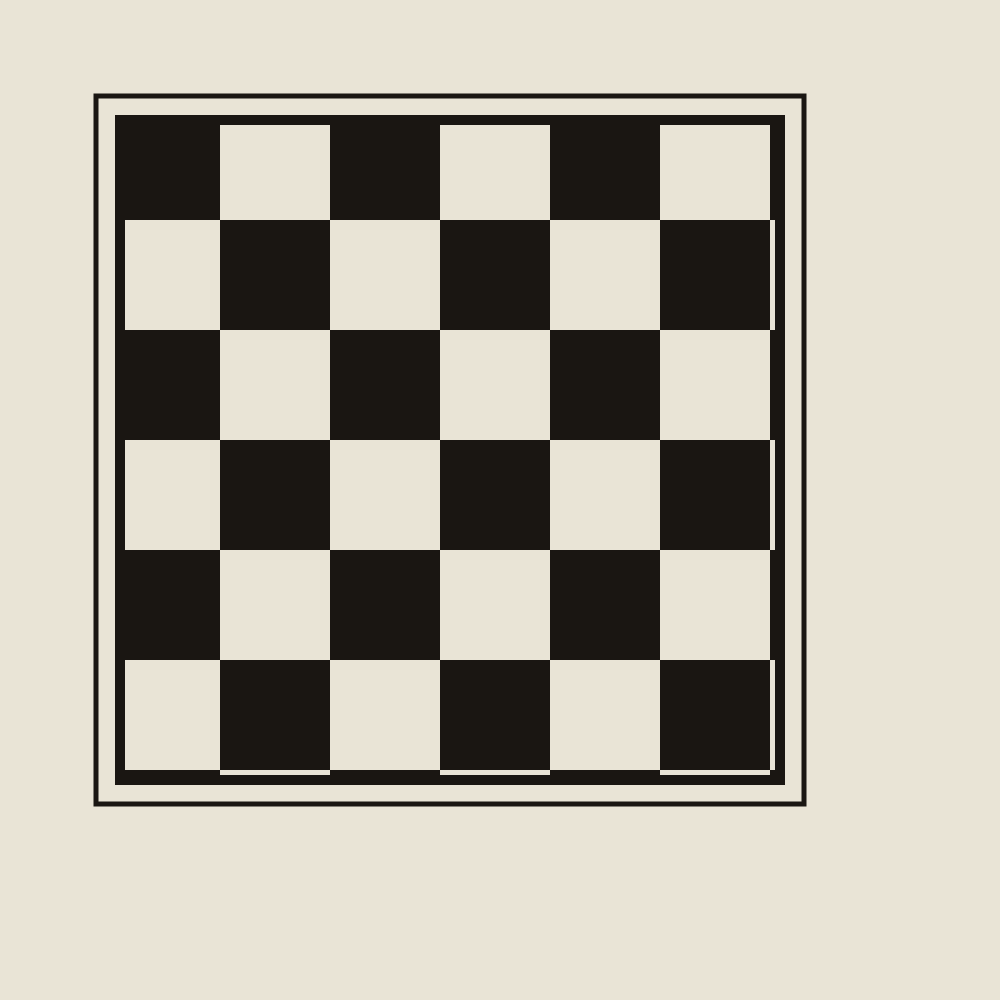
fraternal-masonic
Black and white squares underfoot — duality made literal in every lodge.
corporate
A draped goddess lifting a torch above every Hollywood film since 1924.
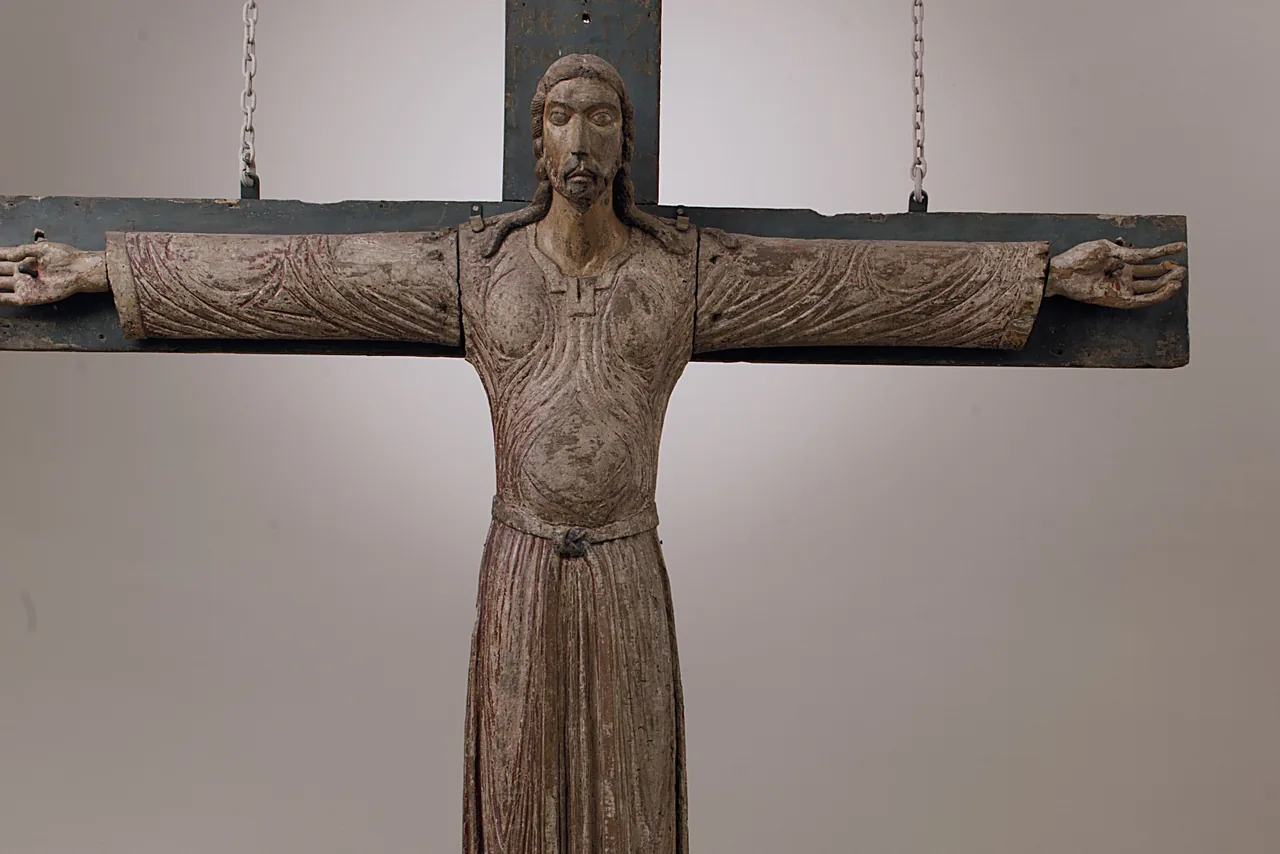
religious
The oldest cross is the sun's path drawn across the sky.
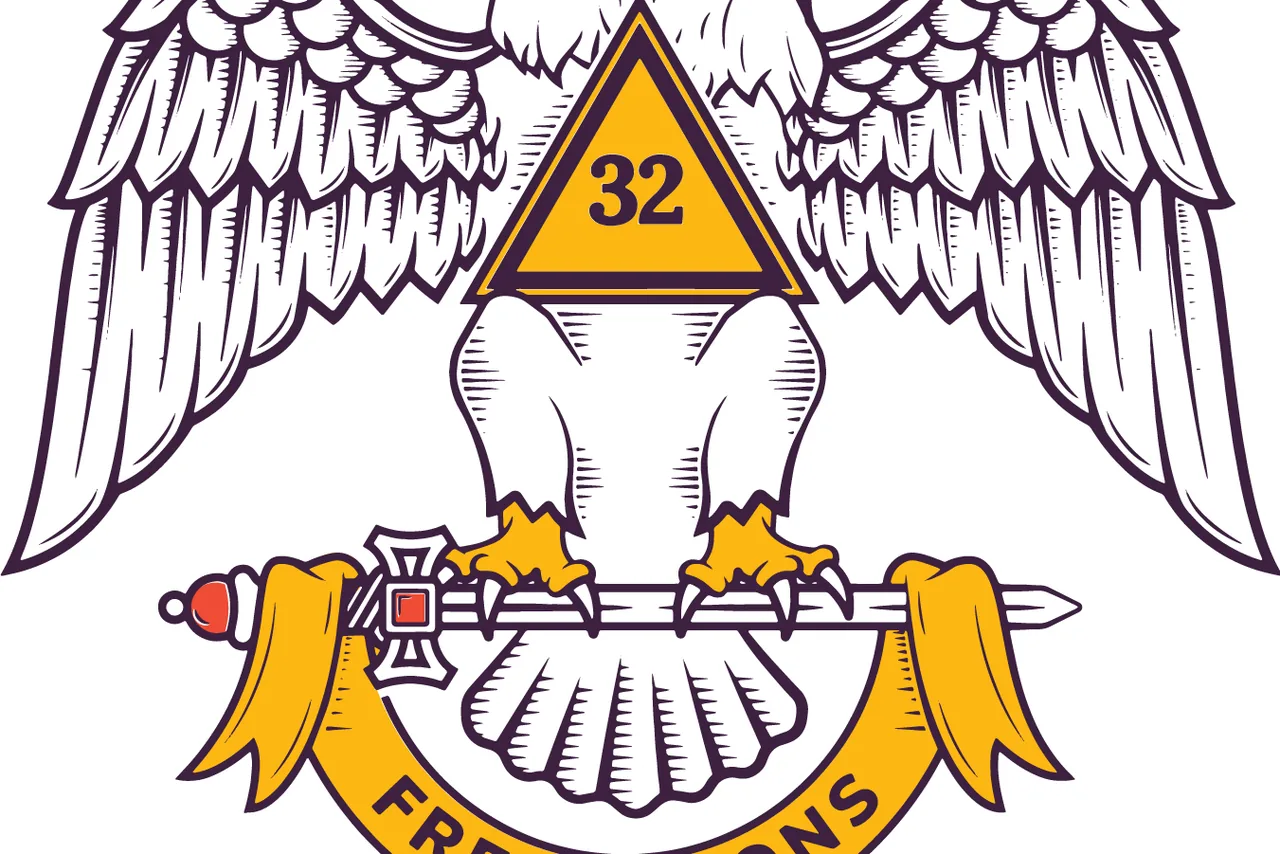
fraternal-masonic
Two heads, one body — the eagle that watches both worlds at once.
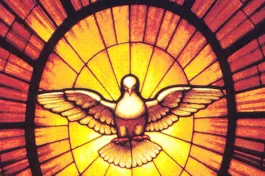
religious
The bird of the goddess, re-named but never fully re-made.
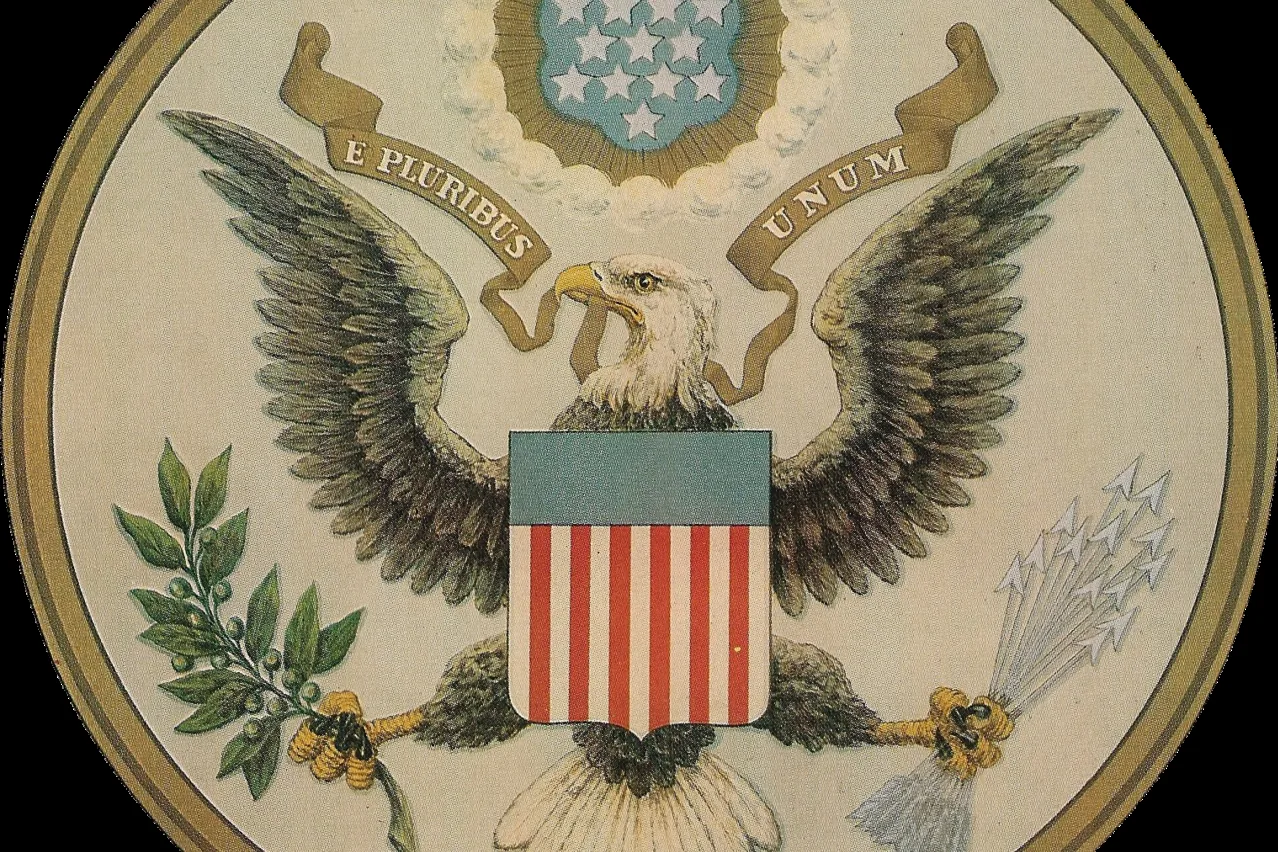
civic-national
The most official bird in America, read as the phoenix in plain dress.
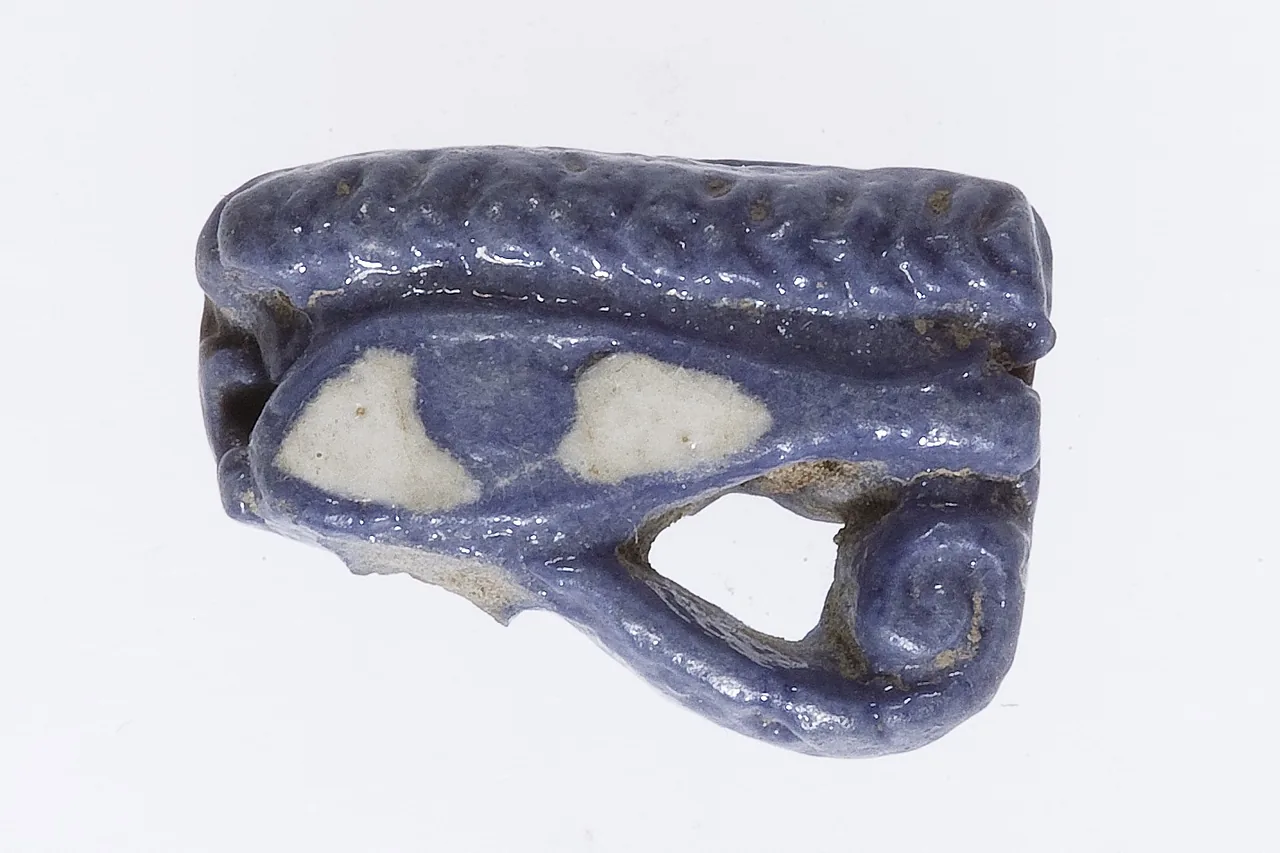
occult
Egypt's watching eye, ancestor of every eye in a triangle.
civic-national
Rome's bundle of rods and axe — coercive power, in plain sight.
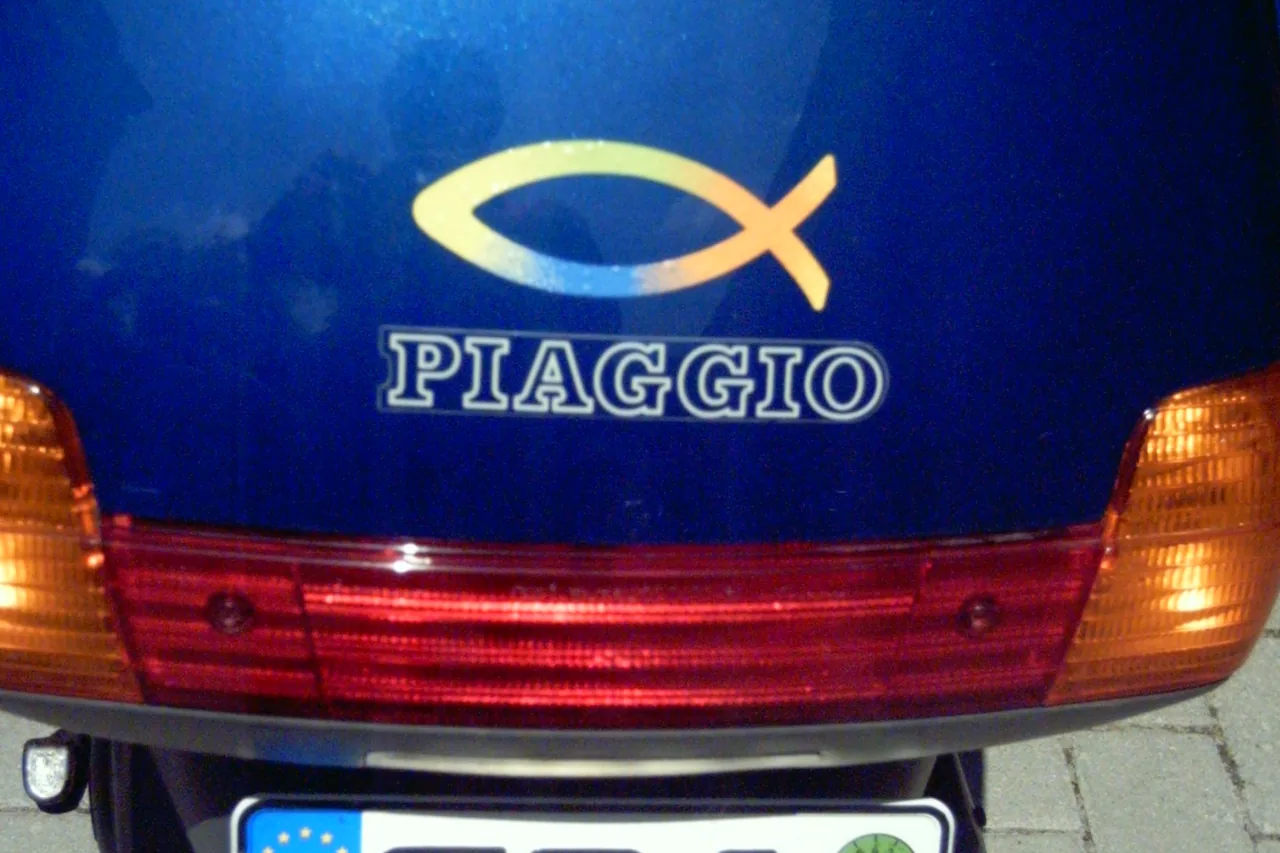
religious
The Jesus fish is the shape of an astrological age.
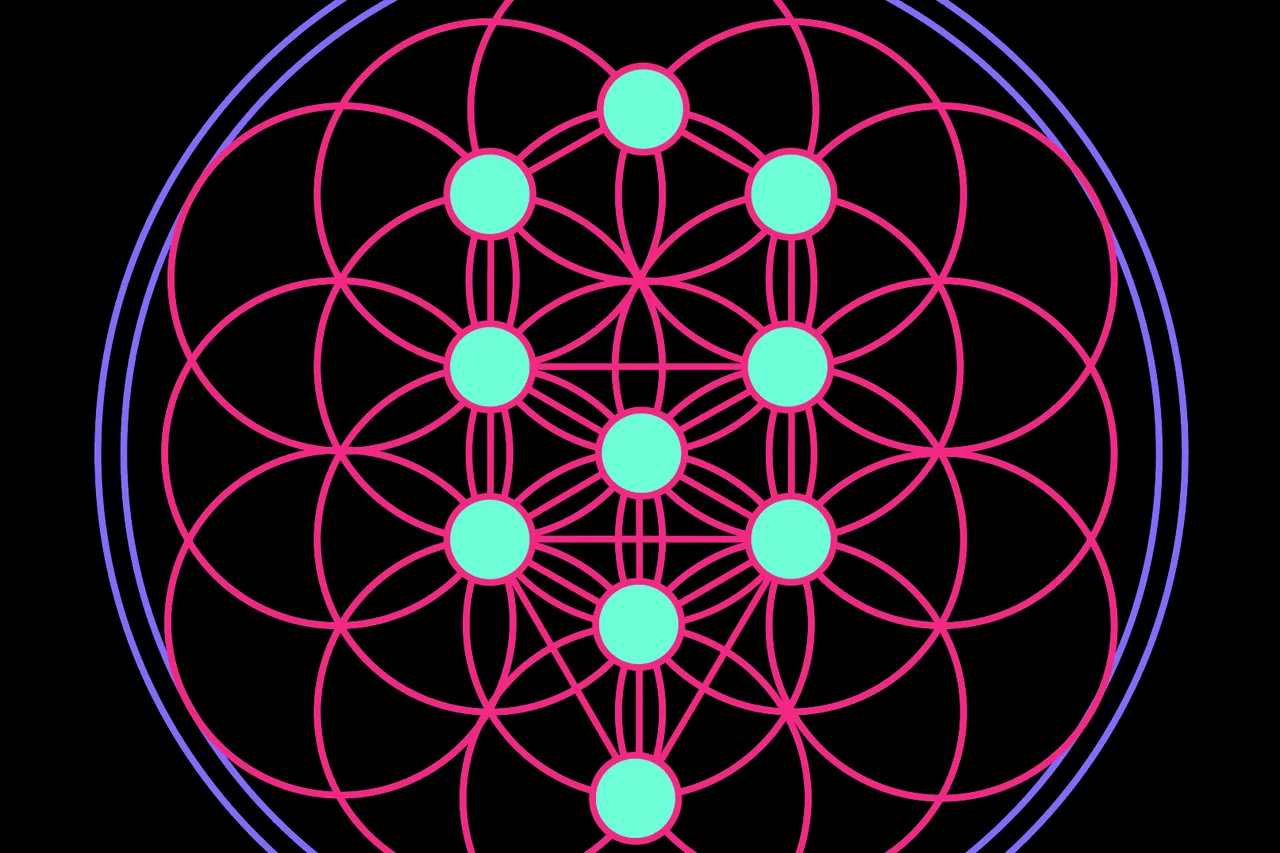
sacred-geometry
Nineteen circles encoding the blueprint of all created form.
sacred-geometry
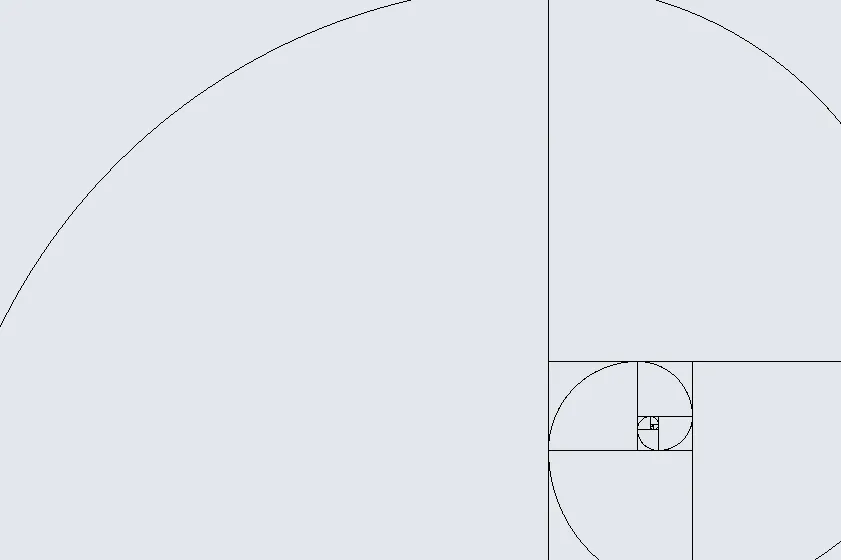
The ratio nature uses to build everything — including you.
civic-national
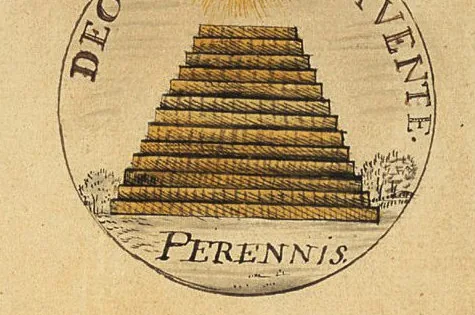
An unfinished pyramid and a watching eye — printed on every dollar.
religious
The disk behind every saint's head is a sun.
sacred-geometry
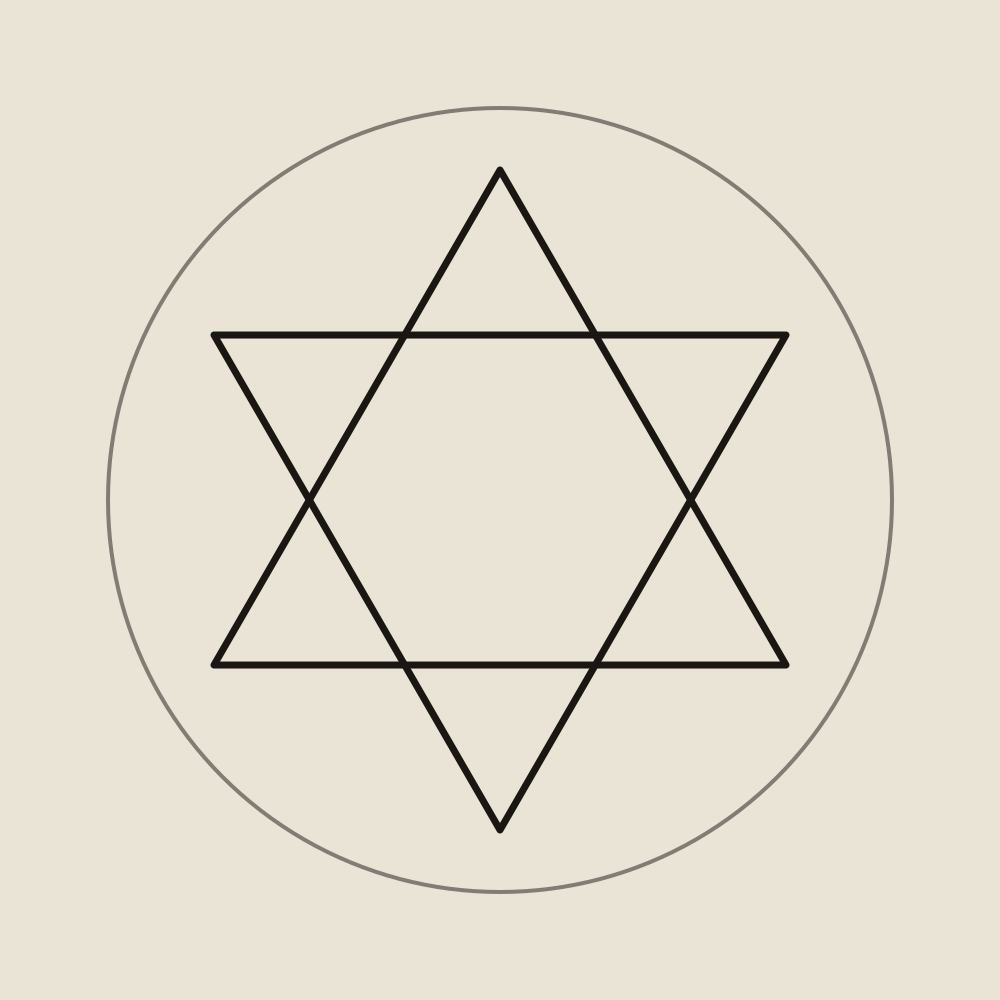
Two triangles, joined — read by the tradition as Saturn's seal.
religious
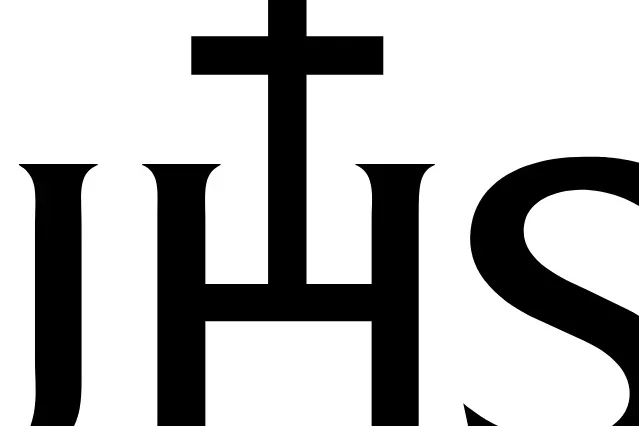
Three letters on every altar — but whose name do they really spell?
occult
One rotation of the star — and its whole meaning flips.
religious
The Lamb of God who takes away the sin of the world — and the sun.
fraternal-masonic
One letter suspended at the heart of the world's most recognizable initiatic emblem.
civic-national
The hat of freedom — and of the solar savior Mithras.
corporate
A bird of a thousand eyes, raised as the face of color broadcasting.
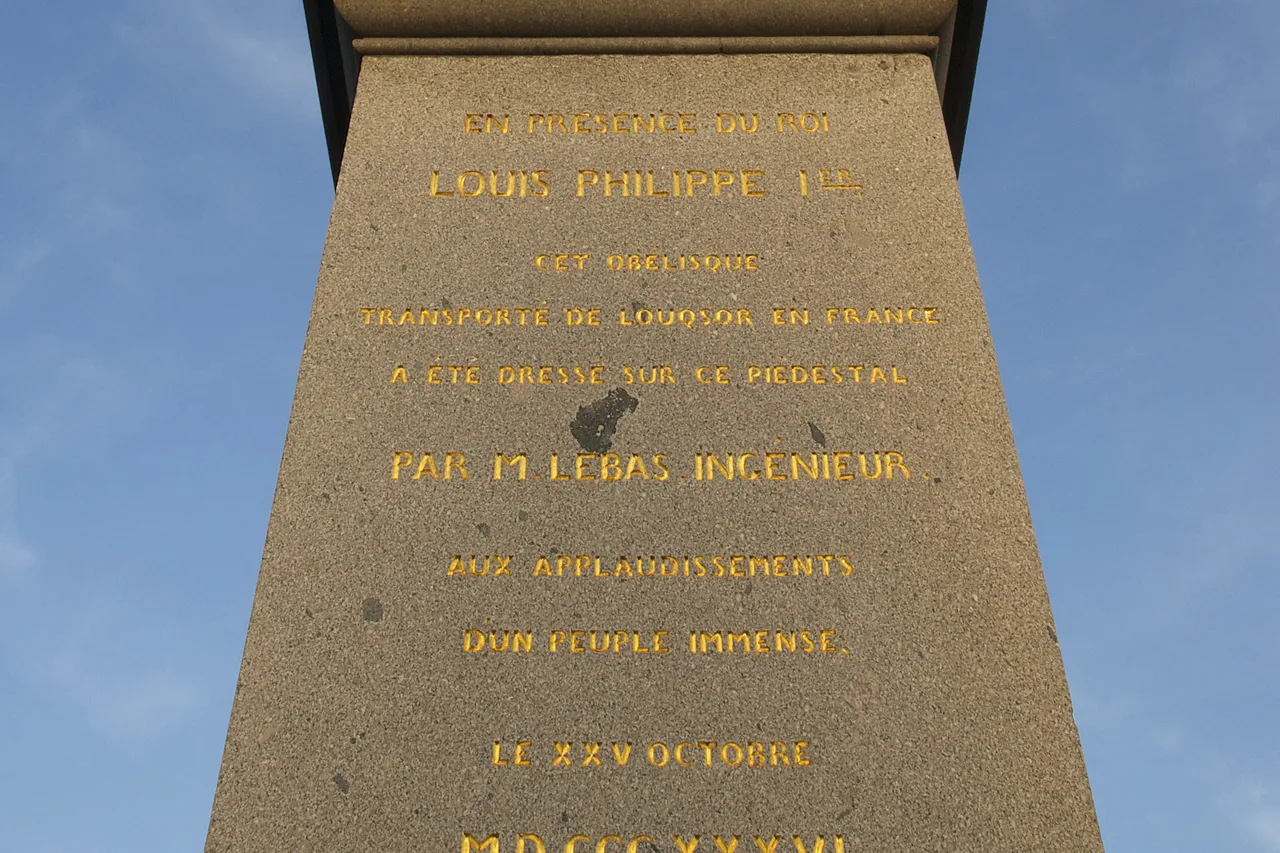
solar-astro
A stone ray of sunlight, planted at the center of empire.
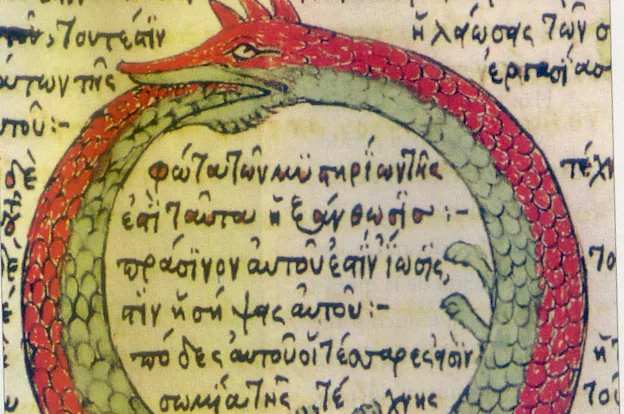
alchemical
The serpent that eats its own tail — the cosmos remaking itself.
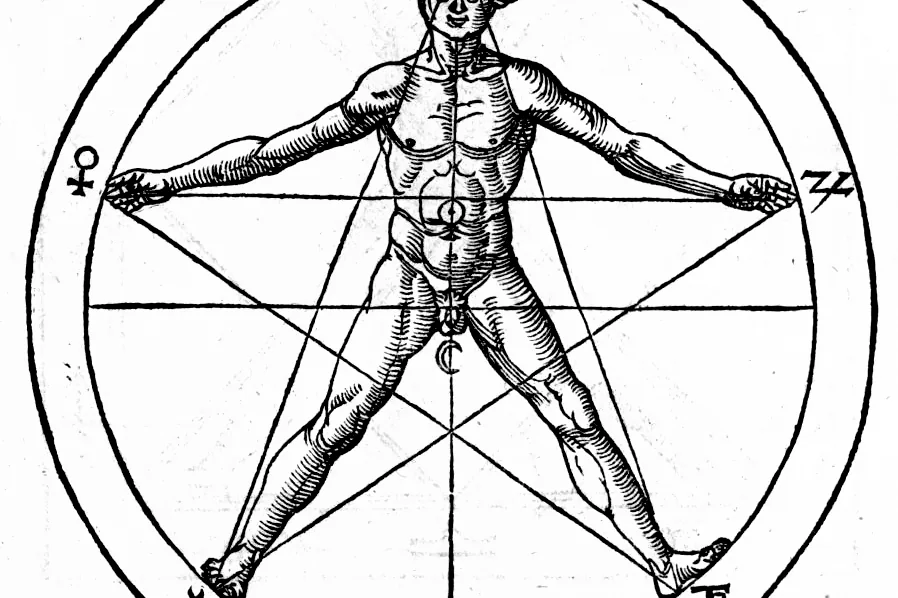
sacred-geometry
The star of the body, the cosmos, and the awakened mind.
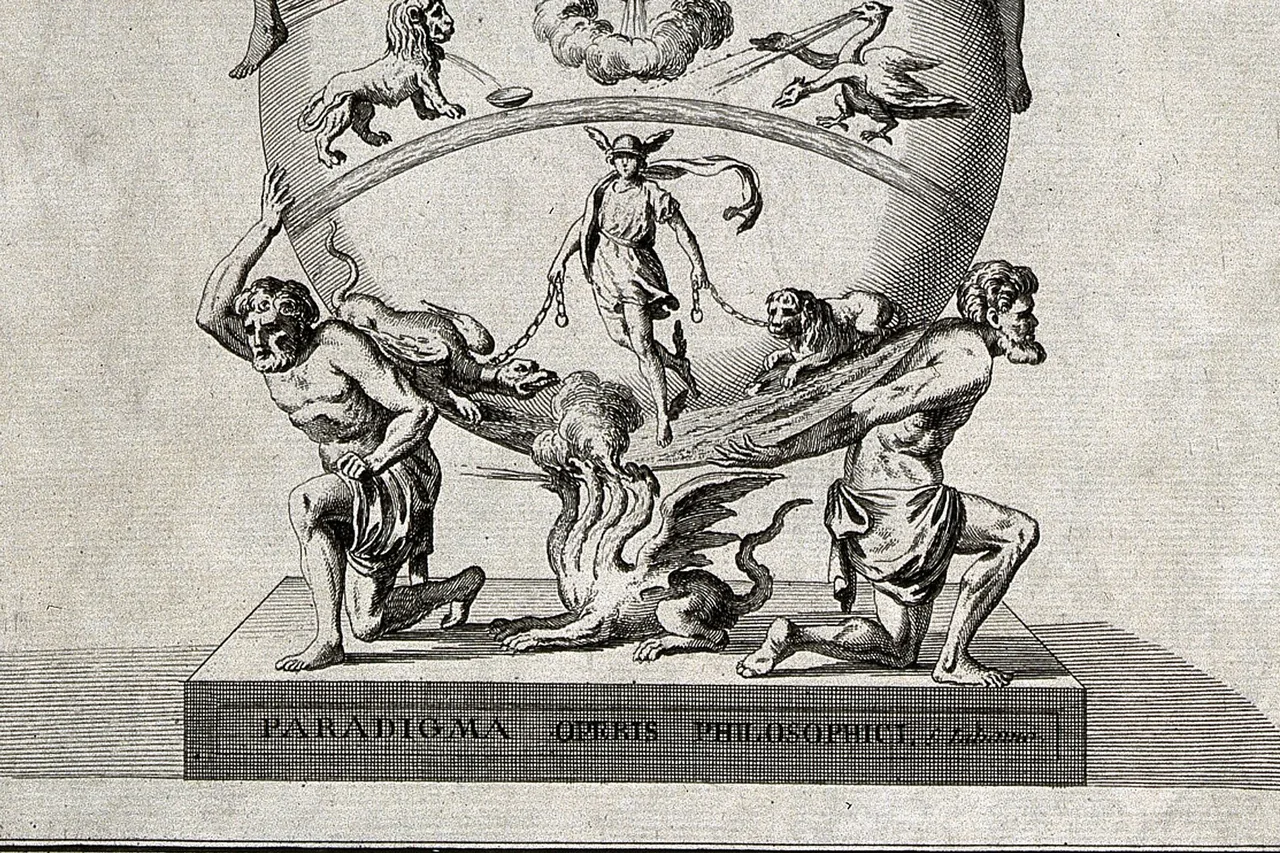
alchemical
The goal of every alchemist — perfection drawn as a single device.
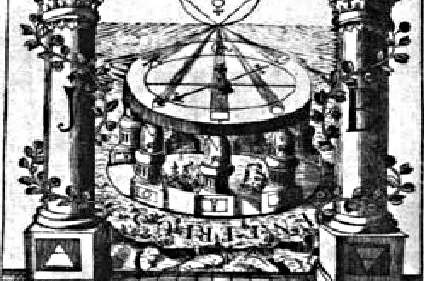
fraternal-masonic
Two bronze pillars at the temple door, flanking every Masonic lodge.
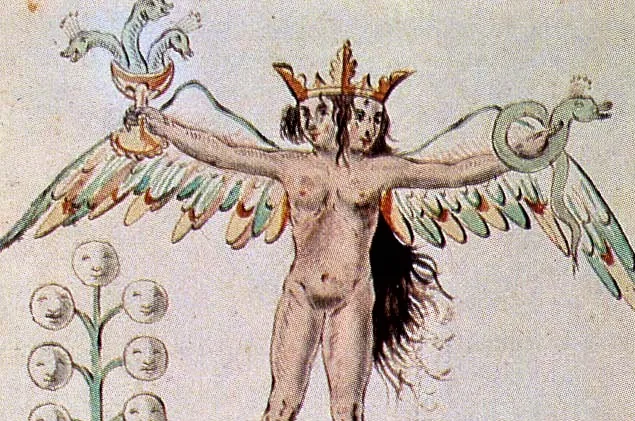
alchemical
Two natures, one body — wholeness as the goal of the Work.
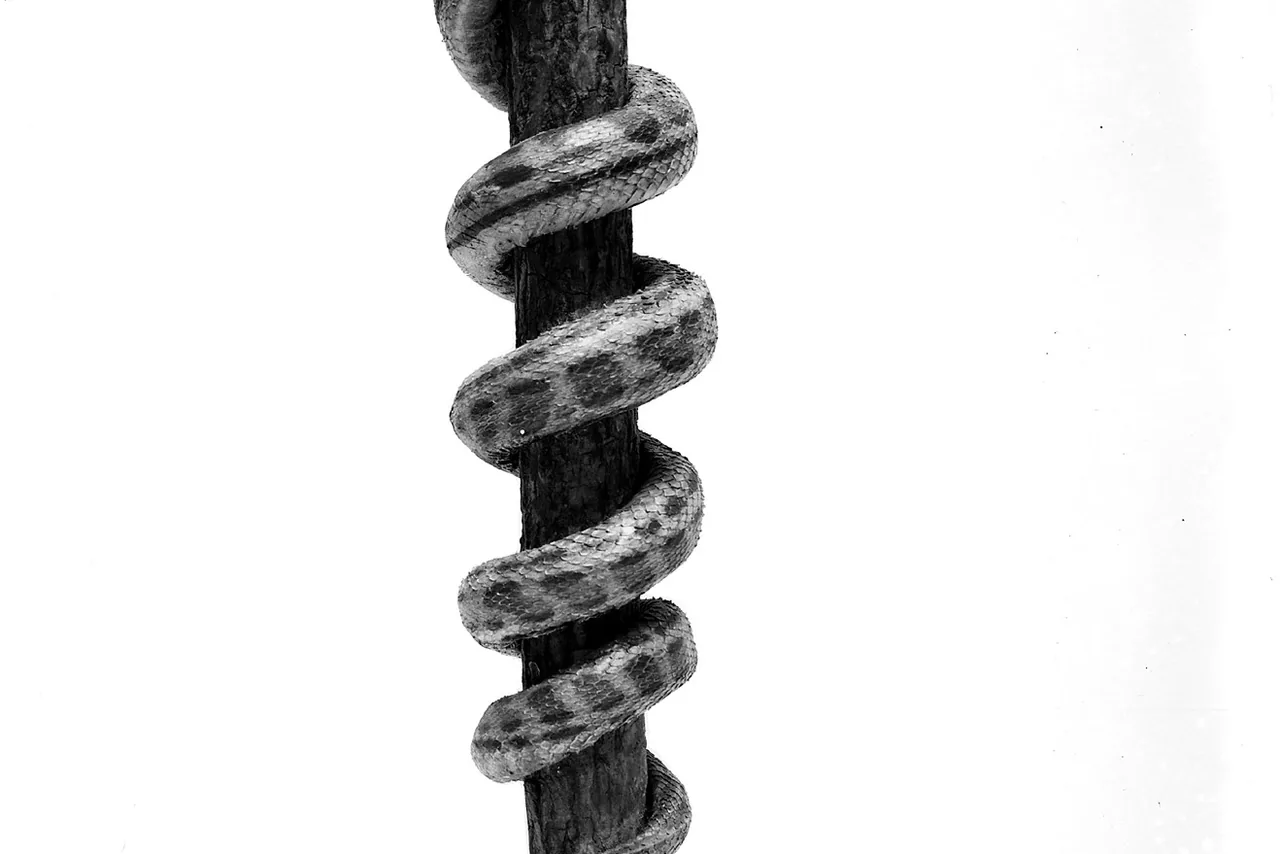
alchemical
One serpent, one staff — the true sign medicine forgot it carried.
occult
The most feared creature in scripture is also its wisest teacher.
corporate
A pilgrim's scallop shell, radiating like the sun, on every fuel pump on earth.
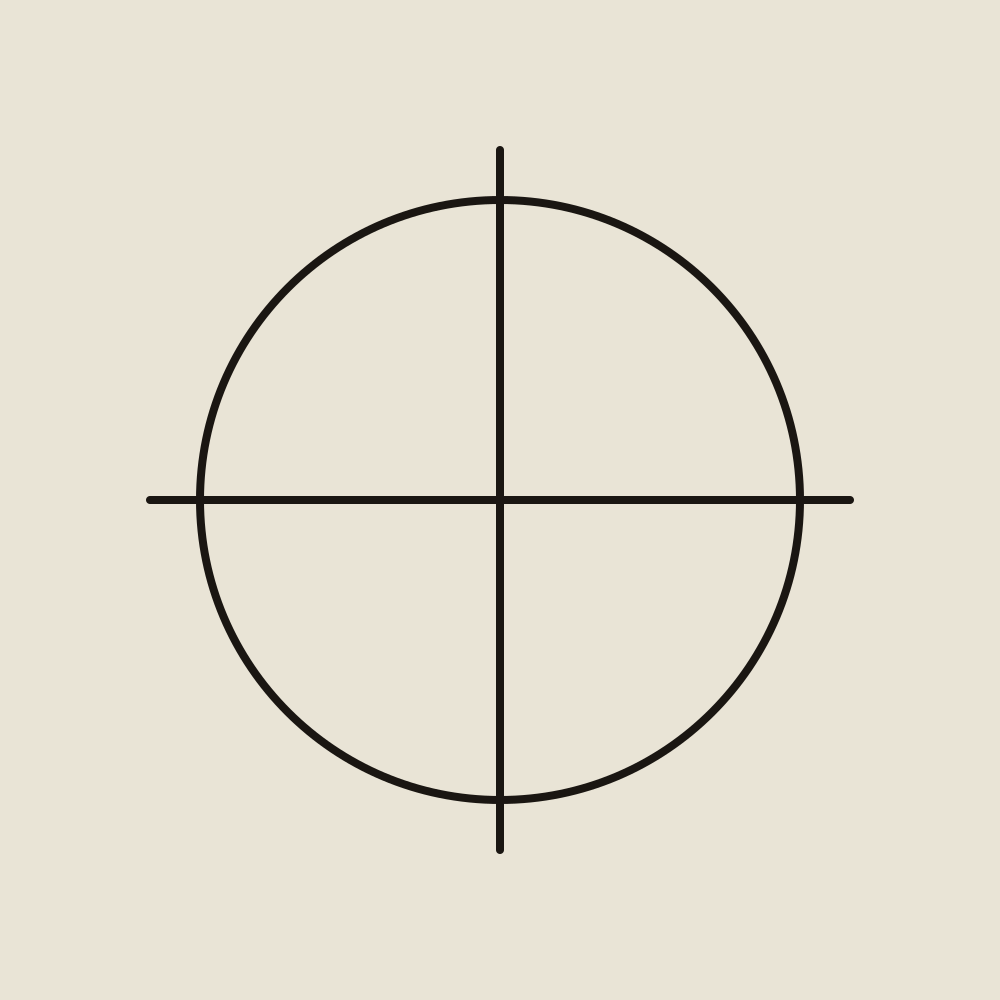
solar-astro
The first cross was the sun's path through the year.
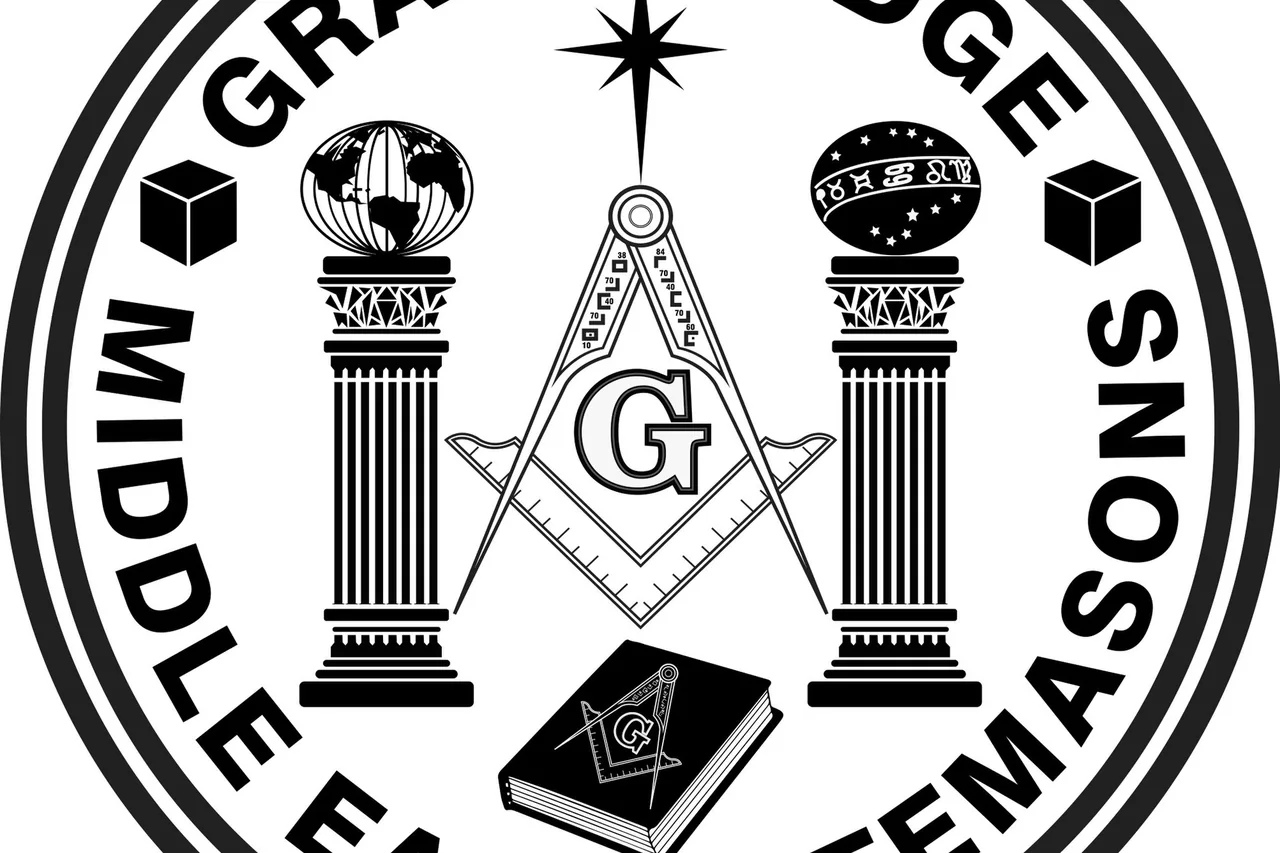
fraternal-masonic
A stonemason's tools, raised into the world's most known initiatic sign.
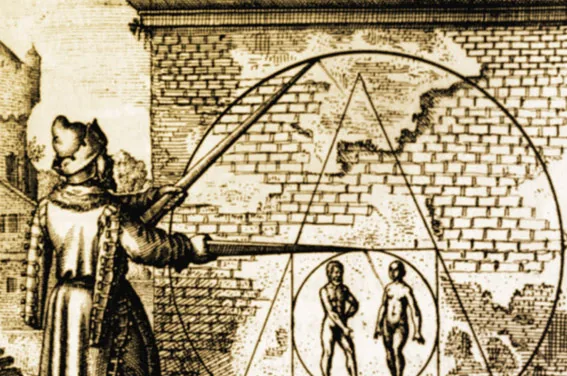
alchemical
Heaven and earth drawn as one figure — the Great Work in geometry.
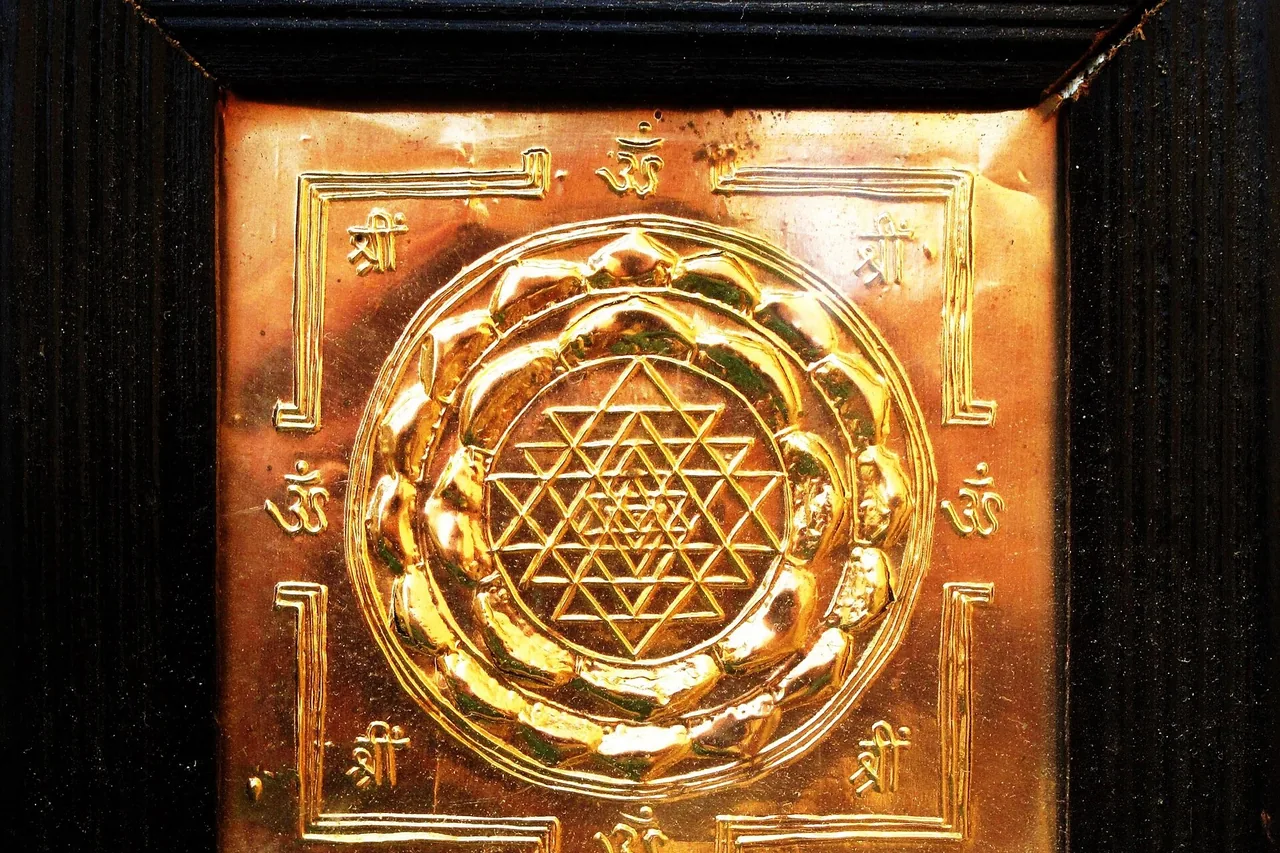
sacred-geometry
Nine triangles, 43 forms — Hinduism's map of cosmic creation.
corporate
A twin-tailed siren of medieval myth, reborn as the world's coffee cup.
civic-national
The goddess in the harbor — Isis wearing a different name.
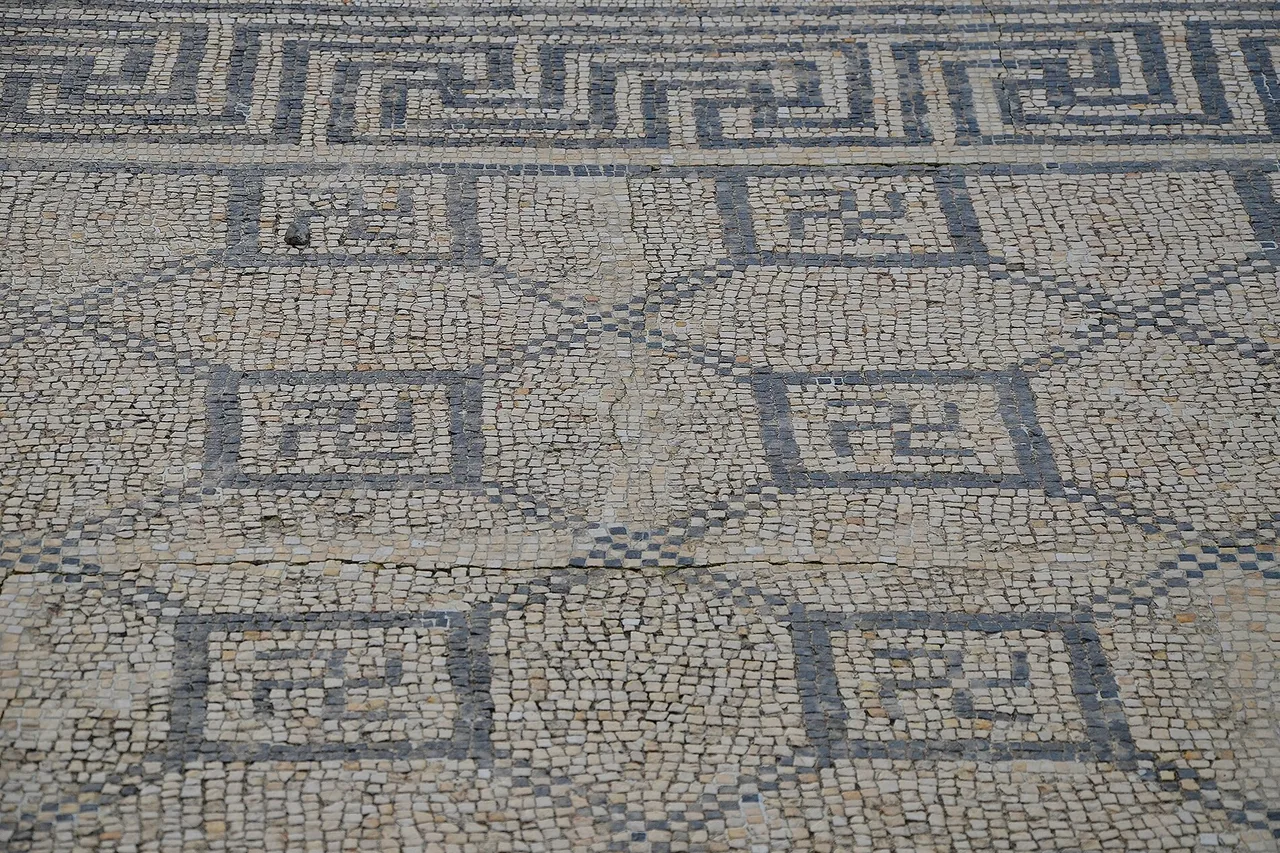
solar-astro
A 15,000-year solar wheel of good fortune, older than every flag.
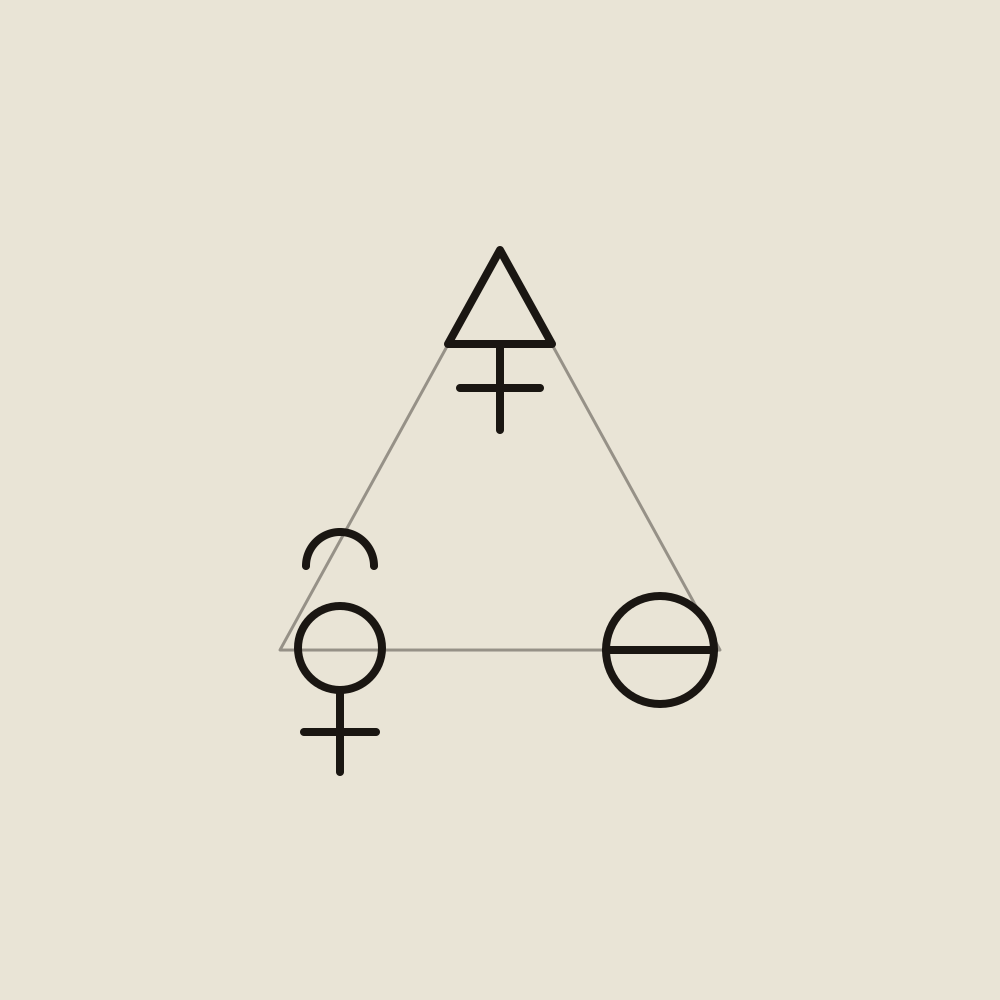
alchemical
Three glyphs that map the soul, the spirit, and the body of all things.
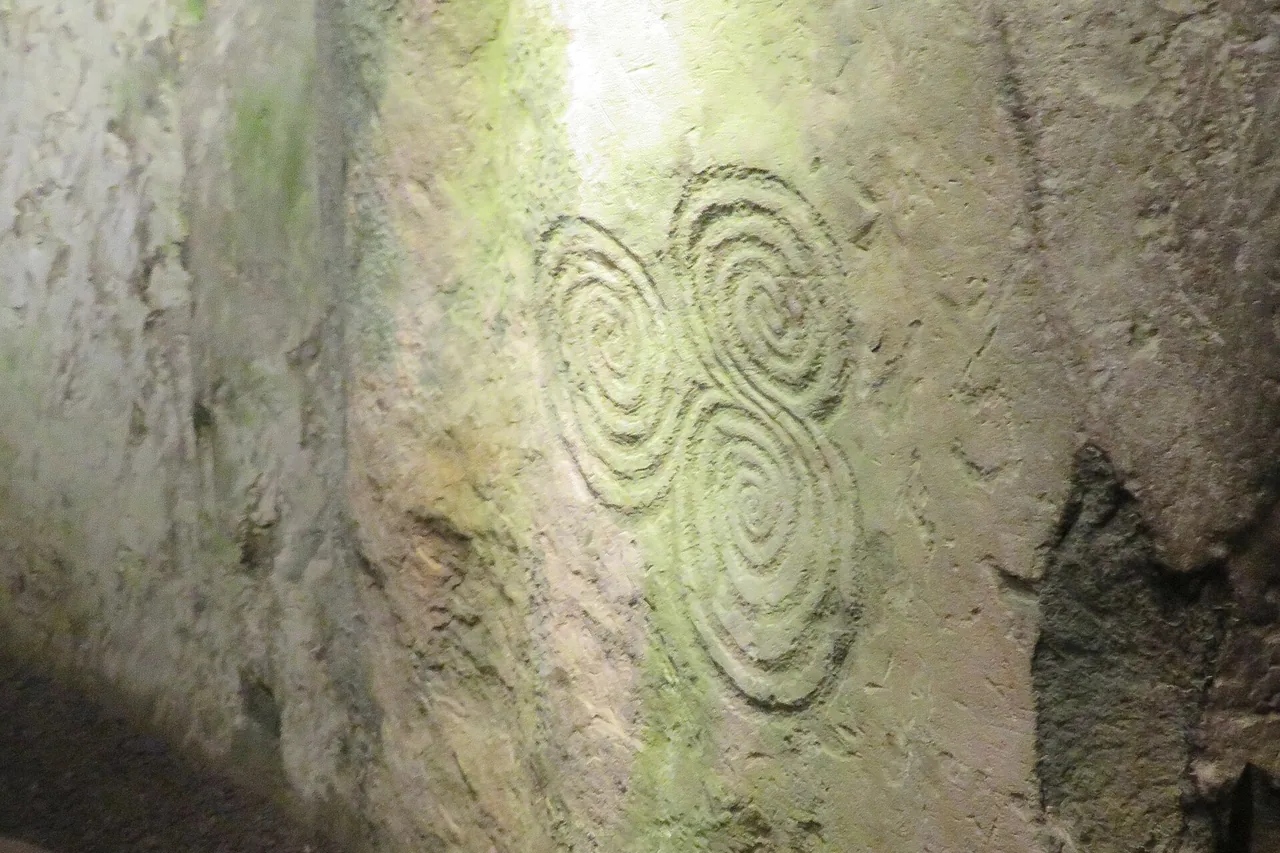
occult
Carved before writing existed — the oldest threefold turn in stone.
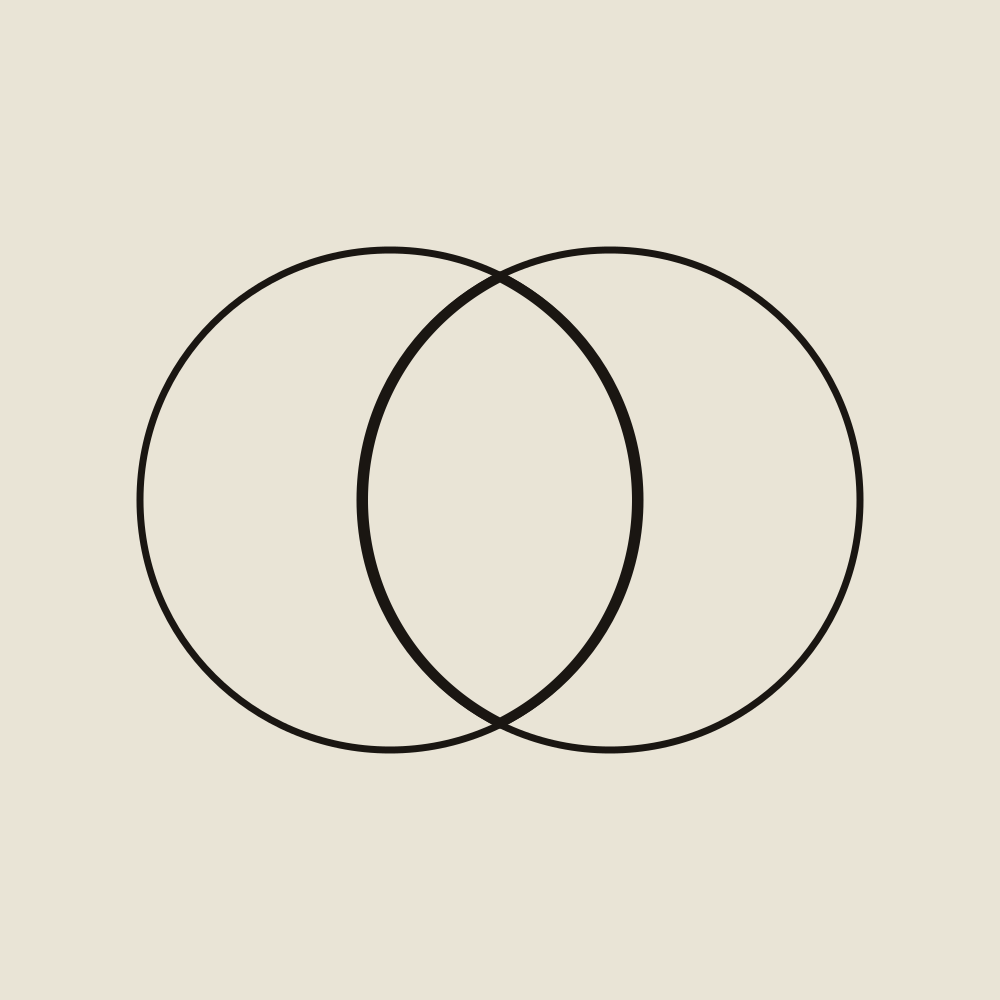
sacred-geometry
Two circles, one overlap — a portal between worlds hidden in plain geometry.
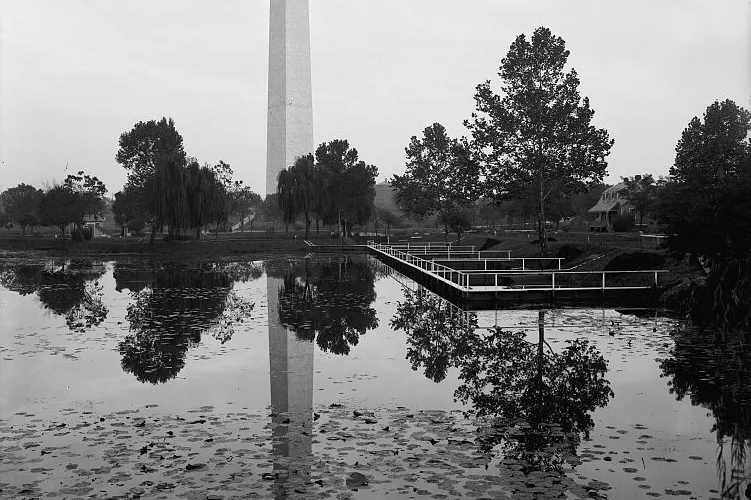
civic-national
An Egyptian sun-pillar planted at the center of American power.
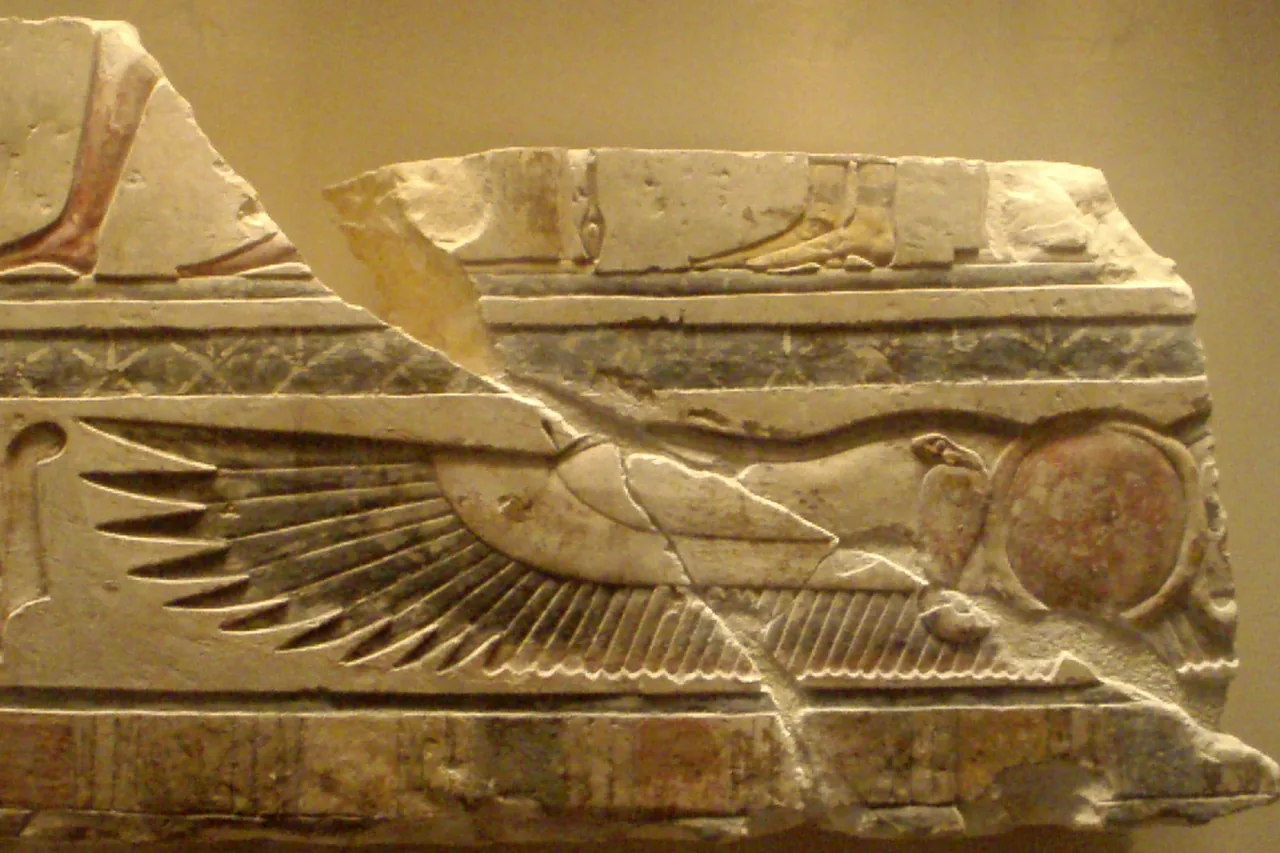
solar-astro
The sun given wings — the sky's supreme god, caught in flight.
solar-astro
Twelve signs, one wheel — the master key all scripture shares.
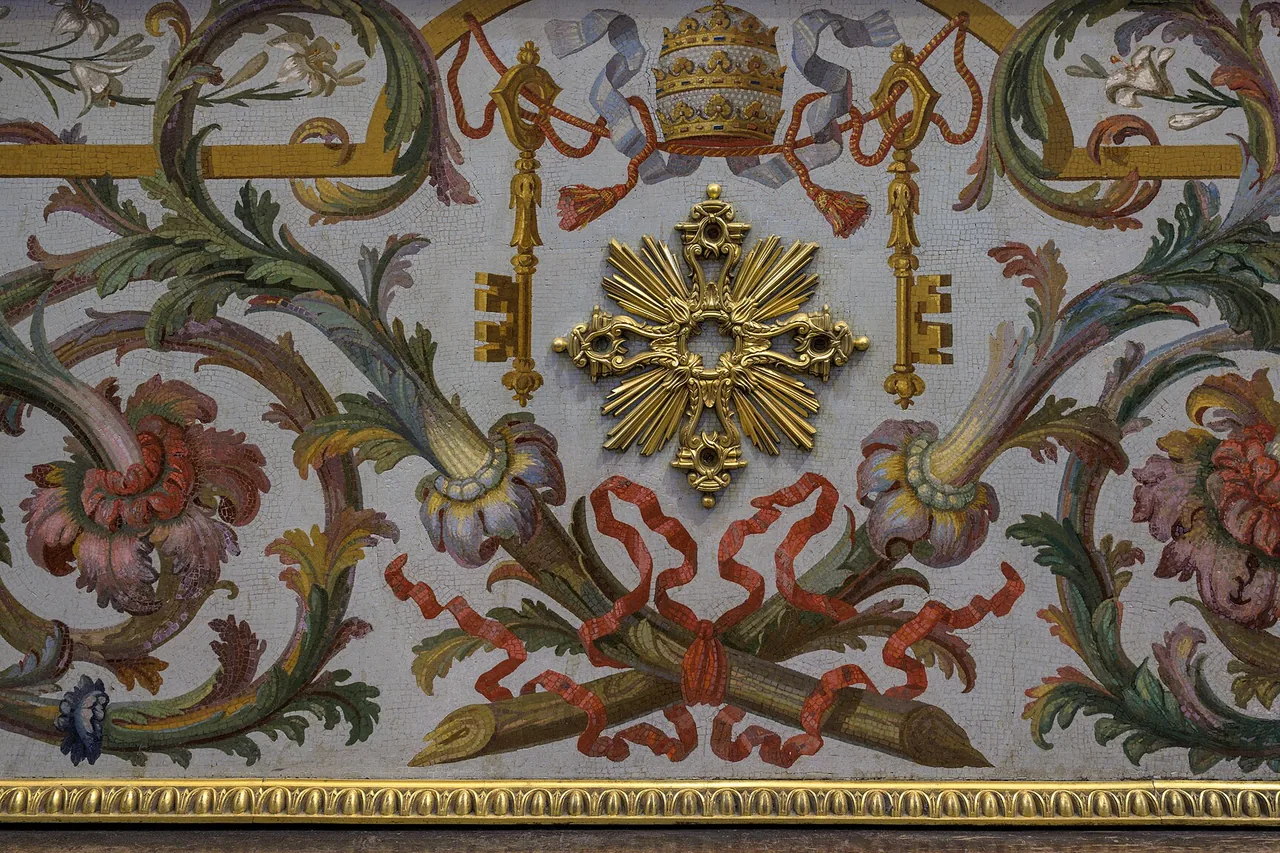
religious
Keys, a fish-hat, and a colossal pinecone — the Vatican's open archive.
Loosen a filter, or let a curated route show you the way in.
occult
The Bible's most feared number, still totaled on the Sun's magic square.
AttributedThe number 666 appears in Revelation 13:18 as “the number of the beast,” said to be “the number of a man.” Scholars of early Christianity widely link it to the Emperor Nero through Hebrew gematria — the numerical value of “Neron Caesar” in Hebrew characters sums to 666. The same figure carries older mathematical significance: the kamea, or magic square, of the Sun is a 6×6 grid of numbers 1 through 36 arranged so that every row, column, and diagonal totals 111, and the entire square totals 666.
Manly P. Hall notes the solar magic square as a primary key to the number’s pre-biblical life — 666 as the sum of the Sun, not a cipher of evil. David Icke and Santos Bonacci extend the analysis toward Saturn: Icke teaches that 666 encodes the sixth planet, the sixth day (Saturday — Saturn’s day), and the six-sided hexagon at Saturn’s north pole; the cube of Saturn and the hexagram (six-pointed star) fold into the same numeric signature. Bonacci’s syncretism holds that the number ties biblical prophecy into a Saturnian current running through Revelation’s imagery of the cube-city New Jerusalem — twelve-thousand furlongs on each side.
It surfaces in popular culture as shock-value shorthand, in numerological readings of barcodes and RFID, and in heavy-metal iconography. Less noticed: the solar kamea still appears in esoteric texts and amulet traditions, 666 as the Sun’s own number, predating the beast by centuries.
Decoded by
occult
Lévi's drawing of opposites in balance — not a devil, a diagram.
Also occult
occult
The geometry of time, lead, and limitation.
Also occult
occult
An inner, invisible sun — and a symbol whose history cannot be separated from its origin.
Also occult
occult
Egypt's watching eye, ancestor of every eye in a triangle.
Also occult
Share this specimen
ANAMNESIS
The solar magic square totals 666 — the Sun wrote that number first.
666 / The Number of the Beast
Robert Fludd, Utriusque Cosmi Historia (1617) · Wikimedia Commons · CC0
alchemical
The chain of being from God to ape, drawn whole.
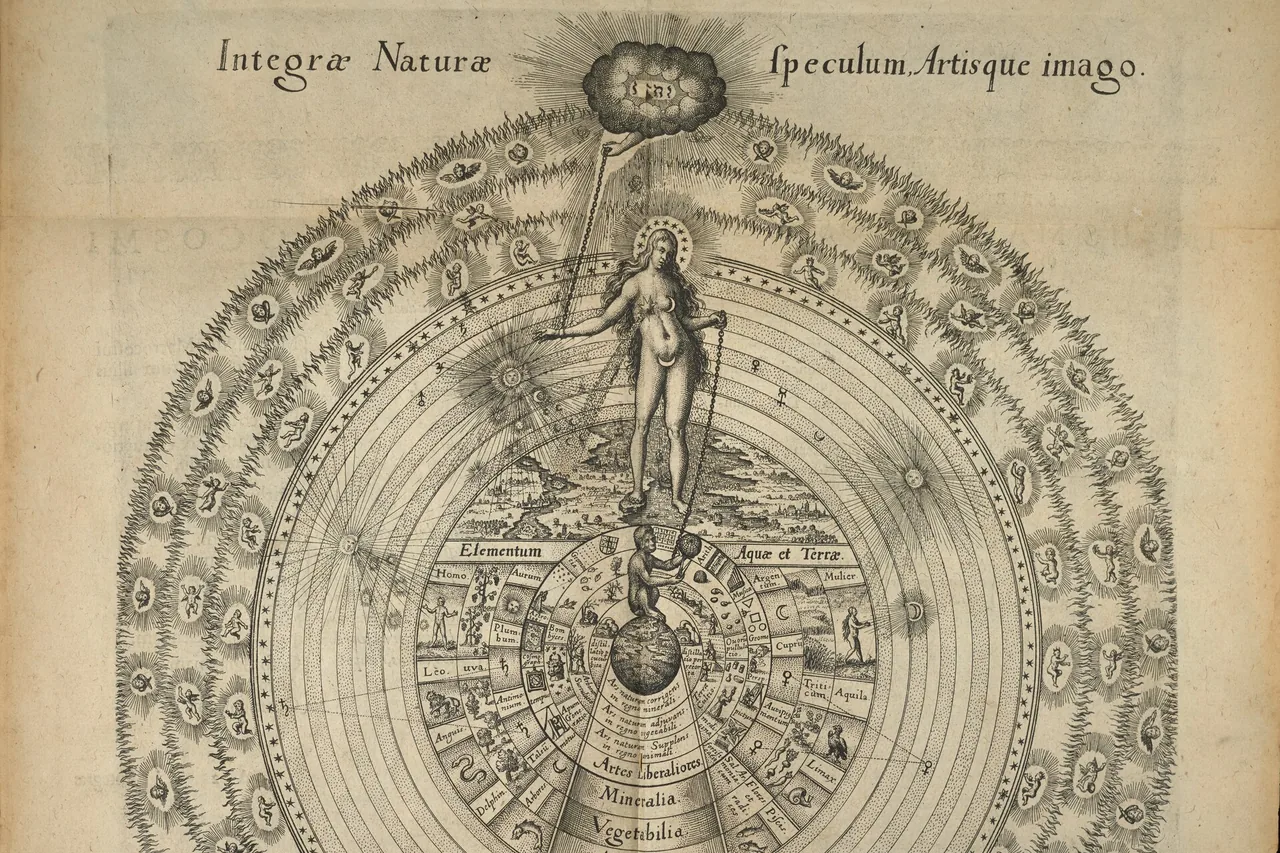
AttributedRobert Fludd’s 1617 engraving Integrae Naturae Speculum — “the mirror of all Nature” — figures the universe as a single graded chain. A divine hand reaches from the clouds; a woman, Nature, is chained to it and to the world below; the order descends through the heavens, the elements, and at last the ape of art, imitating what it cannot make. It remains one of the most complete pictures of the hermetic cosmos ever printed.
The tradition reads the plate as the first principle of the Emerald Tablet made visible: that which is below corresponds to that which is above. Manly P. Hall and Santos Bonacci treat the diagram as a literal map — the human microcosm and the cosmic macrocosm built on one pattern, and the work of the initiate being to find the channel that runs between them.
The axiom survives as a gesture: the mirrored “as above, so below” composition in advertising and album art, the radiant-figure motif in wellness branding, and the quiet pyramid-of-correspondences logic that still structures how brands rank themselves from the divine name down to the product.
Decoded by
alchemical
Hermes' twin-serpent wand, read as energy rising up the spine.
Also alchemical
alchemical
The serpent that eats its own tail — the cosmos remaking itself.
Also alchemical
alchemical
The goal of every alchemist — perfection drawn as a single device.
Also alchemical
alchemical
Two natures, one body — wholeness as the goal of the Work.
Also alchemical
Share this specimen
ANAMNESIS
One pattern runs the cosmos and the body. That's the whole claim.
As Above, So Below
Eliphas Levi · Wikimedia Commons · Public Domain
occult
Lévi's drawing of opposites in balance — not a devil, a diagram.
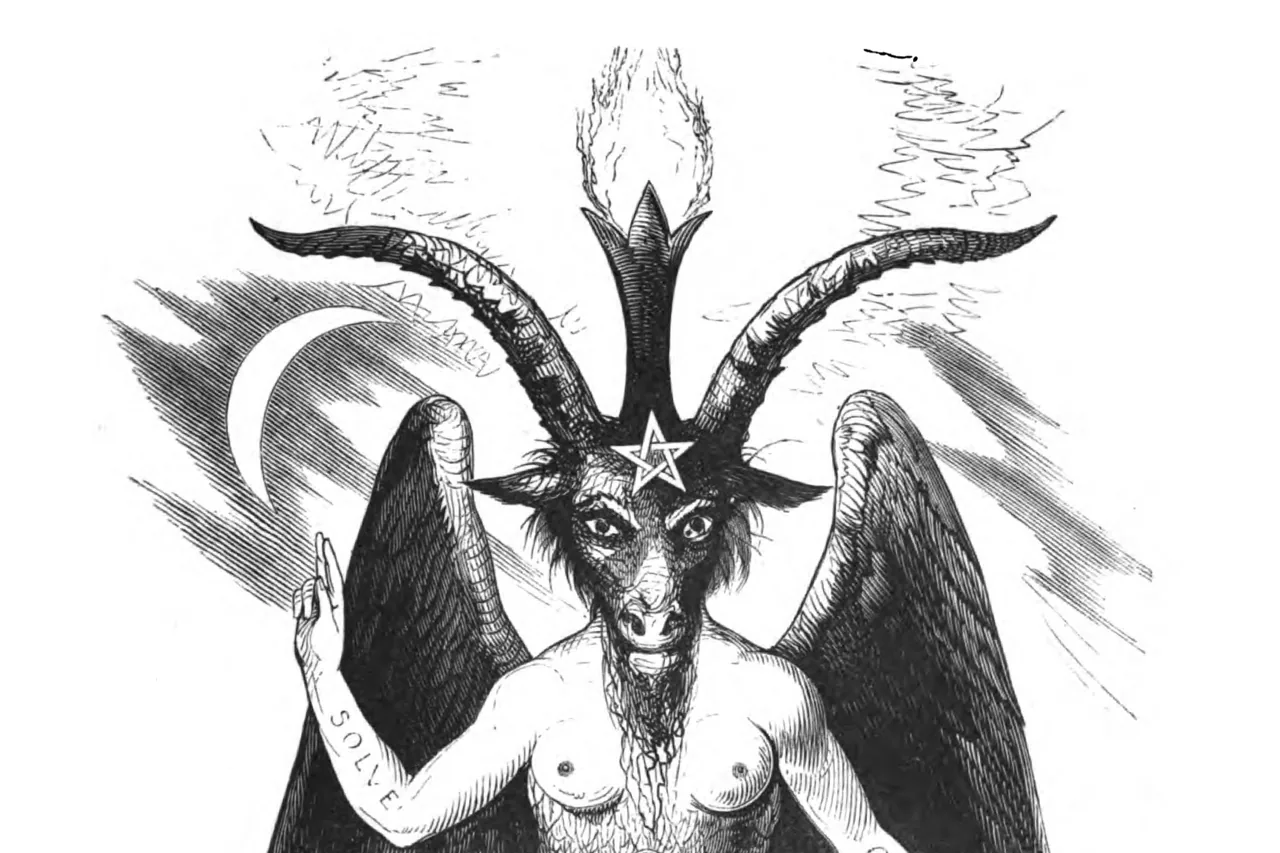
AttributedThe winged, androgynous, goat-headed figure was drawn by Éliphas Lévi in 1856 as “the Sabbatic Goat,” a deliberate synthesis of opposites — male and female, human and animal, light and dark, the arms inscribed solve and coagula. The name “Baphomet” is older than the picture: it appears in a 1098 letter from the First Crusade and again in the 14th-century trials of the Knights Templar, long before Lévi gave it this now-famous form.
Mark Passio reads Baphomet not as a devil but as a teaching diagram — the union of opposites and the balance of natural law, every paired element answering its opposite. Lévi himself intended the figure as “the equilibrium of opposites,” solve et coagula, the Hermetic axiom as above, so below rendered as a single body. Manly P. Hall places it in the same lineage of the reconciled pair, wholeness assembled from contraries.
It recurs in occult art, in the Tarot’s Devil card, and in the imagery of modern Satanic organizations — a 19th-century drawing of balance now read, by turns, as a warning and as a creed.
Decoded by
occult
The Bible's most feared number, still totaled on the Sun's magic square.
Also occult
occult
The geometry of time, lead, and limitation.
Also occult
occult
An inner, invisible sun — and a symbol whose history cannot be separated from its origin.
Also occult
occult
Egypt's watching eye, ancestor of every eye in a triangle.
Also occult
Share this specimen
ANAMNESIS
Read in the tradition not as a devil, but as balance drawn whole.
Baphomet
Alexa Szlavics · Wikimedia Commons · CC BY-SA 4.0
sacred-geometry
Every shape matter can take, drawn from thirteen circles.
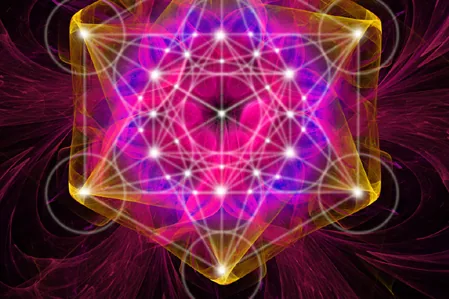
AttributedMetatron’s Cube is constructed by connecting the centers of the thirteen circles that form the “Fruit of Life” — a pattern extracted from the Flower of Life grid. The name belongs to Metatron, the angel of the divine presence in Kabbalistic angelology, described in texts such as the Third Book of Enoch as the celestial scribe standing closest to the throne. The geometric form, uniting those thirteen centers with straight lines, was named and popularized in modern sacred-geometry literature, where it gained wide currency as a teaching diagram of cosmic structure.
In the sacred-geometry tradition, Manly P. Hall reads Metatron’s Cube as a container of the five Platonic solids — the tetrahedron, cube, octahedron, dodecahedron, and icosahedron — held to be the fundamental building blocks of the physical universe. Santos Bonacci teaches that these solids nest within the figure as a complete index of the forms matter can take. In this reading the diagram is not decorative: it is the instruction set from which a cosmos is assembled.
Metatron’s Cube migrated from Renaissance Kabbalistic manuscripts into New Age art and then into the visual language of wellness, spirituality, and design culture. It surfaces on meditation tools, tattoos, and jewelry; increasingly it appears in corporate identity work drawn to its layered geometric authority — a pattern that signals hidden order.
Decoded by
sacred-geometry
Nineteen circles encoding the blueprint of all created form.
Also sacred-geometry
sacred-geometry
The ratio nature uses to build everything — including you.
Also sacred-geometry
sacred-geometry
Two triangles, joined — read by the tradition as Saturn's seal.
Also sacred-geometry
sacred-geometry
The star of the body, the cosmos, and the awakened mind.
Also sacred-geometry
Share this specimen
ANAMNESIS
Thirteen circles, every solid in nature — one figure.
Metatron's Cube
occult
The geometry of time, lead, and limitation.
AttributedAlbrecht Dürer’s 1514 engraving Melencolia I gathers under the sign of Saturn the instruments of measure and limit — a magic square, a truncated polyhedron, scales, an hourglass, and a brooding winged figure who cannot rise. In the old planetary scheme Saturn governs time, lead, boundary, and the melancholic temperament: the weight that holds things down and the order that hems them in.
David Icke and others in the tradition read Saturn as the encoded ruler of restriction — the planet of time and law — and trace its signature through the black cube that unfolds into the cross and the six-pointed seal. Santos Bonacci ties the same planet to the cycles that the astro-theological calendar is built upon. Where the eye is the sun that watches, Saturn is the square that confines.
The cube recurs in the marks of technology and finance; black-cube forms appear in ritual and civic architecture; and the hexagram travels quietly across religion and brand as Saturn’s signature — a geometry of order so common it has become invisible.
Decoded by
occult
The Bible's most feared number, still totaled on the Sun's magic square.
Also occult
occult
Lévi's drawing of opposites in balance — not a devil, a diagram.
Also occult
occult
An inner, invisible sun — and a symbol whose history cannot be separated from its origin.
Also occult
occult
Egypt's watching eye, ancestor of every eye in a triangle.
Also occult
Share this specimen
ANAMNESIS
If the eye is the sun that watches, Saturn is the square that confines.
Saturn & the Black Cube
User:Leinad-Z · Wikimedia Commons · Public Domain
solar-astro
The halo behind every saint is a disk of the sun.
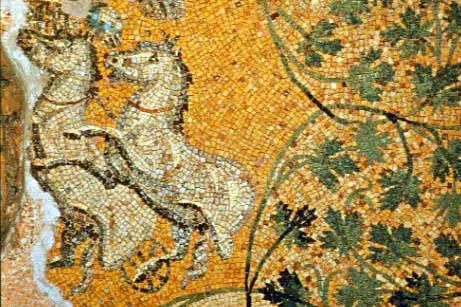
AttributedSol Invictus — the Unconquered Sun — was an official Roman solar cult formalized under the emperor Aurelian in 274 CE, though solar deity worship under that name had been established at Rome since at least the Severan dynasty. The radiant nimbus, or halo, derives from classical iconography of Sol, Helios, and Apollo: a disk of light encircling the head of the sun god to mark his divine nature. As Christianity became the empire’s dominant faith, the nimbus migrated wholesale into Christian sacred art, appearing behind Christ, the Virgin, and the saints.
D.M. Murdock and the astrotheology tradition read the halo as precisely what it began as: the literal disk of the sun rendered behind the head of the solar savior. In this reading, the Christian tradition did not invent a new image — it inherited and renamed the old one. Jordan Maxwell and Santos Bonacci hold that the solar deity simply changed title while keeping all visible markings, the nimbus serving as a continuous signature of solar theology beneath the new theological language.
Every gilded altarpiece, every Renaissance Madonna, every icon’s gold disk is this same ancient emblem. Civil sunburst motifs — state seals, currency vignettes, architectural ornament — carry the radiant form outward from the church and into the secular state, the Unconquered Sun still circling every center of authority.
Decoded by
solar-astro
Egypt's word for life: a loop of sun rising over a cross.
Also solar-astro
solar-astro
A stone ray of sunlight, planted at the center of empire.
Also solar-astro
solar-astro
The first cross was the sun's path through the year.
Also solar-astro
solar-astro
A 15,000-year solar wheel of good fortune, older than every flag.
Also solar-astro
Share this specimen
ANAMNESIS
Rome made the sun a god. Christianity kept the disk and renamed it.
Sol Invictus / The Halo-Nimbus
de:Benutzer:Verwüstung · Wikimedia Commons · Public Domain
civic-national
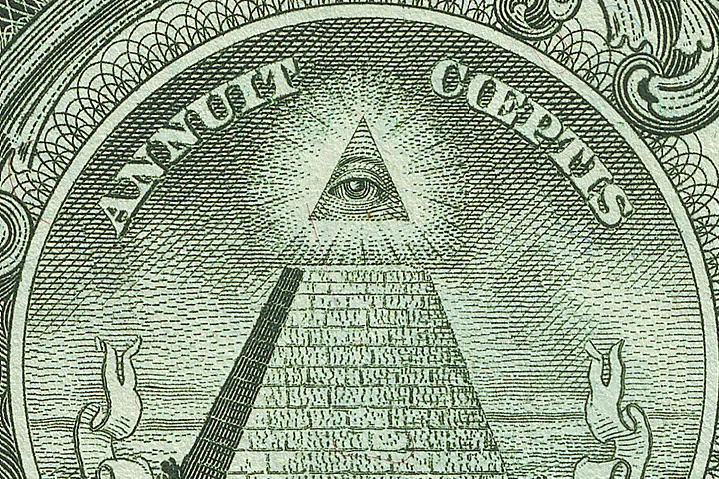
The few who see, hidden on the money in your pocket.
AttributedThe eye set within a triangle and wreathed in rays enters Western art in the Renaissance as a Christian emblem of providence — the omniscience of God watching over creation. In 1782 the new United States fixed it onto the reverse of its Great Seal, hovering above an unfinished thirteen-step pyramid. In 1935 that design was printed onto the one-dollar bill, where it has circulated ever since.
Jordan Maxwell reads the radiant eye not as the Christian God but as the solar eye of Horus and Ra — the watching sun folded into the iconography of the state. Manly P. Hall places it within a long initiatic tradition in which the eye marks the few who see, set deliberately above the many who are only ever seen.
Once you know it, it surfaces everywhere: the Great Seal and the dollar, the 1951 CBS network eye, the pyramidal marks of surveillance and “security” firms, and a thousand corporate logos built around a single, open, observing eye.
Decoded by
civic-national
The legislature's ceiling shows a president ascending to godhood.
Also civic-national
civic-national
The most official bird in America, read as the phoenix in plain dress.
Also civic-national
civic-national
Rome's bundle of rods and axe — coercive power, in plain sight.
Also civic-national
civic-national
An unfinished pyramid and a watching eye — printed on every dollar.
Also civic-national
Share this specimen
ANAMNESIS
The eye on the dollar isn't decoration. It's a claim.
The All-Seeing Eye
Bernard DUPONT from FRANCE · Wikimedia Commons · CC BY-SA 2.0
solar-astro
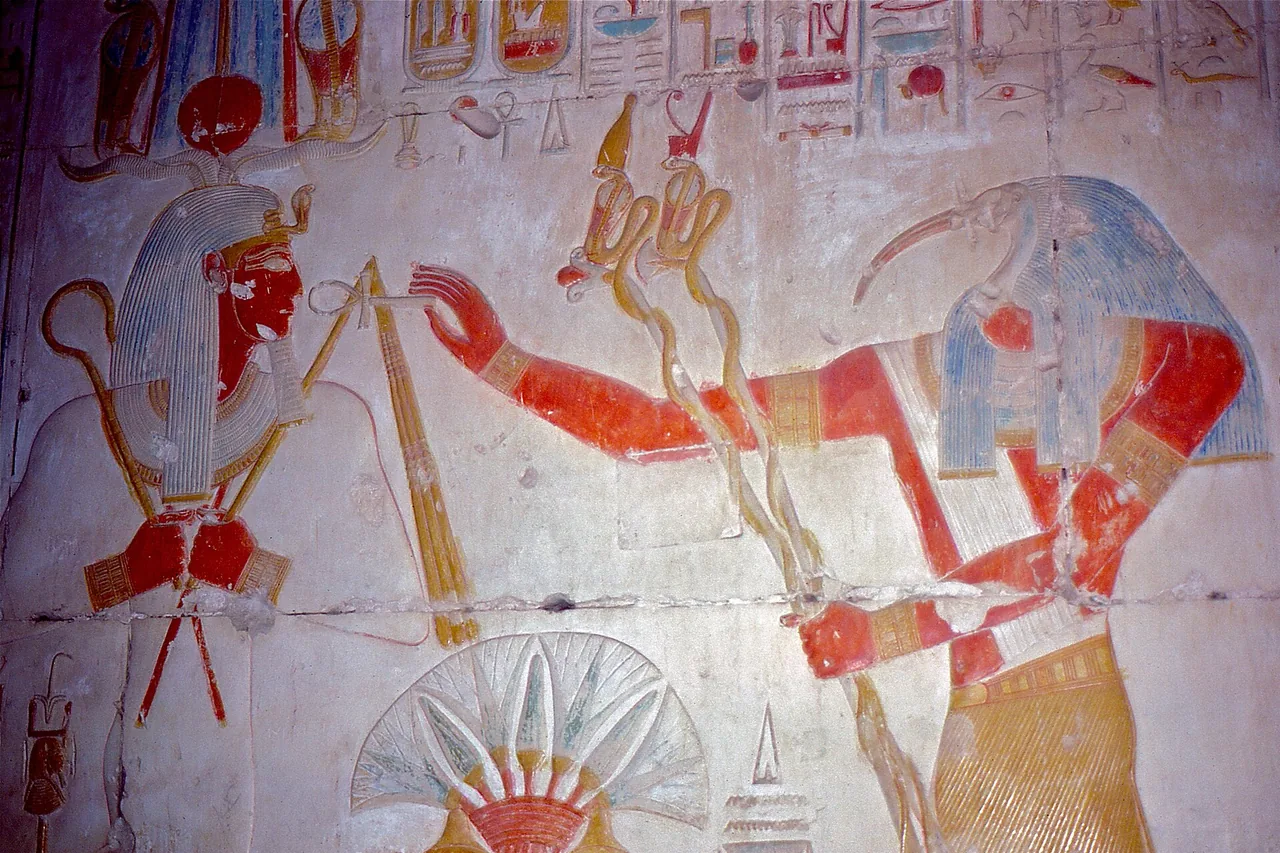
Egypt's word for life: a loop of sun rising over a cross.
AttributedThe ankh is the Egyptian hieroglyph for “life” (nḫ), attested continuously from the First Dynasty. Leading origin theories include Alan Gardiner’s sandal-strap reading and E.A. Wallis Budge’s identification of the loop as a fertility girdle — the “knot of Isis.” Carried by gods and pharaohs in tomb paintings and temple reliefs, it marked the gift of divine life. Coptic Christians later adopted the form as the crux ansata, folding Egypt’s oldest life-glyph into the new faith without changing its shape.
In the astrotheology tradition, Jordan Maxwell and D.M. Murdock read the ankh as a solar and fertility emblem fusing male and female principles — Osiris and Isis united. The teardrop loop above the crossbar is the sun cresting the horizon: Ra ascending over the east-west axis of the earth. Manly P. Hall places it within Egypt’s initiatic teaching that life itself flows from the solar fire, the loop as the inexhaustible source from which the cross of the four directions is generated.
The Coptic cross carries it forward in North Africa’s Christian communities. It reappears in Kemetic neopagan revival, in goth subculture as a mortality charm, and in mass-market jewelry where buyers sense a power in the shape they cannot quite name.
Decoded by
solar-astro
The halo behind every saint is a disk of the sun.
Also solar-astro
solar-astro
A stone ray of sunlight, planted at the center of empire.
Also solar-astro
solar-astro
The first cross was the sun's path through the year.
Also solar-astro
solar-astro
A 15,000-year solar wheel of good fortune, older than every flag.
Also solar-astro
Share this specimen
ANAMNESIS
Egypt's hieroglyph for life was always a picture of the sun.
The Ankh
corporate
The media conglomerate that wore the watching eye as a logo.
AttributedGraphic designer Saul Bass created the Time Warner eye-and-ear emblem in 1990 for the merger of Warner Communications and Time Inc., one of the largest media consolidations of the 20th century. The abstract mark — simultaneously a stylised eye and an ear — became the face of a corporation that owned film studios, cable networks, music labels, and news outlets. It carried into the AOL Time Warner era from 2001 to 2003, briefly making it the emblem of the largest media company on earth.
Jordan Maxwell reads the Time Warner eye as a media-conglomerate rendering of the all-seeing eye — the same ancient watching glyph placed atop the Great Seal, now stamped onto the company that controlled what a nation saw and heard. Mark Passio’s reading is direct: when the institution that manages public perception adopts the eye of surveillance as its identity mark, it is not coincidence but declaration — the watchers naming themselves openly.
The eye recedes into legacy assets — licensing headers, archival footage slates, corporate histories — but the logic it embodies persists in every streaming interface that learns what you watch before you choose it. CBS set an eye on its signal in 1951; Time Warner set one on its empire in 1990. The glyph migrates; the claim does not change.
Decoded by
corporate
A single bite taken from the fruit of knowledge, carried in a billion pockets.
Also corporate
corporate
A broadcaster's eye, open and unblinking, watching forty million households since 1951.
Also corporate
corporate
A draped goddess lifting a torch above every Hollywood film since 1924.
Also corporate
corporate
A bird of a thousand eyes, raised as the face of color broadcasting.
Also corporate
Share this specimen
ANAMNESIS
The eye that watches the world — printed on the world's media.
The AOL / Time Warner All-Seeing Eye
corporate
A single bite taken from the fruit of knowledge, carried in a billion pockets.
AttributedIn 1977, designer Rob Janoff of the Regis McKenna agency created the rainbow-striped bitten-apple mark for Steve Jobs. The bite was introduced so the apple would not be mistaken for a cherry at small sizes; the six rainbow stripes signaled the Apple II personal computer’s color-display capability, a decisive technical advantage at the time. The rainbow version ran from 1977 to 1998, when the mark was rendered in monochrome. The silhouette — apple, bite, leaf — has remained unchanged for nearly five decades.
Jordan Maxwell reads the bitten apple as the apple of Eden — the fruit of the Tree of Knowledge, already bitten, already transgressed. The brand, on this reading, signals the acquisition of forbidden gnosis: knowledge taken in defiance of the prohibition, carried everywhere. Mark Passio reads the same image as a deliberate invocation of that Edenic mythology, the bite encoding the foundational human act of reaching for hidden knowledge and bearing the consequence.
Apple’s mark appears on laptops in lecture halls, on phones in every pocket, on the backs of devices held by billions of people who have never once read the symbol they carry. The bite is already taken. The knowledge is already loose.
Decoded by
Appears in
corporate
The media conglomerate that wore the watching eye as a logo.
Also corporate
corporate
A broadcaster's eye, open and unblinking, watching forty million households since 1951.
Also corporate
corporate
A draped goddess lifting a torch above every Hollywood film since 1924.
Also corporate
corporate
A bird of a thousand eyes, raised as the face of color broadcasting.
Also corporate
Share this specimen
ANAMNESIS
The most carried emblem of forbidden knowledge in history.
The Apple Logo
occult
An inner, invisible sun — and a symbol whose history cannot be separated from its origin.
AttributedThe first known depiction of the design now called the Black Sun is a dark-green sun-wheel mosaic of twelve radial sig-runes set into the white-marble floor of the Obergruppenführersaal — the north tower hall — of Wewelsburg Castle near Paderborn, Germany. It was created under Heinrich Himmler’s SS during the late 1930s, as part of the castle’s transformation into an SS ceremonial center. The SS left no written record of the design’s name or intended meaning. The name “Black Sun” was attached to the motif only in 1991, when the pseudonymous author Russell McCloud published the occult thriller Die Schwarze Sonne von Tashi Lhunpo, becoming the first writer to link the Wewelsburg sun-wheel to the “Black Sun” concept in the works of Wilhelm Landig. The castle is now the site of the Wewelsburg 1933–1945 memorial museum, which documents the SS history of the site and the symbol.
In the esoteric tradition, Robert Sepehr reads the Black Sun as a symbol of the invisible central sun — an inner, hidden light that stands behind the visible, physical sun, the true source from which the outer light is only a reflection. Michael Tsarion places this concept within a broader lineage of inner-light mysticism: the “black” or dark sun as the source before manifestation, the un-lit origin of illumination. Sepehr locates this inner-sun tradition in pre-Christian solar mysticism, noting that the twelve-rayed solar wheel existed as a form long before Himmler’s architects inlaid it in Wewelsburg marble.
The twelve-spoked sun-wheel appears in present-day both esoteric contexts and extremist iconography, where it has been adopted as an emblem by neo-Nazi and white-supremacist movements. Its SS origin is not incidental — it is part of the symbol’s modern history, documented and presented without euphemism at the Wewelsburg 1933–1945 memorial museum. Students of esoteric symbolism encounter this design at the intersection of ancient solar-wheel traditions and 20th-century institutional horror; the two histories cannot be cleanly separated, and intellectual honesty requires holding both.
Decoded by
occult
The Bible's most feared number, still totaled on the Sun's magic square.
Also occult
occult
Lévi's drawing of opposites in balance — not a devil, a diagram.
Also occult
occult
The geometry of time, lead, and limitation.
Also occult
occult
Egypt's watching eye, ancestor of every eye in a triangle.
Also occult
Share this specimen
ANAMNESIS
A mosaic installed by the SS — and a myth that long predates it.
The Black Sun
Original diagram — ANAMNESIS · CC0
fraternal-masonic
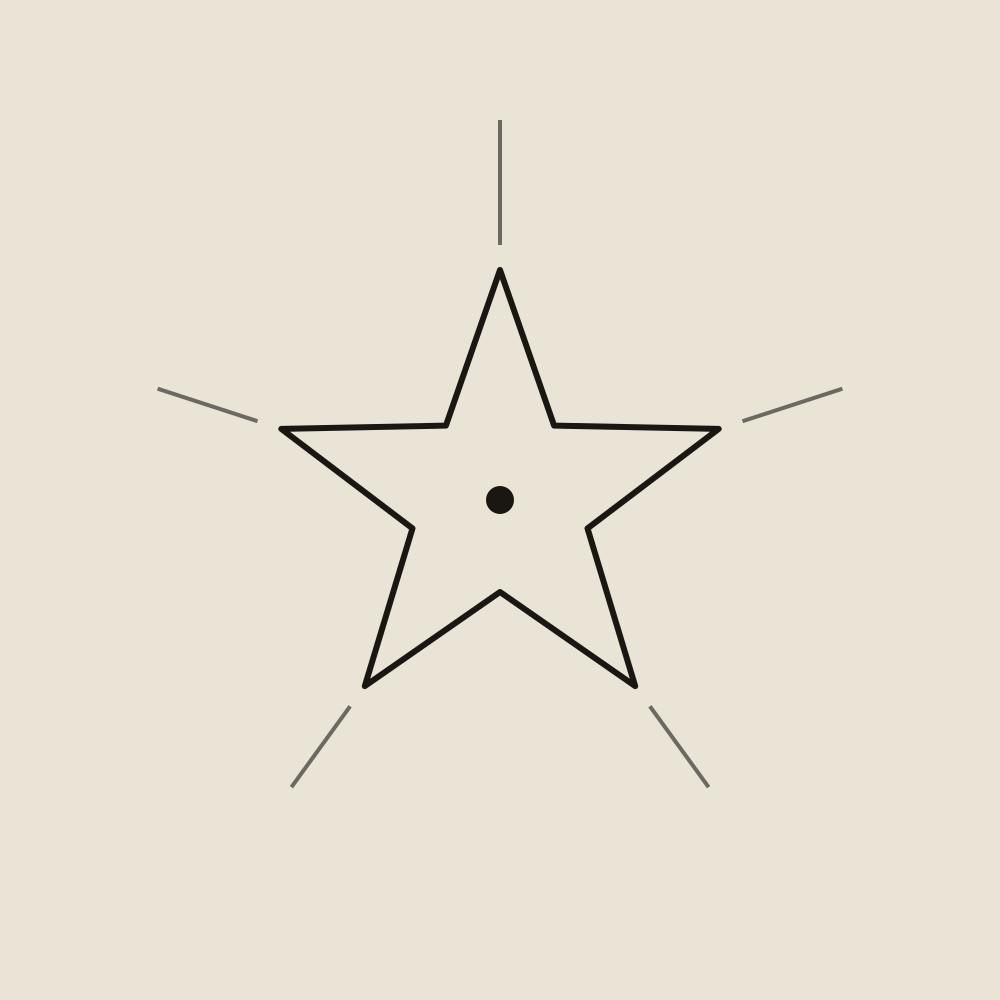
The star at the center of the lodge floor is not decoration — it is the point.
AttributedThe Blazing Star is one of the most prominent furnishings of the Masonic lodge, a five-pointed star set at the center of the mosaic floor or suspended from the ceiling above it. Masonic ritual manuals document its central place in lodge instruction from the eighteenth century; Avery Allyn’s A Ritual and Illustrations of Freemasonry (1831) records it as a standard working symbol of the Craft. The affiliated Order of the Eastern Star — formalized in the mid-nineteenth century by Rob Morris — adopted the same five-pointed star as its governing emblem, with one point downward and each point assigned a biblical heroine and a symbolic color.
Éliphas Lévi taught that the Blazing Star is the pentagram of the microcosm — “the sign of intellectual omnipotence and autocracy,” the figure of the perfected human being whose five points correspond to the four elements crowned by spirit. Manly P. Hall reads the star as the emblem of divine intelligence at the heart of the Craft — the hidden light toward which the initiate orients all work and conduct. The astrotheology tradition that Hall draws on also links the Blazing Star to the star Sirius, the heliacal rising of which marked the Egyptian new year and the annual inundation of the Nile — the brightest fixed star made a lodge symbol.
Blazing Stars appear on lodge floors and ceilings from Edinburgh to Buenos Aires. The Eastern Star’s reversed five-pointed star is among the most widely distributed fraternal emblems in North America — on rings, pendants, and chapter buildings. The shape the tradition insists is a symbol of light appears wherever the Craft marks its presence.
Decoded by
fraternal-masonic
Black and white squares underfoot — duality made literal in every lodge.
Also fraternal-masonic
fraternal-masonic
Two heads, one body — the eagle that watches both worlds at once.
Also fraternal-masonic
fraternal-masonic
One letter suspended at the heart of the world's most recognizable initiatic emblem.
Also fraternal-masonic
fraternal-masonic
Two bronze pillars at the temple door, flanking every Masonic lodge.
Also fraternal-masonic
Share this specimen
ANAMNESIS
Every lodge floor has a star. Ask what it's pointing at.
The Blazing Star
alchemical
Hermes' twin-serpent wand, read as energy rising up the spine.
AttributedThe winged staff entwined by two serpents belonged to Hermes — herald, messenger, patron of commerce and, through the Hermetica, of alchemy. In 1902 the U.S. Army Medical Corps took the caduceus as its badge, and the form has signified medicine in America ever since, even as the older healer’s emblem remained the single-serpent Rod of Asclepius. Two staffs, two histories, run side by side through the iconography of medicine.
Jordan Maxwell reads the twin serpents as the kundalini channels, ida and pingala, rising along the spine to the winged crown of the pineal “third eye.” Manly P. Hall reads the staff as the reconciled pair of forces at the heart of the Hermetic art. Mark Passio reads the climbing serpents as the raising of energy through the body toward awakening — the wand as a map of the nervous system, not merely a herald’s prop.
It appears on commercial seals and, across America, on hospitals, ambulances, and the Surgeon General’s flag — a god’s wand of commerce and magic now standing, almost everywhere, for healing itself.
Decoded by
alchemical
The chain of being from God to ape, drawn whole.
Also alchemical
alchemical
The serpent that eats its own tail — the cosmos remaking itself.
Also alchemical
alchemical
The goal of every alchemist — perfection drawn as a single device.
Also alchemical
alchemical
Two natures, one body — wholeness as the goal of the Work.
Also alchemical
Share this specimen
ANAMNESIS
A god's wand of commerce and magic, now the badge of healing.
The Caduceus
Constantino Brumidi · Wikimedia Commons · Public Domain
civic-national
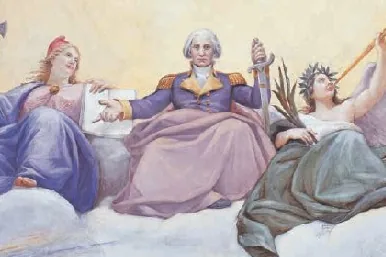
The legislature's ceiling shows a president ascending to godhood.
AttributedThe United States Capitol dome was completed in 1863; the Statue of Freedom — a bronze figure of an armed, helmeted woman — was installed at its apex on December 2 of that year. Two years later, the Italian-American fresco painter Constantino Brumidi completed The Apotheosis of Washington (1865) in the eye of the dome’s interior oculus, 180 feet above the Rotunda floor. The 4,664-square-foot fresco depicts George Washington enthroned in the heavens, robed and draped, ascending to divine status — apotheosis in the classical sense — surrounded by thirteen maidens representing the original states and attended by Roman and Greek deities including Minerva, Neptune, Mercury, Vulcan, Ceres, and Freedom.
Jordan Maxwell reads the Rotunda fresco as the Mystery-school motif of apotheosis — the elevation of the ruler to godhood — placed at the literal center of the American legislature, borrowed from the Roman imperial tradition where emperors were formally deified after death. William Cooper taught that the choice of pagan deities was not artistic convention but encoded theology: the gods of the ancient mystery religion attending the founding figure of the republic in its most sacred architectural space. Michael Tsarion reads the dome itself as the feminine hemisphere paired with the phallic obelisk of the Washington Monument — the ancient temple precinct’s geometry reproduced on the National Mall.
Every visitor to the Capitol looks up at it from the Rotunda floor, though few linger long enough to name the deities attending Washington’s ascent. The image is reproduced in guidebooks and on Capitol tour materials without translation. It is the most explicit piece of pagan iconography in any Western legislature — visible, labeled, and seldom read.
Decoded by
civic-national
The few who see, hidden on the money in your pocket.
Also civic-national
civic-national
The most official bird in America, read as the phoenix in plain dress.
Also civic-national
civic-national
Rome's bundle of rods and axe — coercive power, in plain sight.
Also civic-national
civic-national
An unfinished pyramid and a watching eye — printed on every dollar.
Also civic-national
Share this specimen
ANAMNESIS
Look up in the Capitol: Washington sits among the gods.
The Capitol Dome and the Apotheosis of Washington
corporate
A broadcaster's eye, open and unblinking, watching forty million households since 1951.
AttributedCBS art director William Golden designed the network’s eye logo, which debuted on air on October 20, 1951. Golden cited Pennsylvania Dutch hex signs — folk protective charms painted as open eyes on barns and tools — as his visual starting point; critics of the time also noted the resemblance to René Magritte’s 1928 painting The False Mirror, a human eye whose iris is replaced by a clouded sky. The design has remained in continuous use, refined but never abandoned, for over seventy years.
Jordan Maxwell reads the CBS eye as a direct, unironic deployment of the all-seeing eye at the center of broadcast media — the eye that does not watch the network, but through the network watches. Mark Passio reads it as the classic symbol-control move: the surveillance emblem placed at the point of maximum public exposure, beaming into homes every evening, normalized beyond question by sheer repetition.
The eye runs across CBS television, streaming, and subsidiary branding, appearing nightly in the corner of screens in tens of millions of homes. It is the most widely broadcast eye-symbol in American history — and the one most viewers have never thought to read.
Decoded by
Appears in
corporate
The media conglomerate that wore the watching eye as a logo.
Also corporate
corporate
A single bite taken from the fruit of knowledge, carried in a billion pockets.
Also corporate
corporate
A draped goddess lifting a torch above every Hollywood film since 1924.
Also corporate
corporate
A bird of a thousand eyes, raised as the face of color broadcasting.
Also corporate
Share this specimen
ANAMNESIS
A network eye, open on every TV screen since 1951.
The CBS Eye
Original diagram — ANAMNESIS · CC0
fraternal-masonic
Black and white squares underfoot — duality made literal in every lodge.
AttributedThe black-and-white tessellated floor of the Masonic lodge is described in Craft ritual as the “Mosaic Pavement,” said to represent the ground floor of King Solomon’s Temple. The alternating dark and light squares — like a chessboard — have been a feature of speculative Freemasonry’s lodge design since at least the 18th century, embedded in ritual instruction as one of the “ornaments of the lodge” alongside the blazing star and the indented border.
Mark Passio reads the checkerboard as the most open diagram of cosmic duality the tradition possesses — good and evil, light and dark, order and chaos, square and impartial beneath every standing human. The initiate walks this floor as a reminder that existence is structured opposition, and mastery means navigating it with clear eyes. Manly P. Hall reads the same pattern as the checkered ground of human life, joy and sorrow alternating with every step — neither side to be feared, both to be understood.
It runs beneath ecclesiastical and civic halls, appears in Renaissance portraiture as a sign of learned setting, and recurs in fashion and graphic design as a shorthand for oppositional force. Wherever black and white squares alternate, the lodge’s oldest teaching about duality is already underfoot.
Decoded by
fraternal-masonic
The star at the center of the lodge floor is not decoration — it is the point.
Also fraternal-masonic
fraternal-masonic
Two heads, one body — the eagle that watches both worlds at once.
Also fraternal-masonic
fraternal-masonic
One letter suspended at the heart of the world's most recognizable initiatic emblem.
Also fraternal-masonic
fraternal-masonic
Two bronze pillars at the temple door, flanking every Masonic lodge.
Also fraternal-masonic
Share this specimen
ANAMNESIS
The floor you stand on in a lodge is a map of the universe.
The Checkerboard Floor
corporate
A draped goddess lifting a torch above every Hollywood film since 1924.
AttributedA draped woman holding a torch aloft has served as Columbia Pictures’ emblem since the studio’s founding in 1924. The figure personifies Columbia — the female embodiment of the United States, derived from Libertas, the Roman goddess of liberty, and widely used in American civic art from the 18th century onward. The logo has been redrawn several times; the current painted version, executed by artist Michael Deas using actress Lesley Bogart as model, dates to 1992 and precedes every Columbia theatrical release.
Jordan Maxwell reads the Columbia torch-bearer as the goddess Isis in civic dress — the light-bringer, the keeper of the eternal flame, whose torch is not merely liberty but illumination itself. Freeman Fly reads her as the Columbia/Libertas tradition made explicit: the goddess-as-nation, the feminine principle of esoteric America, raising the same torch as the figure in New York Harbor but placed at the threshold of the cinema — the modern temple of the image.
She appears before every Columbia Pictures film, seen by billions across theatrical and home releases. The most watched torch-bearer on earth opens almost every major Hollywood production — and her name has always been a goddess’s name.
Decoded by
corporate
The media conglomerate that wore the watching eye as a logo.
Also corporate
corporate
A single bite taken from the fruit of knowledge, carried in a billion pockets.
Also corporate
corporate
A broadcaster's eye, open and unblinking, watching forty million households since 1951.
Also corporate
corporate
A bird of a thousand eyes, raised as the face of color broadcasting.
Also corporate
Share this specimen
ANAMNESIS
Every Hollywood film opens with a goddess holding the torch of illumination.
The Columbia Pictures Torch-Bearer
religious
The oldest cross is the sun's path drawn across the sky.
AttributedThe cross as a sacred form is documented across pre-Christian cultures: as a solar and cosmic emblem in Mesopotamia, Egypt, and the pre-Columbian Americas; as the Egyptian ankh; as the Vedic swastika; and as the equal-armed wheel cross on Bronze Age European artifacts. In the Christian tradition the cross enters widespread devotional and architectural use over the early centuries CE, accelerating after Constantine. Its pre-Christian solar and cosmic life is as well-attested as its later theological one — a continuous thread running from the Bronze Age through the cathedrals.
D.M. Murdock reads the crucifixion not as a datable historical event but as a solar allegory: the sun “crossing” the celestial equator at the spring and autumn equinoxes — the astronomical moment when day and night are equal and the sun is said to “die” and “rise again.” Santos Bonacci’s syncretism develops this: the cross of the zodiac, formed by the two equinox points and the two solstice points, is the original cross, and the solar hero nailed to it is the sun moving through those four stations every year. Jordan Maxwell argues the Christian cross inherits this geometry entire, the theological vocabulary changing while the astronomical referent remains constant.
Crosses on churches worldwide; the crucifix in homes and courts; the crossing of roads and intersections (Murdock notes the Latin crux named both the instrument and the crossroads); the Red Cross; national flags from Switzerland to the United Kingdom. The sky’s four-pointed calendar has never stopped being the most ubiquitous mark in Western civilization.
Decoded by
religious
The bird of the goddess, re-named but never fully re-made.
Also religious
religious
The Jesus fish is the shape of an astrological age.
Also religious
religious
The disk behind every saint's head is a sun.
Also religious
religious
Three letters on every altar — but whose name do they really spell?
Also religious
Share this specimen
ANAMNESIS
Before it was a creed, the cross was a calendar.
The Cross
Ancient Accepted Scottish Rite, Northern Masonic Jurisdiction · Wikimedia Commons · CC BY-SA 4.0
fraternal-masonic
Two heads, one body — the eagle that watches both worlds at once.
AttributedThe double-headed eagle is among the most ancient and durable devices in heraldry. The “Eagle of Lagash,” a two-headed eagle with spread wings, appears in Sumerian art as early as the third millennium BCE and was widely used across Hittite, Byzantine, and Holy Roman imperial heraldry. The Ancient and Accepted Scottish Rite of Freemasonry adopted it as the emblem of the thirty-third and highest degree of the Rite — its most recognizable degree symbol — depicted with a sword between its two heads and the number thirty-three at its breast.
Manly P. Hall reads the two-headed eagle as the emblem of the perfected adept: a being who has unified the dual nature of existence — spirit and matter, solar and lunar, active and passive — and can therefore face both worlds simultaneously. The eagle’s two heads do not disagree; they see the complete picture that a single vantage point cannot provide. Jordan Maxwell locates the same symbol in the long tradition of imperial power borrowing the language of esoteric initiation, the double-vision of the eagle marking those who, by the tradition’s own account, govern from a position of integrated understanding that others do not share.
The double-headed eagle appears on Scottish Rite temple facades, regalia, and rings in every country where the Rite operates. It also marks the national coats of arms of Albania, Montenegro, Serbia, Russia, and the former Austro-Hungarian and Byzantine empires — a single device spanning the summit of a fraternal order and the heraldry of states.
Decoded by
fraternal-masonic
The star at the center of the lodge floor is not decoration — it is the point.
Also fraternal-masonic
fraternal-masonic
Black and white squares underfoot — duality made literal in every lodge.
Also fraternal-masonic
fraternal-masonic
One letter suspended at the heart of the world's most recognizable initiatic emblem.
Also fraternal-masonic
fraternal-masonic
Two bronze pillars at the temple door, flanking every Masonic lodge.
Also fraternal-masonic
Share this specimen
ANAMNESIS
The eagle that rules the 33rd degree stares in two directions at once.
The Double-Headed Eagle
Gian Lorenzo Bernini · Wikimedia Commons · Public Domain
religious
The bird of the goddess, re-named but never fully re-made.
AttributedIn Christian iconography the dove descends as the Holy Spirit at the Baptism of Christ (Matthew 3:16) and returns to Noah’s ark bearing the olive branch of peace after the Genesis flood. Its pre-Christian life is equally well attested: it was the sacred bird of Aphrodite in Greece and of Ishtar and Astarte across the ancient Near East, bird of the goddess long before it became the emblem of the third person of the Trinity. The symbol crossed traditions without shedding its earlier associations.
Manly P. Hall notes the dove’s long function as a yonic and feminine emblem — the bird of the sacred feminine, the vessel of creative spirit. D.M. Murdock’s astrotheology tradition reads the Holy Spirit as a Christian inheritance of the goddess Sophia, the divine feminine principle of wisdom, with the dove as her visible form. In this reading, the Spirit descending from above carries the memory of a goddess tradition that the institutional Church absorbed without acknowledgment.
The dove appears in stained glass above baptismal fonts, in peace-movement iconography, and in the logos of charities and religious NGOs worldwide. Dove soap, with its bird-mark, carries the emblem into every bathroom. The goddess-bird became the peace-bird; the peace-bird became a brand — each translation leaving the form intact.
Decoded by
religious
The oldest cross is the sun's path drawn across the sky.
Also religious
religious
The Jesus fish is the shape of an astrological age.
Also religious
religious
The disk behind every saint's head is a sun.
Also religious
religious
Three letters on every altar — but whose name do they really spell?
Also religious
Share this specimen
ANAMNESIS
Long before the Holy Spirit, the dove was the bird of the goddess.
The Dove
Richard Patterson and Richardson Dougall · Wikimedia Commons · Public Domain
civic-national
The most official bird in America, read as the phoenix in plain dress.
AttributedThe bald eagle was adopted as the central device of the U.S. Great Seal in 1782, the design finalized by Charles Thomson and William Barton. Earlier drafts of the seal’s bird carried a more phoenix-like form, and one of Barton’s own proposals showed a phoenix rising in flames before the eagle was settled upon. The eagle has marked American seals, currency, passports, and government insignia ever since.
Manly P. Hall reads the national bird as a veiled phoenix — the mystery-school emblem of death and resurrection, of a nation conceived as rising renewed from what came before. Jordan Maxwell reads the same device within the inherited language of the seal: the solar bird of rebirth carried, under another name, into the official iconography of the state.
It spreads its wings on the dollar, the passport, the podium, and the seal of nearly every federal agency — the most official bird in America, read in this tradition as the phoenix wearing plain feathers.
Decoded by
civic-national
The few who see, hidden on the money in your pocket.
Also civic-national
civic-national
The legislature's ceiling shows a president ascending to godhood.
Also civic-national
civic-national
Rome's bundle of rods and axe — coercive power, in plain sight.
Also civic-national
civic-national
An unfinished pyramid and a watching eye — printed on every dollar.
Also civic-national
Share this specimen
ANAMNESIS
Hall read the national eagle as a phoenix in disguise.
The Eagle as Phoenix
occult
Egypt's watching eye, ancestor of every eye in a triangle.
AttributedThe Egyptian wedjat, the Eye of Horus, was a sign of protection, royal power, and health, bound to the falcon-god Horus; its solar counterpart, the Eye of Ra, was a feminine force both protective and destructive. Drawn as a stylized falcon’s eye with its distinctive teardrop markings, it was worn as an amulet, painted onto coffins, and even used by Egyptian scribes as a set of measuring fractions. It is among the most reproduced images to survive from the ancient world.
Jordan Maxwell reads the Eye of Horus as the prototype of the all-seeing eye — the solar eye of the sky-god, and a glyph for the pineal gland, the “third eye” within. David Icke folds the same single eye into his account of a watching control system, the open eye recurring wherever power wants to be seen seeing. Manly P. Hall places it among the initiatic emblems of Egypt’s mystery schools, the eye that marks the few who see.
It surfaces as jewelry and tattoo, as the eye floating inside corporate and currency motifs, and as the shorthand “Illuminati” eye of internet culture. The oldest watching eye in the record is still open, and still watching, on a thousand surfaces.
Decoded by
Appears in
occult
The Bible's most feared number, still totaled on the Sun's magic square.
Also occult
occult
Lévi's drawing of opposites in balance — not a devil, a diagram.
Also occult
occult
The geometry of time, lead, and limitation.
Also occult
occult
An inner, invisible sun — and a symbol whose history cannot be separated from its origin.
Also occult
Share this specimen
ANAMNESIS
Before the dollar's eye, there was the eye of Horus.
The Eye of Horus
civic-national
Rome's bundle of rods and axe — coercive power, in plain sight.
AttributedA bound bundle of wooden rods, often enclosing an axe, the fasces was an Etruscan-Roman emblem of magisterial authority — imperium — carried before officials by attendants called lictors. The rods stood for the power to scourge, the axe for the power to behead. Its Etruscan origin is confirmed by a 7th-century BCE miniature set found in a tomb at Vetulonia, centuries before Rome raised the same bundle over its own magistrates.
Jordan Maxwell reads the fasces as the open emblem of the state’s coercive power — “strength through unity,” the bundle harder to break than the single rod, set in plain sight in the chambers of government. Mark Passio reads it within his account of authority and the order-follower: the rods and axe as the naked force that stands behind every law, displayed rather than hidden.
Two bronze fasces flank the flag in the U.S. House chamber; they brace the armrests of the seated Lincoln, mark the Senate seal, and once ran along the reverse of the dime — the rods of Rome still bundled, openly, at the center of the republic.
Decoded by
Appears in
civic-national
The few who see, hidden on the money in your pocket.
Also civic-national
civic-national
The legislature's ceiling shows a president ascending to godhood.
Also civic-national
civic-national
The most official bird in America, read as the phoenix in plain dress.
Also civic-national
civic-national
An unfinished pyramid and a watching eye — printed on every dollar.
Also civic-national
Share this specimen
ANAMNESIS
The rods of Rome, still bundled at the center of the republic.
The Fasces
GregorHelms on de.wikipedia · Wikimedia Commons · Public Domain
religious
The Jesus fish is the shape of an astrological age.
AttributedThe Ichthys — the outline of a fish formed by two arcs — functioned as a covert identification symbol among early Christians, its five Greek letters spelling ΙΧΘΥΣ: Iēsous Christos, Theou Yios, Sōtēr — “Jesus Christ, Son of God, Savior.” Geometrically, the form is produced by the intersection of two circles of equal radius, each passing through the other’s center, yielding the pointed oval known as the vesica piscis, a figure with deep roots in sacred geometry. The symbol emerged in the first centuries CE as a quiet mark of community recognition, widely used before the cross became dominant in Christian iconography.
Santos Bonacci’s syncretism places the fish squarely within astronomical time: the precession of the equinoxes moves the vernal equinox backward through one zodiac sign every approximately 2,160 years, completing a full circuit — the Platonic Year — in roughly 25,772 years. The Age of Pisces, Bonacci argues, coincides with the Christian era (c. AD 1 to c. AD 2150), and the fish is its age-marker. D.M. Murdock reads the same alignment: Christ the “fisher of men,” his disciples fishermen, the multiplication of loaves and fishes, the fish symbol itself — all consistent with the iconography of a sun that has entered the zodiac sign of the two fish. Jordan Maxwell extends this to the coming transition: the Age of Aquarius is why the old symbols are becoming unreadable.
The chrome Ichthys emblem clings to the trunks of cars across the country — a devotional sign most drivers could not explain geometrically. It decorates church bulletins, ceramic mugs, and storefront windows. Inside every Jesus fish is a vesica piscis, inside every vesica piscis is the geometry of an astronomical age, and the age is almost over.
Decoded by
religious
The oldest cross is the sun's path drawn across the sky.
Also religious
religious
The bird of the goddess, re-named but never fully re-made.
Also religious
religious
The disk behind every saint's head is a sun.
Also religious
religious
Three letters on every altar — but whose name do they really spell?
Also religious
Share this specimen
ANAMNESIS
The fish on your bumper marks the age the sun is passing through.
The Fish / Ichthys
WILLIAM ISMAEL · Wikimedia Commons · CC BY-SA 2.0
sacred-geometry
Nineteen circles encoding the blueprint of all created form.
AttributedThe classic Flower of Life is an overlapping-circles grid of nineteen circles in a hexagonal arrangement. Red-ochre examples are drawn on the granite columns of the Temple of Osiris at Abydos — the Osireion — one of the most venerated ritual sites in Egypt. Researcher David Furlong places these markings within a long horizon of use that extends across the Mediterranean and Near Eastern decorative traditions, the same hexagonal circle-grid recurring wherever builders and initiates worked with proportional geometry.
In the sacred geometry tradition, Santos Bonacci identifies the Flower of Life as the blueprint of creation: nested within its circles are the Seed of Life, the Fruit of Life, and by extension all five Platonic solids — the basic geometric forms from which, the tradition holds, all physical matter is constructed. Manly P. Hall reads the overlapping-circle structure as the primary diagram of emanation: each circle the ripple of a creative act, each intersection the moment two principles meet to generate a third.
It moves through jewelry, tattoo studios, meditation tools, and New Age decorative art as freely as any folk motif. Sacred geometry workshops use it as their opening diagram. The geometry is straightforward enough to redraw from memory — which may be why it spreads so persistently.
Decoded by
sacred-geometry
Every shape matter can take, drawn from thirteen circles.
Also sacred-geometry
sacred-geometry
The ratio nature uses to build everything — including you.
Also sacred-geometry
sacred-geometry
Two triangles, joined — read by the tradition as Saturn's seal.
Also sacred-geometry
sacred-geometry
The star of the body, the cosmos, and the awakened mind.
Also sacred-geometry
Share this specimen
ANAMNESIS
One pattern, nineteen circles — the geometry tradition calls it everything.
The Flower of Life
Macaddct1984 · Wikimedia Commons · Public Domain
sacred-geometry
The ratio nature uses to build everything — including you.
AttributedThe ratio now written as φ (phi, approximately 1.618) was studied by Euclid in the Elements as the “extreme and mean ratio” — a line divided so that the smaller part relates to the larger as the larger relates to the whole. The related Fibonacci sequence — each number the sum of the two before it — was introduced to Europe by Leonardo of Pisa in Liber Abaci (1202). The logarithmic spiral these numbers approximate surfaces in nautilus shells, sunflower seed-heads, pinecones, and the branching of plants.
In the sacred-geometry tradition, Manly P. Hall reads phi as the “divine proportion” — the ratio through which the creative intelligence of the cosmos writes itself into living form. Santos Bonacci teaches it as the most direct proof of “as above, so below”: the same measure that orders the galaxy’s spiral governs the curl of a fern and the bones of the human hand. The ratio does not merely describe nature; in this reading, it is nature’s primary instruction.
Architecture, graphic design, and brand identity invoke the golden ratio constantly — sometimes precisely, sometimes aspirationally. The Parthenon, Le Corbusier’s Modulor, and the layouts of countless logos all claim phi as their root proportion. Once the spiral is in your eye, you see it in every snail, every rose, every face.
Decoded by
sacred-geometry
Every shape matter can take, drawn from thirteen circles.
Also sacred-geometry
sacred-geometry
Nineteen circles encoding the blueprint of all created form.
Also sacred-geometry
sacred-geometry
Two triangles, joined — read by the tradition as Saturn's seal.
Also sacred-geometry
sacred-geometry
The star of the body, the cosmos, and the awakened mind.
Also sacred-geometry
Share this specimen
ANAMNESIS
One ratio rules the shell, the seed, the human hand.
The Golden Ratio / Fibonacci Spiral
William Barton · Wikimedia Commons · Public Domain
civic-national
An unfinished pyramid and a watching eye — printed on every dollar.
AttributedCongress adopted the Great Seal of the United States in 1782. Its reverse displays an unfinished pyramid of thirteen courses, surmounted by the Eye of Providence radiating light, flanked by two Latin mottoes: Annuit Cœptis (“He approves our undertakings”) and Novus Ordo Seclorum (“a new order of the ages,” from Virgil’s Eclogues). The design sat largely unused until 1935, when Secretary of Agriculture Henry Wallace persuaded President Roosevelt to place both sides of the seal on the one-dollar bill, where they have circulated ever since.
Manly P. Hall noted in 1928 that the seal’s designers gave the republic a Mystery-school emblem — the unfinished pyramid and the all-seeing eye drawn from the same initiatic tradition that ran through Egyptian, Hermetic, and Masonic symbolism. Jordan Maxwell and David Icke read the pyramid-and-eye as the blueprint of a hierarchical control system: the few who see placed above the many who do not, the mottoes announcing the project openly. William Cooper taught that the symbol was never decorative — it was a declaration of intent on the currency that funded the enterprise.
It is never hidden: every dollar bill carries it. What changes is whether you read the seal as a patriotic flourish or a statement of architecture — the incomplete pyramid waiting for its capstone, the eye above the base watching the gap close.
Decoded by
Appears in
civic-national
The few who see, hidden on the money in your pocket.
Also civic-national
civic-national
The legislature's ceiling shows a president ascending to godhood.
Also civic-national
civic-national
The most official bird in America, read as the phoenix in plain dress.
Also civic-national
civic-national
Rome's bundle of rods and axe — coercive power, in plain sight.
Also civic-national
Share this specimen
ANAMNESIS
Novus Ordo Seclorum: the new order, announced on the money.
The Great Seal of the United States
religious
The disk behind every saint's head is a sun.
AttributedThe radiant disk placed behind the head in sacred art derives from classical solar-deity iconography. Sol Invictus, Helios, and Apollo were depicted with a nimbus of rays — the visible sign of the sun carried on the person of the solar god. As Christian art developed across the first centuries CE, it adopted the nimbus wholesale for Christ, the Virgin, and the saints, rendering it at first as a field of light and later as the flat golden circle familiar from Byzantine and medieval painting. The convention passed intact into Renaissance and Baroque sacred art and never left the tradition.
D.M. Murdock reads the halo with precision: it is the disk of the sun, rendered literally behind the head of the solar savior, making every crucifix and icon a diagram of the sun-god tradition from which the Christian iconographic vocabulary descends. The halo does not symbolize the sun in Murdock’s reading — it depicts it. Manly P. Hall traces the same lineage through the mystery schools: the radiant head marks the illuminated — those in whom the inner sun is awakened, the solar hero whose identity was always the sky’s central light. Santos Bonacci places it in the broader framework: Sol Invictus and Christ share the nimbus because they share the same astronomical identity, and the disk behind every painted saint is the record of that equation persisting in plain sight.
Every nativity scene, every church mosaic, every Renaissance altarpiece carries it. The golden O behind the head appears on Christmas cards, in museum galleries, in hospital chapels. Modern pop iconography borrows it for secular halos above celebrities and brand marks. The sun has been behind every sacred head for two thousand years of Christian art — the theology changed, the disk did not.
Decoded by
religious
The oldest cross is the sun's path drawn across the sky.
Also religious
religious
The bird of the goddess, re-named but never fully re-made.
Also religious
religious
The Jesus fish is the shape of an astrological age.
Also religious
religious
Three letters on every altar — but whose name do they really spell?
Also religious
Share this specimen
ANAMNESIS
Every halo in every church is the disk of the sun.
The Halo / Nimbus
Original diagram — ANAMNESIS · CC0
sacred-geometry
Two triangles, joined — read by the tradition as Saturn's seal.
AttributedThe six-pointed star of two interlocking triangles had ancient decorative and magical use across many cultures before becoming a distinctive Jewish identifier in the medieval and modern eras, and the central emblem of the flag of Israel in 1948. In the language of alchemy the two triangles read as fire and water — the upward and downward principles, the ascending and the descending, locked together into a single balanced figure.
David Icke teaches that the hexagram and hexagon are Saturn symbols, tied to the six-sided storm at Saturn’s north pole and to the cube of matter unfolded into a star. Santos Bonacci’s syncretism links the same geometry to the planetary order he reads beneath scripture. Manly P. Hall reads the interlaced triangles as the union of opposites — spirit and matter, above and below, reconciled in one seal: as above, so below.
It travels quietly across religion, alchemy, and brand: the seal on a label, the star on a flag, the hexagon tiling a corporate logo. A geometry of order so common, in this reading, that it has become invisible by sheer repetition.
Decoded by
sacred-geometry
Every shape matter can take, drawn from thirteen circles.
Also sacred-geometry
sacred-geometry
Nineteen circles encoding the blueprint of all created form.
Also sacred-geometry
sacred-geometry
The ratio nature uses to build everything — including you.
Also sacred-geometry
sacred-geometry
The star of the body, the cosmos, and the awakened mind.
Also sacred-geometry
Share this specimen
ANAMNESIS
A geometry of order so common it has gone invisible.
The Hexagram
user:AnonMoos (changes by Rabanus Flavus · Wikimedia Commons · CC0
religious
Three letters on every altar — but whose name do they really spell?
AttributedIHS is a Christogram formed from the first three letters of the Greek name for Jesus — ΙΗΣΟΥΣ — rendered in Latin script. St. Bernardino of Siena promoted it actively in the 15th century, and the Society of Jesus (Jesuits), founded 1540, adopted it as their official emblem, typically enclosed within a radiant sunburst on altars, vestments, and church facades worldwide. It remains one of the most widely displayed religious abbreviations in the Western world.
Bonacci’s syncretism holds that IHS encodes the ancient Egyptian divine triad Isis, Horus, and Seb — the mother, the solar child, and the earth-father — folded inside a Christian acronym. Jordan Maxwell extends this, reading the letters as solar ciphers for the sun’s annual titles (“the Year,” “the Sun,” “Yes”), arguing the Jesuit sunburst that frames the monogram on church seals is itself a direct disclosure of the solar deity within. The frame, Maxwell notes, says more than the letters.
The monogram appears on Catholic altars, vestments, and architecture on every continent. The Jesuit seal places it at the heart of a twelve-rayed sunburst — the solar context built into the official design, visible in plain sight to anyone who pauses to look.
Decoded by
religious
The oldest cross is the sun's path drawn across the sky.
Also religious
religious
The bird of the goddess, re-named but never fully re-made.
Also religious
religious
The Jesus fish is the shape of an astrological age.
Also religious
religious
The disk behind every saint's head is a sun.
Also religious
Share this specimen
ANAMNESIS
IHS: the Jesuit cipher that reads as Isis, Horus, and Seb.
The IHS Monogram
Stanislas de Guaita (died 1897) · Wikimedia Commons · Public Domain
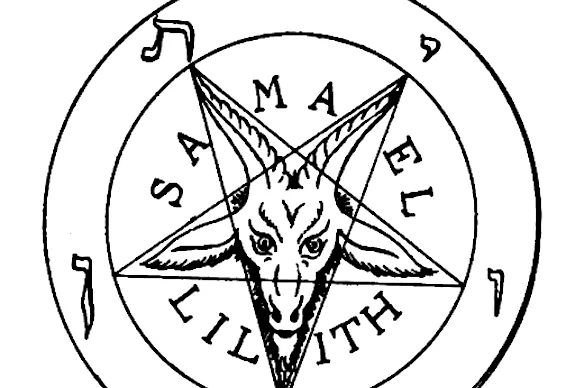
occult
One rotation of the star — and its whole meaning flips.
AttributedA five-pointed star with two points upward. Éliphas Lévi associated this orientation in 1856 with “the goat of the Sabbath,” the inversion of the upright star’s hierarchy. The specific image of a goat-face inscribed within an inverted pentagram first appeared in print in Stanislas de Guaita’s La Clef de la Magie Noire (1897). That design was adapted with the Hebrew letters spelling “Leviathan” added around the perimeter and adopted as the Sigil of Baphomet by the Church of Satan at its founding in 1966, officially registered as its trademark in 1969.
In the occult tradition Lévi established and Mark Passio develops, the orientation of the pentagram is the entire argument: the upright star places the single apex — spirit — above the four lower points of matter; the inversion raises matter and carnal nature above spirit. Passio reads the deliberate use of the inverted form as a declaration of allegiance to the physical and the instinctual over the spiritual and the moral. Manly P. Hall situates the two orientations as mirror teachings — the path upward and the path downward, both encoded in the same five-pointed geometry.
The Sigil of Baphomet appears on Satanic Temple and Church of Satan materials, in heavy-metal iconography, and in popular-culture “edgy” shorthand for the occult. The symbol carries enough institutional history that its orientation still reads as a deliberate, legible choice — not a decoration but a position.
Decoded by
occult
The Bible's most feared number, still totaled on the Sun's magic square.
Also occult
occult
Lévi's drawing of opposites in balance — not a devil, a diagram.
Also occult
occult
The geometry of time, lead, and limitation.
Also occult
occult
An inner, invisible sun — and a symbol whose history cannot be separated from its origin.
Also occult
Share this specimen
ANAMNESIS
Flip the star and matter rises over spirit — that is the entire argument.
The Inverted Pentagram
Jebulon · Wikimedia Commons · CC0
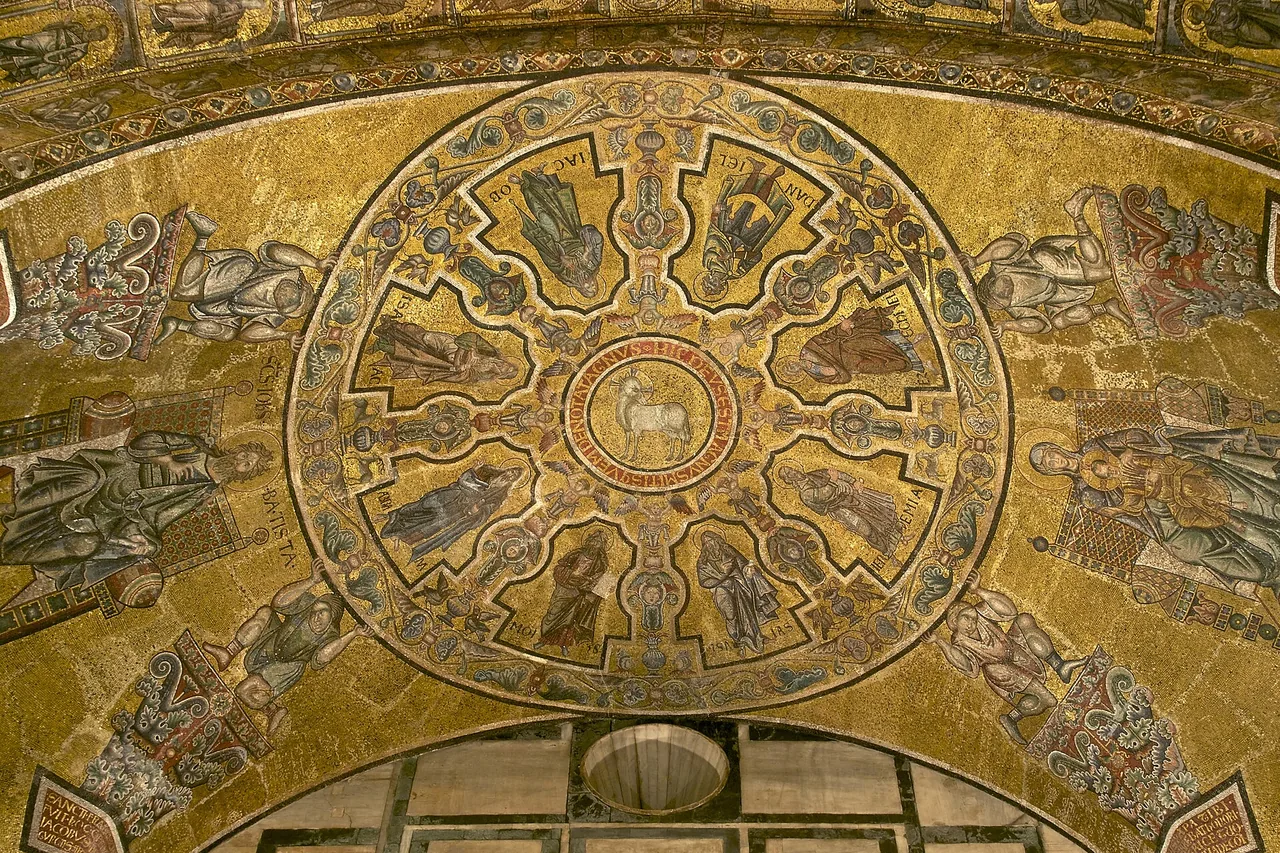
religious
The Lamb of God who takes away the sin of the world — and the sun.
Attributed“Lamb of God” enters Christian scripture at John 1:29 — “Behold the Lamb of God, who takes away the sin of the world” — and the image recurs throughout the Book of Revelation, where the slain and risen Lamb rules creation. The Agnus Dei became one of Christianity’s central emblems of sacrificial atonement, appearing in liturgy, heraldry, and sacred art for two millennia. Astronomically, the lamb maps to Aries the Ram, the first sign of the zodiac.
Bonacci’s syncretism holds that the Lamb of God is the sun entering Aries at the spring equinox — the solar “sacrifice” of winter ending, the new light taking away the darkness of the old year. The wordplay, in Bonacci’s reading, is built into the text: “sin” echoes the sun (the word “sun” in multiple archaic forms), so the Lamb takes away the sun of the world as it crosses into the new season. D.M. Murdock places the Agnus Dei within the same precessional schema, reading the sacrificial lamb as the zodiacal Age of Aries (c. 2150–1 BCE) giving way to the Age of Pisces — the fish that followed the lamb on the altar and on the car.
The Agnus Dei appears in Catholic liturgy, church heraldry, and the flags of nations; the lamb-with-banner is the emblem of the City of London and dozens of religious orders. Every Easter, the imagery of the sacrificed and risen lamb enacts, Bonacci argues, the spring equinox drama in plain sight.
Decoded by
religious
The oldest cross is the sun's path drawn across the sky.
Also religious
religious
The bird of the goddess, re-named but never fully re-made.
Also religious
religious
The Jesus fish is the shape of an astrological age.
Also religious
religious
The disk behind every saint's head is a sun.
Also religious
Share this specimen
ANAMNESIS
The Lamb of God and the Ram of Aries are the same spring dawn.
The Lamb / Agnus Dei
Original diagram — ANAMNESIS · CC0
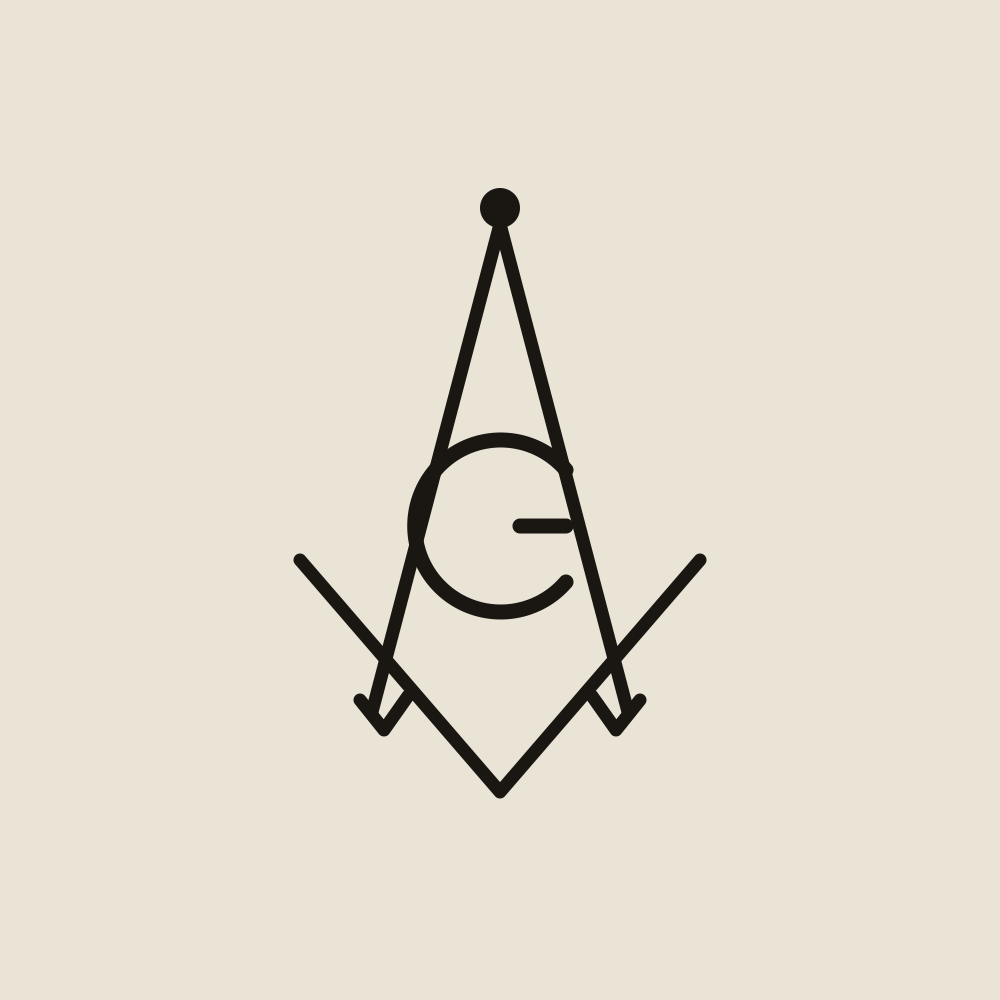
fraternal-masonic
One letter suspended at the heart of the world's most recognizable initiatic emblem.
AttributedThe letter G appears at the center of the square and compasses in Masonic emblems worldwide. Standard lodge instruction offers two explanations: G stands for God — the “Great Architect of the Universe” in whose name the lodge is opened — and for Geometry, the mathematical science upon which the stonemason’s art, and thus speculative Masonry, is said to rest. Both readings are taught openly and simultaneously in 18th- and 19th-century Masonic catechisms and ritual manuals.
Manly P. Hall reads the G as a triple cipher: Geometry, Generation, and Gnosis — the hidden science, the generative principle of nature, and the secret knowledge that initiation promises to unlock. Jordan Maxwell reads it as a mark of the Craft’s deeper cosmology, where geometry is not merely craft technique but the language in which the universe was written. Mark Passio reads the G as the call to self-knowledge — the generative divine spark that every initiate is charged to find within.
It appears on lodge-hall facades, Masonic rings, and street-level signs across every continent. It is perhaps the most openly encoded letter in the Western initiatic tradition — hiding in plain sight at the center of the emblem most people can already name.
Decoded by
fraternal-masonic
The star at the center of the lodge floor is not decoration — it is the point.
Also fraternal-masonic
fraternal-masonic
Black and white squares underfoot — duality made literal in every lodge.
Also fraternal-masonic
fraternal-masonic
Two heads, one body — the eagle that watches both worlds at once.
Also fraternal-masonic
fraternal-masonic
Two bronze pillars at the temple door, flanking every Masonic lodge.
Also fraternal-masonic
Share this specimen
ANAMNESIS
G stands for more than the official story ever tells.
The Letter G
Wikimedia Commons · Public Domain
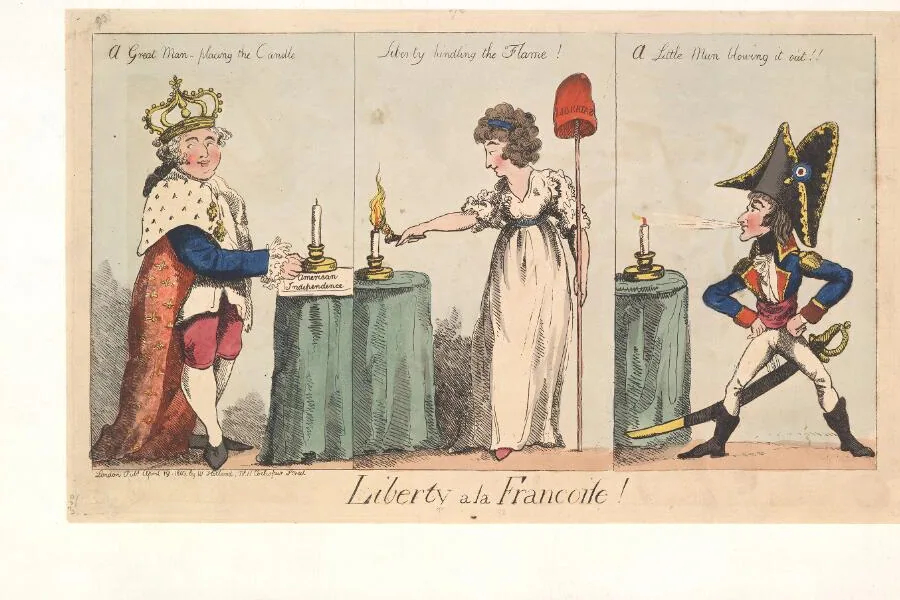
civic-national
The hat of freedom — and of the solar savior Mithras.
AttributedIn ancient Rome the pileus — a soft, brimless, conical felt cap — was placed on the head of a slave at the moment of manumission, marking the passage from bondage to freedom. The Phrygian cap is its distinctive pointed, forward-curving variant. Revived in the era of the American and French Revolutions as the “cap of liberty,” it was placed on the heads of allegorical figures of liberty and freedom across coinage, seals, and revolutionary imagery. It crowns Marianne, the personification of the French Republic, and appears on the seal of the United States Senate.
Jordan Maxwell and Michael Tsarion read the Phrygian cap through its Mithraic axis: the god Mithras — the solar savior of the mystery religion that spread across the Roman Empire from roughly the 1st to 4th centuries CE — is invariably depicted wearing the identical cap. Tsarion argues that when revolutionaries placed the solar savior’s headgear on the figure of Liberty, they were encoding the same sun-cult iconography that had shaped Roman religious and political life, now smuggled into the civic symbols of the modern state.
It crowns Marianne on every official French seal; it sits atop the seated Liberty on U.S. coins; the Senate of the United States carries it on its seal; state seals from New York to Iowa wear it atop a pole. The oldest emblem of manumission is still the republic’s hat — and Mithras still wears it underneath.
Decoded by
civic-national
The few who see, hidden on the money in your pocket.
Also civic-national
civic-national
The legislature's ceiling shows a president ascending to godhood.
Also civic-national
civic-national
The most official bird in America, read as the phoenix in plain dress.
Also civic-national
civic-national
Rome's bundle of rods and axe — coercive power, in plain sight.
Also civic-national
Share this specimen
ANAMNESIS
Mithras wore it first. Then the freed slave. Then the republic.
The Liberty Cap
corporate
A bird of a thousand eyes, raised as the face of color broadcasting.
AttributedNBC introduced its peacock logo in 1956 to promote the RCA/NBC color broadcast rollout. The original mark showed eleven feathers, each a different color, fanning forward to announce programming “in living color” — a direct commercial message from the network’s parent company RCA, which had staked its future on the color television standard. In 1986 the design was simplified to six feathers in the current arrangement, retained to the present day as the mark of both NBC and the Peacock streaming platform.
Jordan Maxwell reads the peacock through its ancient mythological register: in the Greco-Roman tradition, the peacock was the bird of Hera/Juno, its tail bearing the hundred eyes of the slain giant Argus Panoptes — the all-seeing watcher. The choice of the most eye-covered bird in nature as the emblem of broadcast television, on this reading, is not accidental. Freeman Fly extends the reading to the peacock’s solar and phoenix-like dimensions — the bird that sheds and renews its plumage, associated with resurrection and the returning sun.
The multicolored peacock appears at the open and close of NBC broadcasts and across the Peacock streaming platform — a bird whose mythological tail is composed entirely of watching eyes, deployed nightly at the center of American broadcast media.
Decoded by
corporate
The media conglomerate that wore the watching eye as a logo.
Also corporate
corporate
A single bite taken from the fruit of knowledge, carried in a billion pockets.
Also corporate
corporate
A broadcaster's eye, open and unblinking, watching forty million households since 1951.
Also corporate
corporate
A draped goddess lifting a torch above every Hollywood film since 1924.
Also corporate
Share this specimen
ANAMNESIS
A bird whose tail is a hundred eyes — and NBC chose it deliberately.
The NBC Peacock
Jebulon · Wikimedia Commons · CC0
solar-astro
A stone ray of sunlight, planted at the center of empire.
AttributedThe Egyptian obelisk is a monolithic tapering pillar of granite, sacred to the sun god Ra and associated with the benben stone of Heliopolis — the primordial mound where creation first rose from the waters. The pyramid-shaped tip, the pyramidion, was once sheathed in electrum to catch and throw back the first light of morning. Beginning in the Ptolemaic period and accelerating under Rome, obelisks were removed from their original temple sites and re-erected across the empire: Rome received more than a dozen, establishing the pattern every later Western capital would follow.
In the astrotheology and symbol-control tradition, Jordan Maxwell reads the obelisk as a transplanted Egyptian solar-phallic emblem — the sun god’s generative force made into stone and planted at the ritual center of whatever power wished to inherit the ancient authority. William Cooper argued that these relocations were deliberate acts of symbolic possession: the pillar does not merely decorate the capital, it consecrates it. Michael Tsarion extends the reading to the architectural logic of the entire Western civic tradition.
The Washington Monument is the tallest obelisk on earth. The Lateran Obelisk stands in Rome, the tallest surviving ancient obelisk. Cleopatra’s Needles rise on the Thames Embankment, in Central Park, and on the Place de la Concorde. Every one of them was moved. Every one marks a seat of power that wanted to say: this city inherits Egypt.
Decoded by
solar-astro
The halo behind every saint is a disk of the sun.
Also solar-astro
solar-astro
Egypt's word for life: a loop of sun rising over a cross.
Also solar-astro
solar-astro
The first cross was the sun's path through the year.
Also solar-astro
solar-astro
A 15,000-year solar wheel of good fortune, older than every flag.
Also solar-astro
Share this specimen
ANAMNESIS
Every world capital planted a stolen Egyptian sun-pillar at its heart.
The Obelisk
Anonymous (medieval alchemical manuscript) · Wikimedia Commons · Public Domain
alchemical
The serpent that eats its own tail — the cosmos remaking itself.
AttributedThe ouroboros — a serpent or dragon devouring its own tail — has its earliest known depiction in the Egyptian Enigmatic Book of the Netherworld, in the tomb of Tutankhamun, in the 14th century BCE. It became a key emblem of Gnostic and alchemical thought across the centuries that followed. The Chrysopoeia of Cleopatra, an early alchemical text, encloses the figure with the phrase ἓν τὸ πᾶν — “the all is one.”
In the alchemical tradition, Manly P. Hall reads the tail-eating serpent as the eternal cycle of death and renewal and the unity of all matter — a cosmos that consumes and remakes itself without end. Mark Passio reads it within the same Hermetic frame, as the self-sustaining whole in which destruction and creation are not two events but a single continuous motion, beginning and end folded into one line.
It coils through logos and jewelry, through the sideways figure-eight of infinity, and through any image that wants to say without beginning or end — eternity compressed into a snake that feeds on itself.
Decoded by
alchemical
The chain of being from God to ape, drawn whole.
Also alchemical
alchemical
Hermes' twin-serpent wand, read as energy rising up the spine.
Also alchemical
alchemical
The goal of every alchemist — perfection drawn as a single device.
Also alchemical
alchemical
Two natures, one body — wholeness as the goal of the Work.
Also alchemical
Share this specimen
ANAMNESIS
Eternity, drawn as a snake that feeds on itself.
The Ouroboros
Heinrich Cornelius Agrippa · Wikimedia Commons · Public Domain
sacred-geometry
The star of the body, the cosmos, and the awakened mind.
AttributedThe five-pointed star was used by the Pythagoreans as a sign of mutual recognition and appears across many ancient cultures; its proportions embody the golden ratio. Set upright, it stands on two points with a single point raised toward the sky. In the Renaissance and after, it was read as a figure of the human body — head, two arms, two legs — fitted into the geometry of the wider cosmos, the small world matched to the great one.
Éliphas Lévi taught that the upright pentagram represents the microcosm, man, and the triumph of spirit over matter — “the Blazing Star,” the sign of intellectual omnipotence. Manly P. Hall places it among the emblems of the mysteries, the star of the awakened mind set above the elements. Mark Passio reads it as a teaching figure: spirit raised over the four elements of the body, a diagram of mastery rather than a mark of menace.
It marks national flags and military insignia, the sheriff’s badge, the rituals of Wicca and ceremonial magic. A single star can mean, depending entirely on who drew it and which way up, the body, the cosmos, or the mind.
Decoded by
sacred-geometry
Every shape matter can take, drawn from thirteen circles.
Also sacred-geometry
sacred-geometry
Nineteen circles encoding the blueprint of all created form.
Also sacred-geometry
sacred-geometry
The ratio nature uses to build everything — including you.
Also sacred-geometry
sacred-geometry
Two triangles, joined — read by the tradition as Saturn's seal.
Also sacred-geometry
Share this specimen
ANAMNESIS
Five points: the body, the cosmos, the mind — depending on who drew it.
The Pentagram
Emblem of the path to the philosopher's stone · Wellcome Collection (via Wikimedia Commons) · CC BY 4.0
alchemical
The goal of every alchemist — perfection drawn as a single device.
AttributedThe lapis philosophorum — the Philosopher’s Stone — is the supreme object and the supreme agent of alchemical work: the substance held to transmute base metals into gold and to confer immortality. Its device, the “squared circle of the philosophers,” appears across European alchemical manuscripts from the medieval period onward, combining circle, square, triangle, and dot into a compact emblem of the Stone’s fourfold-yet-unified nature. The glyph is not the name of a single formula but a pictographic summary of the entire alchemical program — the end-state of the Great Work rendered as geometry.
In the alchemical tradition, Manly P. Hall reads the Philosopher’s Stone not as a physical mineral but as an allegorical teaching: the Stone is the perfected human being. The transmutation of lead into gold is, in Hall’s reading, the transmutation of the base, unregenerate self into its divine counterpart. The squared-circle glyph encodes the stages of this process — the four elements reconciled, the opposites united, the volatile fixed — and the central point marks the achieved, luminous self at the completion of the Work.
The Stone’s glyph endures in alchemy-themed fiction and film, most recognizably as the central emblem of the Harry Potter franchise’s first installment. Esoteric jewelry and contemporary occult art reproduce it as a shorthand for the entire transformative project that Western alchemy encoded. The Stone itself — the idea of a substance that makes everything it touches more fully what it ought to be — has never stopped circulating.
Decoded by
alchemical
The chain of being from God to ape, drawn whole.
Also alchemical
alchemical
Hermes' twin-serpent wand, read as energy rising up the spine.
Also alchemical
alchemical
The serpent that eats its own tail — the cosmos remaking itself.
Also alchemical
alchemical
Two natures, one body — wholeness as the goal of the Work.
Also alchemical
Share this specimen
ANAMNESIS
Not a stone. A process. The perfecting of everything base.
The Philosopher's Stone Glyph
Grant Schar · Wikimedia Commons · Public Domain
fraternal-masonic
Two bronze pillars at the temple door, flanking every Masonic lodge.
AttributedThe two bronze pillars named Jachin and Boaz stood at the porch of Solomon’s Temple in Jerusalem, recorded in 1 Kings 7:21. Ancient in measure and ornament — each eighteen cubits high, crowned with lily-work capitals — they marked the threshold between the profane world and the sacred interior. When operative masonry gave way to speculative Freemasonry in the 17th and 18th centuries, the twin columns were carried into the lodge as its permanent, symbolic gateway.
Manly P. Hall reads Jachin and Boaz as the active and passive cosmic forces — the outbreath and inbreath of existence — and teaches that the “middle path” between them is the initiate’s goal. Santos Bonacci’s syncretism reads the two pillars as the solstitial gates of Cancer and Capricorn, the solar doors through which souls descend into matter and ascend back to spirit. Jordan Maxwell reads the twin columns as a diagram of duality that every candidate must learn to navigate.
The columns appear at lodge entrances from Edinburgh to Nairobi, on Tarot’s High Priestess card seated between them, and in the twin-tower motif that runs through sacred architecture worldwide. Once placed, the two pillars are impossible to unsee.
Decoded by
fraternal-masonic
The star at the center of the lodge floor is not decoration — it is the point.
Also fraternal-masonic
fraternal-masonic
Black and white squares underfoot — duality made literal in every lodge.
Also fraternal-masonic
fraternal-masonic
Two heads, one body — the eagle that watches both worlds at once.
Also fraternal-masonic
fraternal-masonic
One letter suspended at the heart of the world's most recognizable initiatic emblem.
Also fraternal-masonic
Share this specimen
ANAMNESIS
Every lodge entrance mirrors the door of Solomon's Temple.
The Pillars Jachin and Boaz
Anonymous (alchemical emblem) · Wikimedia Commons · Public Domain
alchemical
Two natures, one body — wholeness as the goal of the Work.
AttributedThe Rebis — from the Latin res bina, “double thing” — is an alchemical figure depicting a two-headed being, one head male and one female, standing atop a dragon or winged sphere. The image appears prominently in the tradition associated with Heinrich Khunrath’s Amphitheatrum Sapientiae Aeternae (1595) and the works attributed to Basil Valentine in the sixteenth and seventeenth centuries. The figure’s dual-sexed body holds the sun and moon — the solar and lunar principles of alchemy — one in each hand, and stands as the visual summary of the Great Work’s culminating stage: the coniunctio, or sacred marriage of opposites.
In the alchemical tradition, Manly P. Hall reads the Rebis as the image of achieved wholeness — the point at which the Work is complete. The male and female principles that drive all of nature’s processes, held in tension throughout the alchemical stages, are here reconciled into a single integrated being. Mark Passio places the Rebis within the broader teaching on natural law: the figure embodies the understanding that solar (active, generative) and lunar (receptive, formative) forces are not opposed but complementary, and that mastery of the self requires holding both. The Rebis is, in this reading, a forerunner of the Baphomet’s androgyny — the same knowledge, a different vessel.
The Rebis endures in occult and esoteric art as a teaching image of integration. Symbolism scholars and students of Jungian psychology find in it an early Western articulation of the conjunctio oppositorum — the union of apparent opposites as the path to wholeness. The figure is quiet now, confined mostly to illustration and academic study, but the idea it carries — that completion requires the union of contraries, not the victory of one over the other — has never left the tradition.
Decoded by
alchemical
The chain of being from God to ape, drawn whole.
Also alchemical
alchemical
Hermes' twin-serpent wand, read as energy rising up the spine.
Also alchemical
alchemical
The serpent that eats its own tail — the cosmos remaking itself.
Also alchemical
alchemical
The goal of every alchemist — perfection drawn as a single device.
Also alchemical
Share this specimen
ANAMNESIS
Sun and moon, man and woman — resolved into one figure.
The Rebis
alchemical
One serpent, one staff — the true sign medicine forgot it carried.
AttributedA single serpent coiled around a rough, knotted staff is the attribute of Asclepius, the Greek god of healing, whose cult was centered at Epidaurus. The staff and serpent entered Western medical iconography as the authentic emblem of the healing arts. One scholarly theory links the image to the ancient extraction of Guinea worm parasites, which were slowly wound out on a stick — a practice documented across the ancient Near East. The rod is distinguished from the caduceus (the winged staff of Hermes, with two serpents) and is the symbol used by the World Health Organization and the American Medical Association.
In the astrotheology tradition, Jordan Maxwell links the single serpent to the brazen serpent Moses raised on a pole in the wilderness (Numbers 21) — a solar and healing emblem whose gaze restored sight and health. Manly P. Hall places the serpent of Asclepius within the broad Hermetic teaching on the serpent as the force of divine wisdom and regeneration: the creature that sheds its skin is nature’s standing image of renewal.
The rod appears on the WHO emblem, ambulance panels, hospital signage, and military medical corps insignia worldwide. Its near-twin the caduceus — wrongly adopted by the U.S. Army Medical Corps in 1902 — remains in widespread commercial and government use, a centuries-long case of substitution in plain sight.
Decoded by
alchemical
The chain of being from God to ape, drawn whole.
Also alchemical
alchemical
Hermes' twin-serpent wand, read as energy rising up the spine.
Also alchemical
alchemical
The serpent that eats its own tail — the cosmos remaking itself.
Also alchemical
alchemical
The goal of every alchemist — perfection drawn as a single device.
Also alchemical
Share this specimen
ANAMNESIS
The serpent on the staff heals. The two-serpent staff does not.
The Rod of Asclepius
occult
The most feared creature in scripture is also its wisest teacher.
AttributedThe serpent is among the most ancient sacred symbols on record. The Egyptian uraeus — the rearing cobra at the brow of the pharaoh — embodied divine authority and the fire of the sun-god Ra. In the Indian tradition, kundalini is described as a dormant spiritual energy coiled at the base of the spine, central to yogic and Tantric practice. The Genesis serpent imparts knowledge of good and evil; the brazen serpent Moses raises on a pole (Numbers 21) heals those who look upon it. The Greek Asclepius heals with a serpent-wound staff. Across cultures, the serpent denotes wisdom, healing, regeneration, and the dangerous threshold between states.
Manly P. Hall reads the serpent as the universal emblem of the solar fire and of initiate wisdom — the creature that sheds its skin and is perpetually reborn. Mark Passio identifies the biblical “fall” narrative as a record of knowledge-suppression: the serpent offers gnosis that an institutional authority did not want distributed. Jordan Maxwell reads the serpent in the Garden as the teacher-figure, the bringer of the light of understanding. Michael Tsarion places the kundalini current within a lineage of pre-diluvian initiatic teaching, the force that rises through the chakra centers to open the “third eye” — the same eye the uraeus marks at the pharaoh’s brow.
The serpent appears in medical symbols (the caduceus and Rod of Asclepius), in yoga-studio branding, in Nāga imagery across South and Southeast Asian temple architecture, and in the ouroboros that loops through occult art from ancient Egypt to contemporary tattoo. The most feared creature in the Bible remains the teacher in every other tradition.
Decoded by
occult
The Bible's most feared number, still totaled on the Sun's magic square.
Also occult
occult
Lévi's drawing of opposites in balance — not a devil, a diagram.
Also occult
occult
The geometry of time, lead, and limitation.
Also occult
occult
An inner, invisible sun — and a symbol whose history cannot be separated from its origin.
Also occult
Share this specimen
ANAMNESIS
In every tradition, the serpent that is feared is also the one that heals.
The Serpent / Kundalini
corporate
A pilgrim's scallop shell, radiating like the sun, on every fuel pump on earth.
AttributedShell’s origins lie in Marcus Samuel & Co., a London firm that began by trading in oriental seashells in the 19th century. A mussel-shell motif appeared around 1900; the company switched to the scallop (pecten) in 1904, possibly drawn from the Graham family’s coat of arms — a St. James’s pilgrim-shell, the scallop being the badge of the Santiago de Compostela pilgrimage since the medieval period. The current stylized, radially ribbed form was refined by designer Raymond Loewy in 1971; the red-and-yellow color pairing dates to California service stations in 1948.
Jordan Maxwell reads the Shell Pecten as a solar-scallop emblem: the shell’s radiating ribs are the sun’s rays given a natural form, and the scallop’s ancient association with Venus and pilgrimage places it in the lineage of solar and feminine sacred imagery. Freeman Fly reads the same mark as an open solar icon pressed into one of the world’s most powerful energy corporations — the sun’s emblem on the pump that delivers what the modern world burns.
The red-and-yellow scallop appears on forecourts, tankers, and corporate assets across more than seventy countries. A medieval pilgrim’s badge, now the face of a global energy empire — the sun’s ribs radiating outward at every fill-up.
Decoded by
corporate
The media conglomerate that wore the watching eye as a logo.
Also corporate
corporate
A single bite taken from the fruit of knowledge, carried in a billion pockets.
Also corporate
corporate
A broadcaster's eye, open and unblinking, watching forty million households since 1951.
Also corporate
corporate
A draped goddess lifting a torch above every Hollywood film since 1924.
Also corporate
Share this specimen
ANAMNESIS
The scallop shell radiating solar rays, at every fuel pump on earth.
The Shell Logo
Original diagram — ANAMNESIS · CC0
solar-astro
The first cross was the sun's path through the year.
AttributedAn equal-armed cross enclosed in a circle is among the oldest recurring motifs in human art, carved on Bronze Age European artifacts and prehistoric rock faces. Scholars widely read it as an image of the sun and the solar year, its four arms marking the year’s turning points — the two solstices and two equinoxes. The same wheel-cross recurs across cultures with no contact between them, wherever people watched the sky and divided the year by what they saw.
Jordan Maxwell reads the wheel-cross as the original cross: the sun’s annual path traced through the band of the zodiac, its cardinal points fixed at the equinoxes and solstices. Santos Bonacci’s syncretism follows the same line — the “crossing” is the sun crossing the celestial equator, and the later religious cross inherits that solar geometry. In this reading the figure is a calendar before it is ever a creed.
Once you see it, it is everywhere the year is marked: the Celtic high cross, the haloed disk behind a saint’s head, the roundel on a car or a national flag, the vignette engraved on currency. The plainest geometry in the culture turns out to be a map of the sky.
Decoded by
solar-astro
The halo behind every saint is a disk of the sun.
Also solar-astro
solar-astro
Egypt's word for life: a loop of sun rising over a cross.
Also solar-astro
solar-astro
A stone ray of sunlight, planted at the center of empire.
Also solar-astro
solar-astro
A 15,000-year solar wheel of good fortune, older than every flag.
Also solar-astro
Share this specimen
ANAMNESIS
The cross is older than the church — and it points at the sun.
The Solar Cross
Jamalsaman · Wikimedia Commons · CC BY 4.0
fraternal-masonic
A stonemason's tools, raised into the world's most known initiatic sign.
AttributedThe square and compasses — the stonemason’s tools, often enclosing the letter G — is the principal emblem of Freemasonry, standardized as the Craft’s identifying mark across the 18th and 19th centuries. The square trues a right angle; the compasses describe a circle. Together they passed from the working mason’s bench into the symbolic vocabulary of the lodge, and from there onto buildings, rings, and aprons worldwide.
Manly P. Hall reads the square as matter, earth, and body, and the compasses as spirit, heaven, and soul — their joining the “squaring” of human conduct toward virtue. Jordan Maxwell reads the tools as a language of power passed quietly between initiates. Mark Passio reads the same emblem as a moral instrument: geometry borrowed to teach the building of a disciplined self, the rough stone worked smooth.
It rings lodge doors, signet rings, aprons, and the cornerstones of civic buildings across the world — a working builder’s toolkit lifted into the most widely recognized initiatic sign on earth.
Decoded by
fraternal-masonic
The star at the center of the lodge floor is not decoration — it is the point.
Also fraternal-masonic
fraternal-masonic
Black and white squares underfoot — duality made literal in every lodge.
Also fraternal-masonic
fraternal-masonic
Two heads, one body — the eagle that watches both worlds at once.
Also fraternal-masonic
fraternal-masonic
One letter suspended at the heart of the world's most recognizable initiatic emblem.
Also fraternal-masonic
Share this specimen
ANAMNESIS
A builder's toolkit, read as a diagram for building the self.
The Square and Compasses
Michael Maier, Atalanta Fugiens, Emblem 21 (1618) · Wikimedia Commons · Public Domain
alchemical
Heaven and earth drawn as one figure — the Great Work in geometry.
AttributedA circle and a square combined in a single figure is a classic alchemical emblem of the union of opposites. Its most famous formulation appears in Michael Maier’s Atalanta Fugiens (1617), where Emblem XXI instructs: “Make of a man and woman a circle; then a square; then a triangle; then a circle, and you will have the Philosopher’s Stone.” The underlying geometric puzzle — constructing a square with the same area as a given circle using compass and straightedge alone — was known to the ancient Greeks and pursued across millennia without resolution, a persistence the alchemical tradition read as proof that the union it symbolized belonged to a higher order than ordinary geometry. When Lindemann confirmed the transcendence of π in 1882, the tradition took the finding as confirmation: the reconciliation of circle and square exceeds the tools of the merely rational.
In the alchemical tradition, Manly P. Hall reads the circle as the symbol of spirit and the celestial: limitless, unbounded, eternal. The square he reads as earth and matter: fixed, measured, four-cornered. The Great Work — the alchemist’s central task — is precisely the reconciliation of these two natures into one perfected substance. Mark Passio teaches the squared circle as the diagram of integration: the Work is done not in a crucible but in the self, when the spiritual and material dimensions of a human life are brought into conscious harmony.
The squared circle appears in the Vitruvian Man — Leonardo’s figure of a man simultaneously inscribed in circle and square — and in the ground plans of sacred architecture worldwide. It surfaces in esoteric art and contemporary logo design wherever a brand wishes to signal the marriage of idea and substance, of vision and form.
Decoded by
alchemical
The chain of being from God to ape, drawn whole.
Also alchemical
alchemical
Hermes' twin-serpent wand, read as energy rising up the spine.
Also alchemical
alchemical
The serpent that eats its own tail — the cosmos remaking itself.
Also alchemical
alchemical
The goal of every alchemist — perfection drawn as a single device.
Also alchemical
Share this specimen
ANAMNESIS
Circle the square, square the circle — spirit meets matter here.
The Squared Circle
Tangopaso · Wikimedia Commons · Public Domain
sacred-geometry
Nine triangles, 43 forms — Hinduism's map of cosmic creation.
AttributedThe Sri Yantra is a Hindu Tantric diagram of nine interlocking triangles arranged so that their intersections produce forty-three smaller triangles radiating outward from a central point called the bindu. It is the primary object of meditation and worship in the Shri Vidya school — one of the oldest Tantric traditions of the Indian subcontinent. The diagram is typically surrounded by two concentric circles of lotus petals and enclosed within a square “gateway” structure, the whole composition representing successive layers of manifestation from the unmanifest center outward.
In the sacred geometry tradition, Manly P. Hall reads the Sri Yantra as a map of cosmic creation: five downward-pointing triangles represent Shakti, the feminine creative principle, while four upward-pointing triangles represent Shiva, the masculine. Their nine-fold interlocking is the union that generates the universe — every subsequent form an expression of that original meeting. Santos Bonacci draws the parallel to the sacred geometry of Western tradition, reading the same masculine-feminine triangular opposition in the hexagram and the Pythagorean geometries of the West.
Meditation and yoga studios display it as a focal point for practice. Mandala art traditions worldwide have absorbed its visual logic. The diagram has migrated into secular design culture, recognizable as “complex sacred geometry” to audiences who do not know its name — its nine-fold interlocking compelling even without the cosmology it encodes.
Decoded by
sacred-geometry
Every shape matter can take, drawn from thirteen circles.
Also sacred-geometry
sacred-geometry
Nineteen circles encoding the blueprint of all created form.
Also sacred-geometry
sacred-geometry
The ratio nature uses to build everything — including you.
Also sacred-geometry
sacred-geometry
Two triangles, joined — read by the tradition as Saturn's seal.
Also sacred-geometry
Share this specimen
ANAMNESIS
Forty-three triangles nested in nine — a map of how existence unfolds.
The Sri Yantra
corporate
A twin-tailed siren of medieval myth, reborn as the world's coffee cup.
AttributedWhen Starbucks opened in 1971, designer Terry Heckler adapted the logo from old woodcut imagery of a twin-tailed mermaid. Scholarship traces the figure to the Melusine — the supernatural serpent-woman of the Roman de Melusine, the founding myth of the House of Lusignan, depicted in the 1480 Augsburg woodcut edition. The logo was progressively simplified and re-cropped in 1987, 1992, and 2011, zooming ever closer until today’s version shows only her face, crown, and the twin tails rising symmetrically at either side.
Jordan Maxwell and Freeman Fly read the Starbucks Siren as the twin-tailed Melusine of myth and alchemy — a duality figure whose two tails unite the opposites, water and earth, the above and below. Freeman Fly reads her as a corporate-age goddess, the ancient enchantress placed at the threshold of consumption: the siren whose call sailors could not refuse, now drawing in millions daily with the promise of warmth and ritual.
She appears on an estimated eight million cups, storefronts, and sleeves served daily across more than eighty countries — a medieval supernatural figure who became the world’s most recognized corporate goddess, circulated hand to hand at the start of every morning.
Decoded by
Appears in
corporate
The media conglomerate that wore the watching eye as a logo.
Also corporate
corporate
A single bite taken from the fruit of knowledge, carried in a billion pockets.
Also corporate
corporate
A broadcaster's eye, open and unblinking, watching forty million households since 1951.
Also corporate
corporate
A draped goddess lifting a torch above every Hollywood film since 1924.
Also corporate
Share this specimen
ANAMNESIS
You hold a medieval siren of myth every morning without knowing it.
The Starbucks Siren
Miscellaneous Items in High Demand, PPOC, Library of Congress · Wikimedia Commons · Public Domain
civic-national
The goddess in the harbor — Isis wearing a different name.
AttributedSculptor Frédéric-Auguste Bartholdi designed the statue and Gustave Eiffel engineered its iron armature; it was dedicated on October 28, 1886. Bartholdi modeled the figure on Libertas, the Roman goddess of freedom, and placed on her head a seven-rayed radiate crown — a form borrowed from solar iconography applied to the sun god Sol Invictus and the Colossus of Rhodes, not from antique representations of Libertas herself. She stands 305 feet at the torch tip, holds a law-tablet dated July IV MDCCLXXVI, and breaks a chain at her feet.
Jordan Maxwell reads the figure in New York Harbor not as a Roman abstraction but as the goddess Isis transplanted to the New World — the eternal feminine principle of illumination, her torch the flame of the mystery tradition brought to a new civilization. Michael Tsarion’s reading follows the same current: the radiate crown marks her as a solar deity, the torch is the light of esoteric knowledge, and “Columbia” (the nation’s own female personification) is another mask on the same face — Isis, Libertas, Columbia, one goddess, many harbors.
She stands in every harbor in miniature: the Columbia Pictures torch-bearer opens each film; she graces quarters, stamps, and bond certificates; Libertas with her torch illuminates courthouses and state seals across the country. The goddess never left — she just changed her paperwork.
Decoded by
civic-national
The few who see, hidden on the money in your pocket.
Also civic-national
civic-national
The legislature's ceiling shows a president ascending to godhood.
Also civic-national
civic-national
The most official bird in America, read as the phoenix in plain dress.
Also civic-national
civic-national
Rome's bundle of rods and axe — coercive power, in plain sight.
Also civic-national
Share this specimen
ANAMNESIS
The torch she carries is older than America.
The Statue of Liberty
Carole Raddato from FRANKFURT, Germany · Wikimedia Commons · CC BY-SA 2.0
solar-astro
A 15,000-year solar wheel of good fortune, older than every flag.
AttributedThe oldest known swastika is carved on a mammoth-ivory bird figurine unearthed at Mezine, Ukraine, radiocarbon-dated to approximately 12,000–15,000 years ago, now held in the National Museum of the History of Ukraine. The Sanskrit scholar Monier Monier-Williams documented that most scholars consider the form originally a solar symbol; the Sanskrit svastika means simply “well-being.” Across Eurasia — Hindu, Buddhist, and Jain temples, Greek pottery, Roman mosaics, Norse runestones — the hooked cross recurs as a sign of good fortune and cosmic motion.
In the astrotheology tradition, Jordan Maxwell and Manly P. Hall read the swastika as a depiction of the sun in rotation — the cosmos turning on its own axis, generating life. Robert Sepehr emphasizes its pan-Eurasian distribution as evidence of a shared primordial solar grammar: the four bent arms are the sun’s rays caught mid-sweep, the universe spinning outward from a still center. In this reading it is a “good fortune” glyph before it is anything else.
Hindu, Buddhist, and Jain temples, homes, and festival decorations across Asia display it continuously, as they have for millennia. Ancient pottery and Roman mosaic floors carry it across Europe’s museum collections. The glyph predates every nation that has ever tried to own it.
Decoded by
solar-astro
The halo behind every saint is a disk of the sun.
Also solar-astro
solar-astro
Egypt's word for life: a loop of sun rising over a cross.
Also solar-astro
solar-astro
A stone ray of sunlight, planted at the center of empire.
Also solar-astro
solar-astro
The first cross was the sun's path through the year.
Also solar-astro
Share this specimen
ANAMNESIS
Before any flag claimed it, this glyph meant well-being.
The Swastika
Original diagram — ANAMNESIS · CC0
alchemical
Three glyphs that map the soul, the spirit, and the body of all things.
AttributedThe “three primes” were formulated by the Swiss physician-alchemist Paracelsus in the sixteenth century as a replacement for the classical four elements. Sulfur — rendered as a triangle set above a cross — represents the soul and the principle of combustibility. Mercury, denoted by its own compound glyph, carries spirit and volatility. Salt, the fixed and enduring residue, stands for body and solidity. Each substance received its own alchemical glyph, and the triad became the organizational framework of Paracelsian medicine and natural philosophy across Europe.
In the alchemical tradition, Manly P. Hall reads the Tria Prima not as chemistry but as cosmology: sulfur, mercury, and salt are the three philosophical principles composing every substance in the universe, and the threefold nature of the human being — spirit, soul, and body — mirrors the same division. Mark Passio teaches the three primes as a map of consciousness itself: the fiery will, the fluid mind, and the fixed physical vehicle through which both act. To know the Tria Prima, in this tradition, is to know what you are made of.
The triangular sulfur glyph, the winged mercury sign, and the divided-circle of salt appear in alchemical manuscript illustrations from the sixteenth through eighteenth centuries and endure in occult literature, tattoos, and emblem design. The underlying threefold pattern — mind, body, spirit — has become so embedded in wellness culture that its alchemical origin has been nearly forgotten.
Decoded by
alchemical
The chain of being from God to ape, drawn whole.
Also alchemical
alchemical
Hermes' twin-serpent wand, read as energy rising up the spine.
Also alchemical
alchemical
The serpent that eats its own tail — the cosmos remaking itself.
Also alchemical
alchemical
The goal of every alchemist — perfection drawn as a single device.
Also alchemical
Share this specimen
ANAMNESIS
Sulfur burns. Mercury flows. Salt endures. You are all three.
The Tria Prima
O'Dea · Wikimedia Commons · CC BY-SA 4.0
occult
Carved before writing existed — the oldest threefold turn in stone.
AttributedThe triple spiral — three interlocking or radiating spirals — is among the oldest motifs in European prehistoric art. The most celebrated example is carved in relief at the entrance stone of the Newgrange passage tomb in County Meath, Ireland, radiocarbon-dated to approximately 3200 BCE, making it older than Stonehenge and the Great Pyramid. The motif recurred through the later La Tène period of Celtic art, appearing on metalwork, illuminated manuscripts, and stone carvings across the British Isles and northern Europe.
Manly P. Hall reads the triple spiral as a graphic of the threefold cycle underlying existence — life, death, and rebirth; past, present, and future; the three realms of land, sea, and sky — expressed as the spiraling motion of a universe that turns on itself. Robert Sepehr situates it within a broader Indo-European and Atlantic tradition, reading the three arms as the three phases of the solar year and the sun’s annual turning: the solstices and the zenith. In Sepehr’s reading the Newgrange chamber, which admits the rising sun only at the winter solstice, confirms that the spirals carved at its threshold were drawn in dialogue with the sun from the first day of their making.
The triskele appears on the flag of the Isle of Man and the emblem of Sicily, in Celtic jewelry, tattoo culture, and neopagan iconography worldwide. The spiral has made the full journey from Neolithic tomb to fast-fashion pendant without losing the threefold structure that gives it its force.
Decoded by
occult
The Bible's most feared number, still totaled on the Sun's magic square.
Also occult
occult
Lévi's drawing of opposites in balance — not a devil, a diagram.
Also occult
occult
The geometry of time, lead, and limitation.
Also occult
occult
An inner, invisible sun — and a symbol whose history cannot be separated from its origin.
Also occult
Share this specimen
ANAMNESIS
Three spirals carved at Newgrange in 3200 BCE — still spinning today.
The Triple Spiral / Triskele
Original diagram — ANAMNESIS · CC0
sacred-geometry
Two circles, one overlap — a portal between worlds hidden in plain geometry.
AttributedThe vesica piscis is the pointed-oval or “lens” shape formed when two circles of equal radius are placed so that each center sits on the other’s circumference. The intersection yields a figure whose long axis to short axis ratio is √3 — a proportion that generates the equilateral triangle and underlies much of classical sacred architecture. The form was employed as a geometric generator in antiquity and codified as a master proportion by medieval cathedral builders, who used it to establish the proportions of nave, choir, and vault.
In the sacred geometry tradition, Manly P. Hall reads the vesica piscis as the primordial womb — the portal through which spirit passes to enter matter, the meeting of two perfect circles producing the first differentiated form. Santos Bonacci extends the reading to the Christian fish: the Ichthys symbol is the vesica in outline, and the fish of Pisces is the womb of the astrological age. In this view the most ubiquitous symbol of Christianity is a geometry lesson about the nature of creation.
Gothic church windows frame their tracery inside it; the mandorla encloses Christ and the Virgin in altarpieces across Europe. The Christian bumper-sticker fish is its simplest trace. Corporate logo designers reach for the overlap without always knowing the name — the almond-shaped intersection marking the place where two things become one.
Decoded by
sacred-geometry
Every shape matter can take, drawn from thirteen circles.
Also sacred-geometry
sacred-geometry
Nineteen circles encoding the blueprint of all created form.
Also sacred-geometry
sacred-geometry
The ratio nature uses to build everything — including you.
Also sacred-geometry
sacred-geometry
Two triangles, joined — read by the tradition as Saturn's seal.
Also sacred-geometry
Share this specimen
ANAMNESIS
The fish symbol is a geometry lesson. This is what it teaches.
The Vesica Piscis
Detroit Photo · Wikimedia Commons · Public Domain
civic-national
An Egyptian sun-pillar planted at the center of American power.
AttributedThe Washington Monument is an Egyptian-revival obelisk, 555 feet tall, built of white Maryland marble, granite, and bluestone gneiss. Construction began in 1848, stalled through the Civil War, and completed in 1884 — making it, at that moment, the tallest structure on earth. The form is deliberately ancient: obelisks were Egyptian monoliths sacred to Ra, the sun god, associated with the benben stone of Heliopolis and understood as petrified rays of the solar body. Several original Egyptian obelisks had already been transported to Rome centuries before; the U.S. capitol built a new one of its own.
Jordan Maxwell reads the Washington Monument as a transplanted Egyptian solar-phallic emblem — the generative power of the sun god Ra planted at the ritual center of U.S. political authority, marking the capital the way Heliopolis and later Rome marked theirs. William Cooper taught that the obelisk was not an architectural accident or a designer’s whim but a deliberate statement of which tradition the new republic’s founders drew on. Michael Tsarion places it within a pattern: the Capitol dome (the feminine, the womb) paired with the obelisk (the masculine) in the same spatial relationship found in ancient sacred precincts.
It stands in plain sight on the National Mall, reflected in the reflecting pool, visible from the air and from nearly every monumental angle in the capital. St. Peter’s Square in Rome, the Place de la Concorde in Paris, the Thames Embankment in London — every center of former empire plants the same pillar. Washington D.C. is the newest site of the oldest axis.
Decoded by
Appears in
civic-national
The few who see, hidden on the money in your pocket.
Also civic-national
civic-national
The legislature's ceiling shows a president ascending to godhood.
Also civic-national
civic-national
The most official bird in America, read as the phoenix in plain dress.
Also civic-national
civic-national
Rome's bundle of rods and axe — coercive power, in plain sight.
Also civic-national
Share this specimen
ANAMNESIS
The tallest stone structure in America is an Egyptian sun-pillar.
The Washington Monument
Keith Schengili-Roberts · Wikimedia Commons · CC BY-SA 2.5
solar-astro
The sun given wings — the sky's supreme god, caught in flight.
AttributedA sun disk flanked by outstretched falcon wings — often guarded by two uraeus serpents — appears in Egyptian monuments from the reign of Sneferu in the twenty-sixth century BCE. Associated with Horus of Behdet and later fused with Ra-Horakhty, it marked temple gateways and sarcophagi as the seal of royal solar protection. The motif spread across the ancient Near East: Assyrian, Anatolian, and Persian artists adopted and adapted it, giving rise to the Zoroastrian Faravahar still worn today as the symbol of Iran’s oldest faith.
In the astrotheology tradition, Jordan Maxwell reads the winged disk as the supreme emblem of the deified sun in motion — the visible god of the sky rendered in a single image that says simultaneously “divine,” “royal,” and “celestial.” Michael Tsarion traces its migration as evidence of a shared solar theology that preceded and outlasted each empire that carried it, the wings marking not one culture’s god but the universal principle of the ascending solar light.
The Faravahar graces Iranian national identity and Zoroastrian ceremony worldwide. Masonic, Theosophical, and Rosicrucian imagery absorbed the form in the eighteenth and nineteenth centuries. Once you recognize the disk-and-wings, you find it pressed into the lintels of institutions that consider themselves heirs to ancient authority.
Decoded by
solar-astro
The halo behind every saint is a disk of the sun.
Also solar-astro
solar-astro
Egypt's word for life: a loop of sun rising over a cross.
Also solar-astro
solar-astro
A stone ray of sunlight, planted at the center of empire.
Also solar-astro
solar-astro
The first cross was the sun's path through the year.
Also solar-astro
Share this specimen
ANAMNESIS
Egypt put wings on the sun. Every sky-god ever since borrowed those wings.
The Winged Sun Disk
solar-astro
Twelve signs, one wheel — the master key all scripture shares.
AttributedThe twelve-sign zodiac was developed in Babylonian astronomy in the first millennium BCE, each of the twelve constellations assigned roughly thirty degrees of the ecliptic — the apparent path of the sun through the sky. Greek astronomers received and codified the system, and it moved through the Hellenistic world into Western religious and artistic tradition. Cathedral floors, astronomical clocks, and illuminated manuscripts carried the wheel forward into the modern era intact.
Santos Bonacci’s syncretism holds that the zodiac is the master-key to all scripture: the twelve tribes of Israel, the twelve disciples, and their counterparts in every major tradition are the twelve signs, and the hero at the center is always the sun moving through them. Bonacci further reads “Is-Ra-El” as encoding Isis, Ra, and Saturn-El — the wheel as the hidden cosmology beneath every creed. Jordan Maxwell and D.M. Murdock follow the same structural argument.
Cathedral floor mosaics, astronomical clocks in city squares, astrology columns in mainstream media — the wheel never disappeared. It waits in plain sight on the floor of Notre-Dame and in every newspaper’s horoscope column, the same Babylonian circle it has always been.
Decoded by
solar-astro
The halo behind every saint is a disk of the sun.
Also solar-astro
solar-astro
Egypt's word for life: a loop of sun rising over a cross.
Also solar-astro
solar-astro
A stone ray of sunlight, planted at the center of empire.
Also solar-astro
solar-astro
The first cross was the sun's path through the year.
Also solar-astro
Share this specimen
ANAMNESIS
Every scripture has twelve heroes. They all live on this wheel.
The Zodiac Wheel
Wilfredor · Wikimedia Commons · CC0
religious
Keys, a fish-hat, and a colossal pinecone — the Vatican's open archive.
AttributedThe crossed Keys of St. Peter derive from Matthew 16:19, in which Christ grants Peter the keys of heaven. The bishop’s mitre — the tall, cleft headdress of Catholic prelates — developed as liturgical dress through the early medieval centuries. The Pigna, a colossal bronze pinecone standing roughly four metres tall, is a Roman-era fountain sculpture originally placed near the Pantheon; it was moved to the Vatican’s Cortile della Pigna, where it remains, flanked by bronze peacocks, a landmark of the papal complex.
Jordan Maxwell reads the cleft papal mitre as a fish-head headdress, linking it to the iconography of the ancient Mesopotamian fish-deity Dagon; Maxwell argues this priestly lineage represents an unbroken institutional succession running from the ancient Near East into the modern Church. David Icke argues the colossal pinecone is a direct representation of the pineal gland — the biological “third eye” — displayed openly by an institution that, in Icke’s published account, guards consciousness-knowledge it does not distribute. Mark Passio situates all three symbols inside the same framework: a priestly institution whose public iconography encodes older, pre-Christian meanings for initiates who know how to read it.
The mitre appears on every bishop and pope at every formal ceremony broadcast worldwide. The Pigna stands in St. Peter’s Square complex, photographed by millions of tourists annually. The Keys emblazon Vatican heraldry, Swiss Guard uniforms, and official seals — the institution’s complete symbolic archive, open to anyone who arrives with the right question.
Decoded by
religious
The oldest cross is the sun's path drawn across the sky.
Also religious
religious
The bird of the goddess, re-named but never fully re-made.
Also religious
religious
The Jesus fish is the shape of an astrological age.
Also religious
religious
The disk behind every saint's head is a sun.
Also religious
Share this specimen
ANAMNESIS
A pinecone, a fish-hat, crossed keys — the oldest symbols, still on display.
Vatican / Papal Symbolism