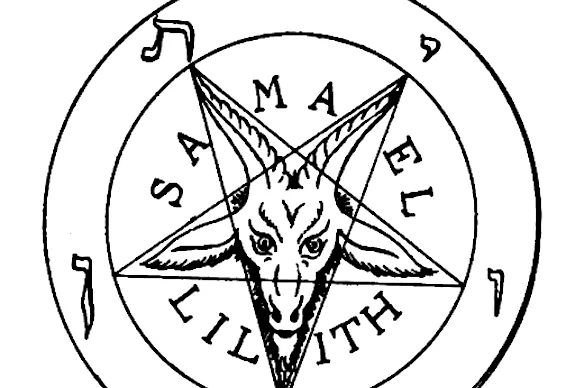
Stanislas de Guaita (died 1897) · Wikimedia Commons · Public Domain
occult
The Inverted Pentagram
One rotation of the star — and its whole meaning flips.
AttributedDocumented origin
A five-pointed star with two points upward. Éliphas Lévi associated this orientation in 1856 with “the goat of the Sabbath,” the inversion of the upright star’s hierarchy. The specific image of a goat-face inscribed within an inverted pentagram first appeared in print in Stanislas de Guaita’s La Clef de la Magie Noire (1897). That design was adapted with the Hebrew letters spelling “Leviathan” added around the perimeter and adopted as the Sigil of Baphomet by the Church of Satan at its founding in 1966, officially registered as its trademark in 1969.
The reading
In the occult tradition Lévi established and Mark Passio develops, the orientation of the pentagram is the entire argument: the upright star places the single apex — spirit — above the four lower points of matter; the inversion raises matter and carnal nature above spirit. Passio reads the deliberate use of the inverted form as a declaration of allegiance to the physical and the instinctual over the spiritual and the moral. Manly P. Hall situates the two orientations as mirror teachings — the path upward and the path downward, both encoded in the same five-pointed geometry.
Where it hides today
The Sigil of Baphomet appears on Satanic Temple and Church of Satan materials, in heavy-metal iconography, and in popular-culture “edgy” shorthand for the occult. The symbol carries enough institutional history that its orientation still reads as a deliberate, legible choice — not a decoration but a position.
Decoded by
- Mark Passio
- Manly P Hall
- Eliphas Levi
Where next
-
occult
666 / The Number of the Beast
The Bible's most feared number, still totaled on the Sun's magic square.
Also occult
Attributed Saturnian -
occult
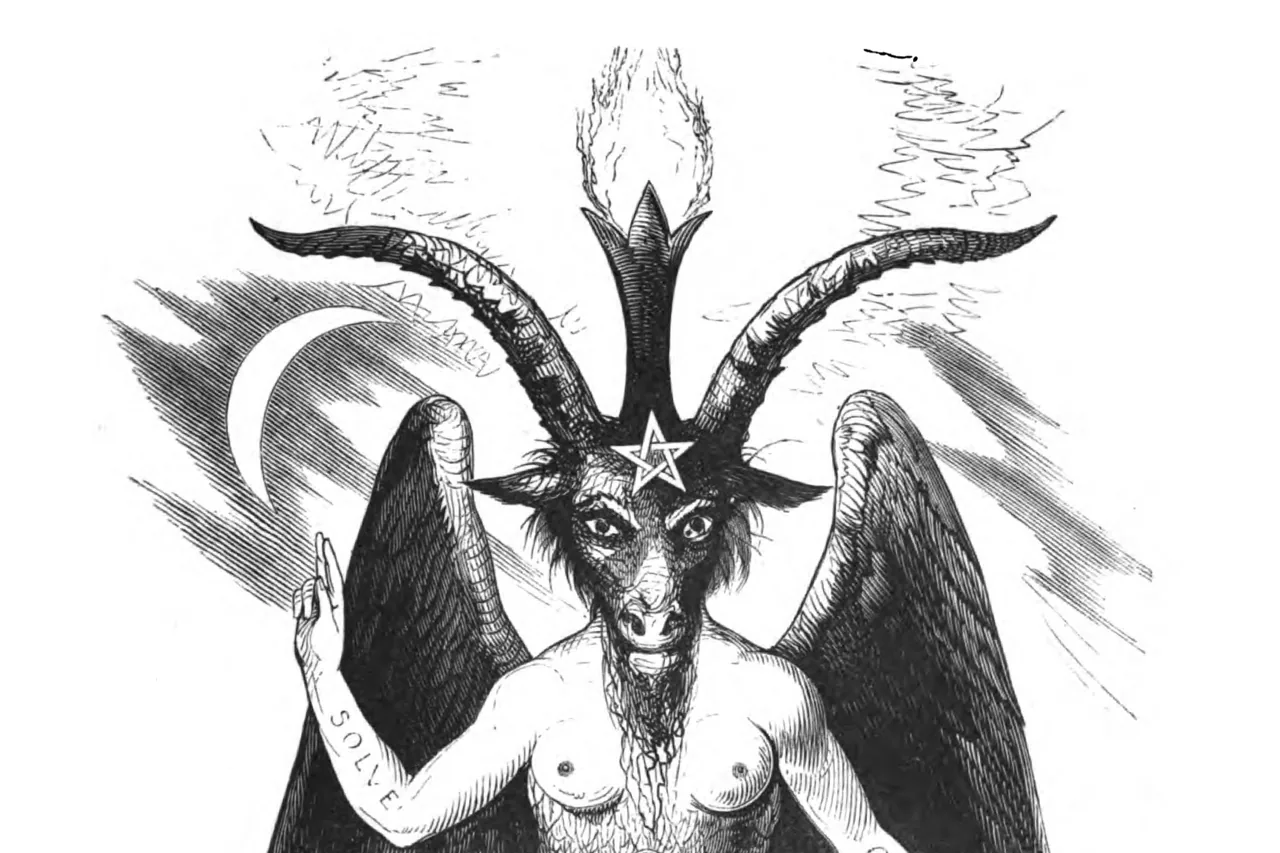
Baphomet
Lévi's drawing of opposites in balance — not a devil, a diagram.
Also occult
Attributed Hermetic -
occult
Saturn & the Black Cube
The geometry of time, lead, and limitation.
Also occult
Attributed Saturnian -
occult
The Black Sun
An inner, invisible sun — and a symbol whose history cannot be separated from its origin.
Also occult
Attributed Hermetic
Share this specimen
ANAMNESIS
Flip the star and matter rises over spirit — that is the entire argument.
The Inverted Pentagram