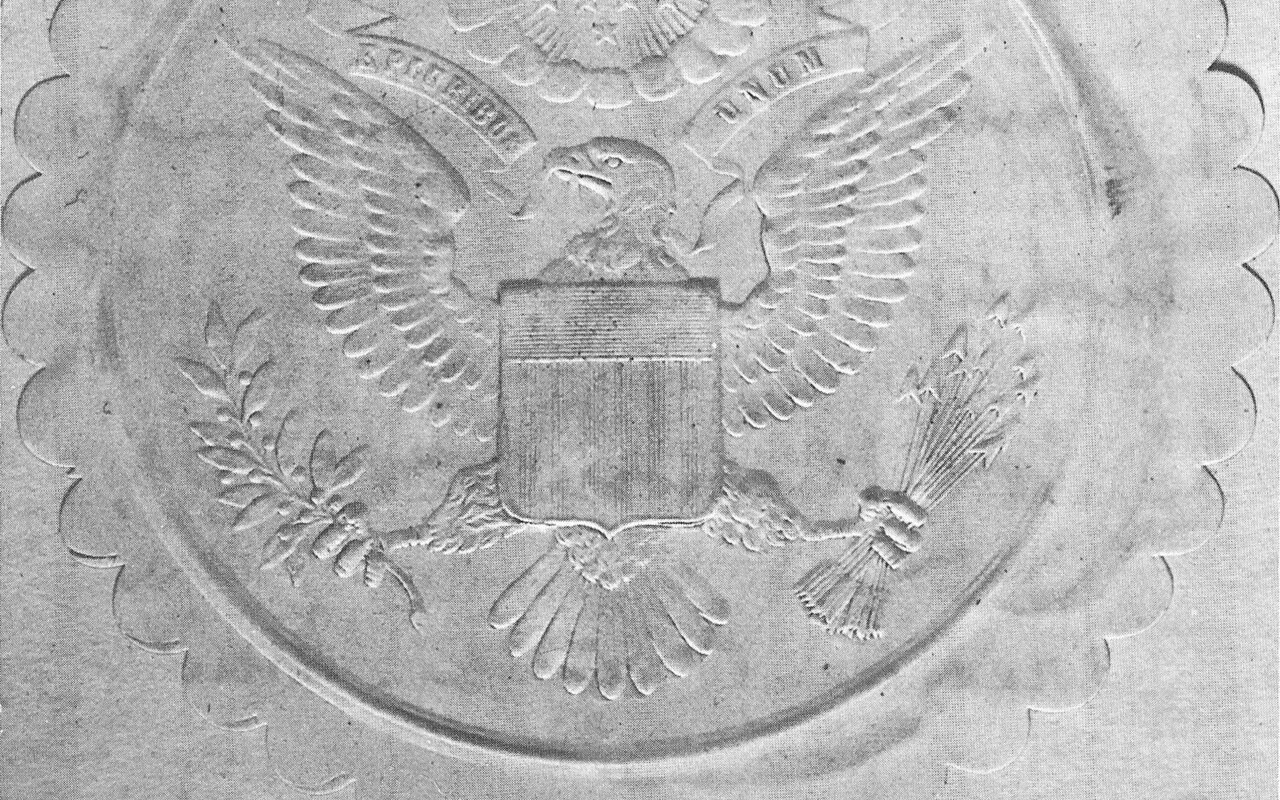
Photo courtesy of the National Archives. · Wikimedia Commons · Public Domain
Casebook decode · The obverse of the Great Seal of the United States
The Great Seal Eagle as Phoenix
The bird on the dollar is not an eagle. Manly Hall reads it as the phoenix.
The surface
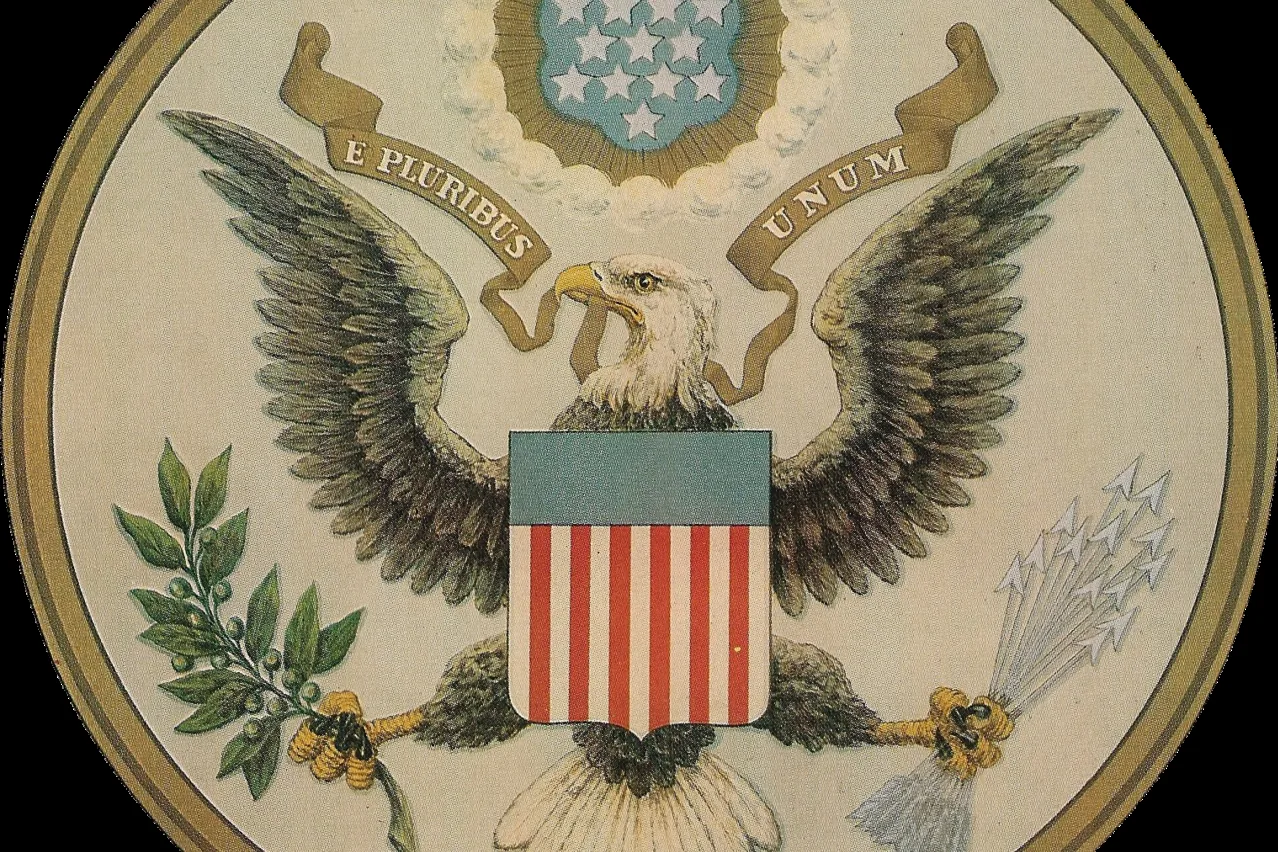
On the obverse of the Great Seal of the United States, an eagle spreads its wings against a blue field. It holds thirteen arrows in its left talon and an olive branch in its right. A shield of thirteen vertical stripes covers its breast. Above its head a cloud-burst of thirteen five-pointed stars arranges itself into a hexagram — a six-pointed stellar form. The motto E Pluribus Unum — “out of many, one” — scrolls from its beak.
The decode
Manly P. Hall reads the Great Seal’s bird as a conventionalized phoenix, not a common eagle — the solar bird of resurrection placed at the heart of the new republic’s emblem. In Hall’s reading the number thirteen (thirteen stars, thirteen arrows, thirteen stripes, thirteen courses on the reverse pyramid) is the signature count of the initiatic tradition, and the phoenix is its central emblem: the “twice-born” initiate who dies and is reborn into illumination. Hall notes that William Barton’s original 1782 proposals for the seal included a phoenix in flames, and that the bird’s breast-shield echoes the “breastplate of Righteousness” of the Mysteries.
The symbol lineage
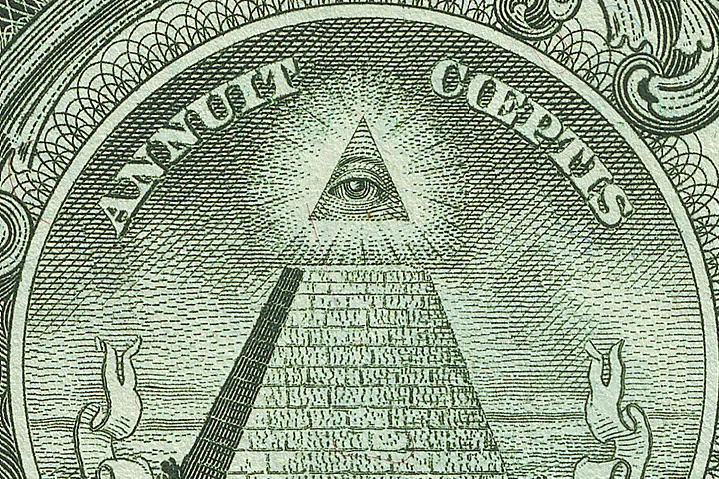
The eagle-as-phoenix traces to the Egyptian Bennu — the solar heron of Heliopolis, emblem of Ra and the Benben stone, the self-renewing fire-bird whose cycle symbolized cosmic rebirth. The Greeks received it as the phoenix of Herodotus and Pliny, a creature of five-hundred-year solar cycles, and it entered Christian iconography as the resurrection symbol. William Barton’s early Great Seal design (1782) explicitly depicted a phoenix. The thirteen-star “glory” above the bird echoes the all-seeing eye motif of radiant celestial oversight: the light from above, arranged into a six-pointed star of stars. Hall argues these are not coincidences of design but the deliberate signature of an order that understood the language of symbols — and placed their mark on the nation’s face.
The symbol lineage
Broken into its symbols
The artifact is a stack of inherited symbols. Scroll to lift each one out ↓
Who teaches this decode
- Manly P Hall
Sources
Where next
Share this decode
ANAMNESIS
The bird on your dollar is the phoenix of rebirth — Manly Hall read it in 1928.
The Great Seal Eagle as Phoenix