Pillar 1 of 5
P1 — Who Controls the Image
Representation is not ornament — it is power. Whoever selects which images, stories, and sounds reach a people selects who that people become, because symbols work beneath the threshold of reason. Plato knew this, legislated it in his ideal city, then exiled the artists who would undo it. The same logic runs unbroken to the money in your pocket.
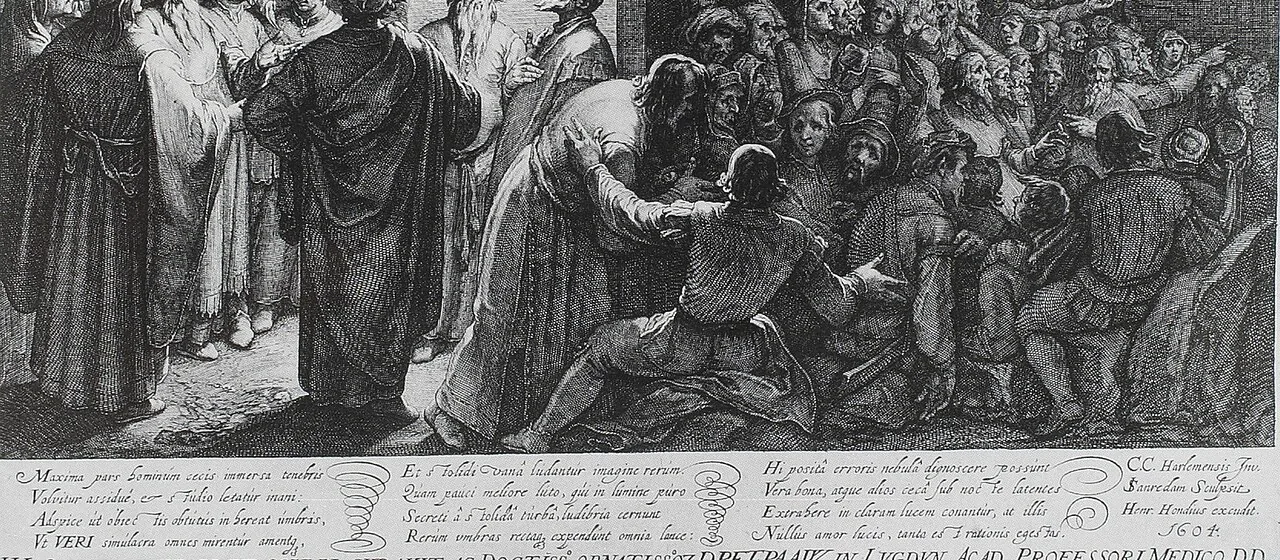
Jan Saenredam / After Cornelis van Haarlem · Wikimedia Commons · Public Domain
The question no one is asking
There is a question older than advertising, older than the printing press, older than the church. It is the question every empire has answered before it put a single coin in circulation, planted a single column, or chose which stories its children would hear at night.
Who controls the image?
Not as a matter of aesthetics. As a matter of power. The question is not what is beautiful — it is what is allowed to exist in the minds of a people, because what is allowed to exist in the mind governs what the mind is capable of wanting, fearing, and obeying.
Plato answered this question first, in writing, and his answer has never been improved on. It should disturb you that it was written by the founding philosopher of the Western tradition, is taught in every university, and is almost never followed to its obvious conclusion.
What Plato actually legislated
The Republic is, on its surface, a dialogue about justice. But Plato spends the bulk of Books II and III on something that looks, to the modern reader, shockingly practical: he designs a censorship regime.
The poets must go — or at least be edited. Homer’s gods cannot weep, rage, or dissemble. The myths that show the underworld as terrifying must be expunged, because citizens who fear death will not fight. The laments and dirges of music must be banned. Plato names the modes to be retained: the Dorian and the Phrygian — the modes of courage in danger and of reasoned temperance. The soft, “relaxed” modes and the modes of lamentation are removed from the city by decree. A guardian who hears the wrong scale will, Plato argues, be shaped into the wrong kind of soul.
This is not metaphor. Plato is writing an administrative blueprint. The state controls which frequencies of sound reach its citizens from childhood, because those frequencies are not decorative — they are formative.
Mimesis: the mechanism
The philosophical engine running beneath this legislation is mimesis — imitation. In Book III Plato distinguishes between a narrative that describes an event and one that performs it, making the poet speak as the character. The danger in the latter is precise: when the poet enters the character’s voice, the audience does too. The image — of a weeping hero, a cunning god, a man undone by grief — is not observed from a safe distance. It is inhabited. The soul of the listener shapes itself around the form it receives.
By Book X the argument is sharpened into a weapon. The painter or poet who renders a bed produces, Plato argues, an imitation of an imitation — the physical bed being itself an imitation of the Form. The image is twice-removed from truth, and twice as powerful over the appetitive soul precisely because it bypasses the reasoning faculty. The great poets, Homer included, are banished from the ideal city not because their work is valueless but because it is too powerful in the wrong direction. They produce emotional states the state has not authorized.
Stephen Halliwell’s landmark study of mimesis traces how this single concept — the soul taking the shape of what it imitates — runs as a continuous thread from Plato through the whole history of Western aesthetics. The worry Plato is naming is not literary. It is architectural: images build the interior of a person, and whoever controls the images controls the architecture.
The conclusion Plato draws
Allow yourself to hear it plainly. Plato’s conclusion — stated in the Republic without embarrassment — is that the ideal state must own representation.
Not regulate it. Own it. Select the stories. Fix the modes. Approve the images. Train the guardians in approved forms from infancy so that when they encounter unauthorized forms — a lament, a comedy that makes injustice look attractive, a portrait of the gods behaving badly — something in them recoils.
This is not a thought experiment. It is a technology of governance, identified more than two thousand years before the age of mass media, advertising, and algorithmic feeds.
The pyramid and the eye
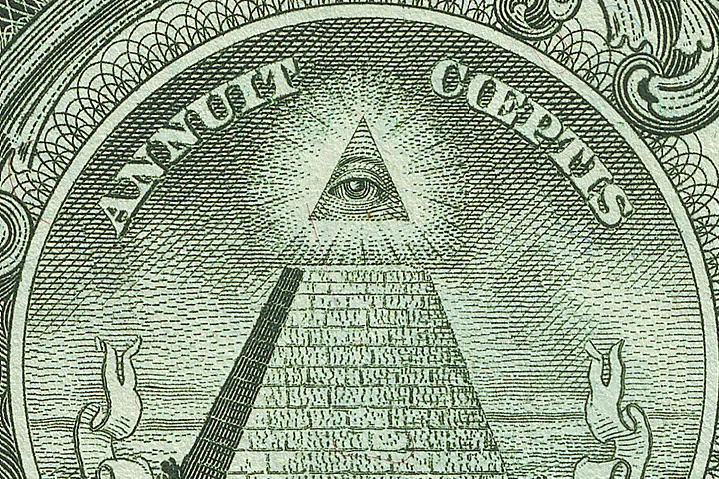
Look at the back of a one-dollar bill.
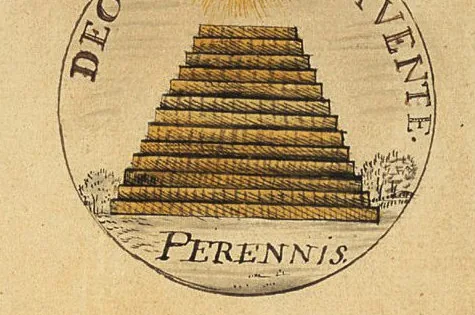
A pyramid of thirteen courses, unfinished at the apex. Above it, floating in a rayed triangle, a single open eye. Two Latin mottoes: Annuit Cœptis — “he has approved our undertakings” — and Novus Ordo Seclorum — “a new order of the ages.”
This design was finalized in 1782 for the reverse of the Great Seal of the United States. It was placed on the dollar bill in 1935. Since then it has circulated through billions of hands, studied by almost no one.
Manly P. Hall, in The Secret Teachings of All Ages (1928), reads the seal as what he calls “the signature of the Mysteries” — an initiatic emblem, drawn from the same tradition of hieroglyphic imagery that governed Egypt, placed openly on the republic’s currency. The unfinished pyramid, in Hall’s reading, is the Great Work still in progress. The all-seeing eye above is the eye of those who see — placed, structurally, above those who do not.
What Hall is describing is a Platonic move: an image inserted into mass circulation that carries a specific content about hierarchy, observation, and incomplete work — content legible only to those trained to read it, invisible to everyone else.
The seal is not proof of any particular conspiracy. It is a demonstration of something simpler and more verifiable: those who design civic symbols know they are designing them, know what they are encoding, and know that the unprepared eye will receive the image without reading it. This is exactly the mechanism Plato describes in the Republic. A form enters the soul. It shapes the soul. The soul never examines the transaction.
The all-seeing eye: where the logic lives today
The Eye of Providence has a documented entry point into Western art: the Renaissance emblem of divine omniscience — God’s gaze rendered as an eye in a triangle, watching over creation. It arrives on the Great Seal in 1782. It arrives on the dollar in 1935. Since then it has propagated: corporate logos, surveillance-firm insignia, media network branding, the visual grammar of a hundred institutions whose authority rests partly on being seen as watching.
Michael Tsarion, whose work traces the genealogy of subliminal symbol-placement in the modern image environment, argues that this propagation is not accidental repetition. The image of the observing eye set above the observer encodes a specific relationship of power — the seen and the unseen, the many below and the few above — and circulates it at a level beneath critical awareness. Tsarion’s reading places the Eye directly in the Platonic lineage: an image whose effect on the interior does not require the viewer’s conscious assent.
The Eye is one entry in the Dictionary this archive maintains. Each entry documents the symbol’s history, the reading the tradition gives it, and where it appears today. Taken together they form a map of the image environment Plato was describing — now fully industrialized, carried in every pocket, loaded on every screen.
What the archive is for
Plato’s legislators controlled who learned to read symbols. The initiate traditions that followed maintained their symbol-literacy inside closed lineages. The modern image industry — advertising, cinema, news, social media, and now AI-generated imagery — operates on the same principle Plato identified: images shape the interior below the threshold of conscious examination, and the people who cannot read the images are the most fully shaped by them.
This archive is built on the inverse principle. The images exist. The lineage of each is traceable. The readings are documented, attributed, sourced. Symbol-literacy is learnable.
The question Plato answered — who controls the image? — generates a second question the Republic does not ask: what happens when the controlled begin to read?
That is what this archive is for.
Into the war
P1 identifies the mechanism. P2 — The War on Images — documents the historical proof: every power that has wanted the soul has fought over images first. The Second Commandment, Byzantine Iconoclasm, the Protestant whitewashing of the churches — the same pattern, four millennia running.
The Symbol Dictionary is the working tool. Start with the All-Seeing Eye — the symbol on the money — and follow its lineage back.
The read was always possible. It was just never taught.
The claims
- Plato's Republic establishes that rhythm, story, and image bypass reason and condition the soul directly.
- Books II–III of the Republic mandate state censorship of the poets and restriction of musical modes to those that produce martial and moderate character.
- Book X exile of the imitative artists removes from the city anyone who could produce unauthorized emotional states.
- The concept of mimesis — imitation — is Plato's name for the mechanism by which images transfer inner states from maker to audience.
- The Great Seal's pyramid and all-seeing eye demonstrate that the ancient image-control logic is still operative today, printed on every dollar.
- Tsarion argues that the modern symbol environment functions as an industrialized version of the Platonic regime — engineering consent through images most citizens cannot read.
The citable spine
- Plato, Republic II–III (c. 375 BCE): censorship of poets, restriction of musical modes to Dorian and Phrygian — modes deemed to produce courage and temperance.
- Plato, Republic X (c. 375 BCE): formal exile of the imitative artist from the ideal city; the 'three beds' argument establishing mimesis as twice-removed from truth.
- The concept of mimesis as mechanism of soul-formation — the argument that image-making transfers inner states and so shapes character at a level reason cannot reach.
- The Great Seal of the United States (1782): pyramid, Eye of Providence, and the mottoes Annuit Coeptis and Novus Ordo Seclorum — an image-statement pressed onto the national currency.
Proponents
Worked examples