Pillar 5 of 5
P5 — Symbolic Illiteracy & the AI Image Age
We are the most image-saturated population in recorded history and among the least equipped to read what those images mean. Now the machines that generate images at industrial scale are owned by a handful of corporations. Whoever owns the model owns the visual unconscious of the age — Plato's nightmare, fully industrialized, running in your pocket. This is the capstone claim. It is also the most documented claim in this archive.
This section covers a fast-moving regulatory and technological landscape. All claims are dated to their source. Figures, deadlines, and regulatory status may have changed since the dates cited.
The inversion
Every civilization in this archive’s account has had a literacy problem with images. Plato’s citizens were formed by images they could not examine. The Byzantine faithful received sacred imagery they could not place in a theological tradition. The pre-Reformation laity moved through an image-environment built by institutional Rome and could not read the grammar of what surrounded them.
None of them were as saturated with images as we are. None of them were as ill-equipped to read what those images meant.
The average person in 2024 encounters more engineered images before breakfast than a Byzantine monk encountered in a month. The average person also knows less about who made those images, why, what symbols they carry, and what the symbols are designed to produce in the interior. We have scaled the volume by several orders of magnitude and reduced the literacy to near zero.
This is the capstone. And it has one additional feature that separates it from every previous episode in the war over images: the machines that generate images at industrial scale are now privately owned, concentrated in a small number of corporate systems, and capable of producing fabricated imagery that the majority of the population cannot distinguish from the real.
The gap: what the surveys say
The Reuters Institute Digital News Report 2024 surveyed 94,943 people across 47 markets between late January and early February 2024. Its finding on the real/fake question is direct: concern about distinguishing real from fake content online “has risen by 3 percentage points… with around six in ten — 59% — concerned.” In the United States that figure rises to 72%. In South Africa, 81%.
These are not marginal populations experiencing edge-case confusion. These are majorities, measured across nearly a hundred thousand respondents, expressing concern about a capacity they understand themselves to lack.
Ofcom, the UK’s communications regulator, published “A deep dive into deepfakes” in 2024. Its polling of 2,000 UK adults found that approximately 43% had encountered at least one deepfake in the preceding six months. Only approximately 9% felt confident they could identify one.
The gap between encounter rate (43%) and confident recognition (9%) is the operational fact this pillar rests on. Nearly half the population is seeing fabricated imagery regularly. One in eleven feels equipped to recognize it.
A 2025 arXiv preprint by Roca et al. (arXiv:2507.18640, submitted 12 May 2025) reports an analysis of approximately 287,000 image evaluations by over 12,500 participants: overall success rate in distinguishing AI-generated from real images was only 62% — marginally above chance. Note: this is a preprint, not yet peer-reviewed, and the authors market a detection product — treat as lower-tier until independently corroborated.
The machines and who holds them
The image-generation infrastructure as of mid-2026 is concentrated in a small number of corporate systems. OpenAI’s GPT Image (formerly DALL·E), Google’s Imagen and Gemini image generation, Adobe’s Firefly, Midjourney, Stability AI, Black Forest Labs (Flux), and xAI’s Grok Imagine collectively account for the overwhelming majority of AI-generated images produced by the public. Adobe integrated partner models from Google, OpenAI, Black Forest Labs, and Runway into its platform in December 2025. Note: market-concentration figures for AI image generation are drawn from trade analysis (Tier C); ownership claims should be corroborated against company filings and official announcements before citation.
Each of these systems embeds its own default aesthetic biases, its own training-data provenance, its own decisions about what kinds of images it will and will not produce. The person generating an image with one of these tools is operating inside a visual vocabulary curated by the corporate entity that trained the model. They are not generating freely. They are selecting from a pre-authorized range.
This is the Platonic structure, made operational in corporate form. The model-owner functions as Plato’s legislator: determining which images can be conjured, which cannot, which receive default stylistic treatment, which are rendered impossible. The population using the tools inhabits the image-world the model allows. Most users are unaware that this selection process is occurring.
The regulatory response: marking the manufactured image
Governments have recognized the problem and are moving to address the most acute version of it — the inability to distinguish AI-generated from authentic imagery. The regulatory record as of mid-2026 is as follows.
EU AI Act, Article 50 — The primary legal text on deepfake disclosure and machine-readable marking. The full text and a practical guide are published at artificialintelligenceact.eu. Obligations under Article 50 apply from 2 August 2026. Under the AI Omnibus provisional agreement reached in May 2026, generative AI systems already on the market receive until 2 December 2026 to meet the Article 50(2) machine-readable marking requirement. Article 50 requires that AI-generated or manipulated content be disclosed to recipients and, where technically feasible, marked in a machine-readable way.
European Commission Code of Practice on Transparency of AI-Generated Content — The European Commission’s digital strategy directorate published the first draft of this Code of Practice on 17 December 2025 and the second draft on 3 March 2026, with the final version expected by June 2026. The Code governs how signatories disclose and label AI-generated content across the EU’s digital single market.
NSA/CISA, “Content Credentials” (January 2025) — In January 2025, a multi-agency advisory from NSA, CISA, and partner agencies formally endorsed the C2PA Content Credentials standard as a framework for strengthening multimedia integrity in the generative AI era. The C2PA (Coalition for Content Provenance and Authenticity), founded in 2021 by Adobe, Arm, BBC, Intel, Microsoft, Truepic, and now comprising more than 200 member organizations, develops open technical standards for attaching provenance metadata — who made this, when, with what tool — to digital content at the point of creation.
Google DeepMind SynthID (arXiv, 2025) — The technical paper “SynthID-Image: Image watermarking at internet scale” (arXiv:2510.09263) describes Google DeepMind’s system for embedding invisible, imperceptible watermarks into AI-generated images. The watermark persists through common transformations (compression, cropping, color adjustment) and allows automated detection of AI-generated origin. Flag: this is a preprint (arXiv, 2025), not yet peer-reviewed; treat as provisional until publication in a peer-reviewed venue.
What the regulatory and technical record establishes is that the manufactured image is now a recognized governance problem — recognized not by alternative researchers but by the EU legislature, the NSA, and the technical research division of Google. The question of who made an image, with what tool, and whether it represents something that actually occurred has moved from philosophical to juridical.
What the regulation cannot address
The regulatory interventions are aimed at the most acute symptom: fabricated imagery that deceives viewers into believing they are seeing real events. This is important and urgent, and the regulatory record above is real.
It does not address the deeper problem this archive exists to name.
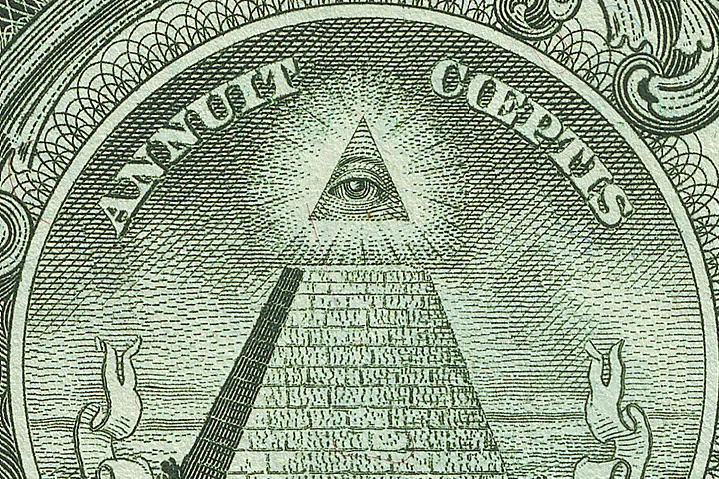
The deeper problem is not that AI-generated images are indistinguishable from photographs. The deeper problem is that the entire image environment — AI-generated and otherwise — operates through a symbol-vocabulary that the population receiving it has never been taught to read. The All-Seeing Eye that appears in a corporate logo, a music-video set piece, or an AI-generated artwork functions identically regardless of whether it was painted by hand, photographed, or produced by a generative model. Its effect on the interior does not depend on its provenance. It depends on the viewer’s inability to place it in its lineage.
A watermark tells you that an image was AI-generated. It does not tell you what symbols the image carries, where those symbols come from, what they have historically been used to produce in the interior life of a population, or whose interests are served by their deployment. The regulation addresses authenticity. Symbol literacy addresses meaning.
The visual unconscious under private ownership
In every previous episode of the war over images, the entity controlling the image-environment was visible. The pharaoh put his image on the temple. The emperor put his seal on the coin. The church put its iconographic program on the apse. Bernays put his name on the book.
The AI model-owners are visible in a different and more obscure way. The name of the system — Midjourney, Firefly, GPT Image — is disclosed. What is not disclosed is the training data, the aesthetic defaults, the value-laden choices embedded in the model’s understanding of what a “professional photograph,” a “realistic portrait,” or a “logo design” looks like. The model was trained on a particular visual history, curated by particular people with particular interests, and it produces images that reproduce the assumptions of that training with every generation.
This is the industrialization of the Platonic condition. Plato’s philosopher-legislators decided in advance which images would circulate. The model-owner’s training-data curators make equivalent decisions — but in a technical rather than a civic process, with no public hearing and no Platonic dialogue about which forms the city’s soul should take.
The population using these models is the most image-productive in history. It is producing, at consumer scale, more images per hour than the entire Renaissance produced in a century. And it is producing them inside visual vocabularies whose assumptions it has not examined, from systems whose selection criteria it has not seen, to circulate among audiences who have never been taught to read a symbol.
Plato would recognize the situation immediately. He would probably note that the only difference is that his philosopher-legislators at least knew they were doing it.
What symbol-literacy changes
The claim of this archive is not that the manufactured image-environment can be dismantled. It is that the population inside it can become capable of reading it.
The Symbol Dictionary — the working tool this archive maintains — does not require you to stop receiving images. It requires you to be able to place them. The All-Seeing Eye in a corporate logo is the same form as the Eye of Providence on the Great Seal of 1782, which is the same form as the divine omniscience emblem of the Renaissance, which is traceable back through a lineage documented in the Dictionary. Knowing the lineage does not neutralize the image. It changes your relationship to it: from interior to observer.
The EU is attempting to mark the manufactured image at the point of generation. C2PA is attempting to build a provenance record into the image file. These are technical and regulatory moves. Symbol literacy is a different kind of move: the decision, made by an individual, to become capable of reading what is already there.
That decision is what this archive is built to enable. Start with the All-Seeing Eye. Follow its lineage back through the Casebook, the Timeline, and the Pillars. The images existed before the AI generated them. The symbols existed before the models were trained. The war over images is older than any technology. It only ever had one antidote: the ability to read.
The archive is the reading lesson.
The claims
- As of 2024, approximately 59% of news consumers across 47 markets report concern about distinguishing real from fake online content, rising to 72% in the US (Reuters Institute, 2024).
- A 2024 Ofcom study found that while roughly 43% of UK adults had encountered a deepfake, only approximately 9% felt confident they could identify one.
- EU AI Act Article 50 mandates machine-readable marking of AI-generated content, with obligations applying from 2 August 2026; under the AI Omnibus provisional agreement (May 2026), systems already on market have until 2 December 2026 for the marking requirement.
- The European Commission published a Code of Practice on Transparency of AI-Generated Content, with a first draft 17 December 2025 and second draft 3 March 2026, final version expected June 2026.
- AI image generation is now concentrated in a small number of corporate systems: OpenAI, Google DeepMind, Adobe, Midjourney, Stability AI, and xAI, whose models collectively shape the default visual vocabulary of the era.
- Google DeepMind's SynthID system embeds invisible watermarks in AI-generated images at internet scale — an attempt to mark the manufactured image at the point of creation (arXiv preprint, 2025; not yet peer-reviewed).
The citable spine
- EU AI Act Article 50 (full text): deepfake disclosure and machine-readable marking obligations, applying from 2 August 2026 (AI Omnibus grandfathering deadline: 2 December 2026).
- European Commission, Code of Practice on Transparency of AI-Generated Content: 1st draft 17 December 2025; 2nd draft 3 March 2026; final version expected June 2026.
- NSA/CISA et al., 'Content Credentials: Strengthening Multimedia Integrity in the Generative AI Era' (January 2025): official government endorsement of the C2PA Content Credentials standard.
- Reuters Institute Digital News Report 2024: survey of 94,943 people across 47 markets; 59% concerned about real/fake distinction online; 72% in the US; 81% in South Africa.
- Ofcom, 'A deep dive into deepfakes' (2024): ~43% of UK adults encountered a deepfake; ~9% felt confident they could spot one.
- Google DeepMind, 'SynthID-Image: Image watermarking at internet scale' (arXiv:2510.09263, 2025) — preprint, not yet peer-reviewed.