Pillar 4 of 5
P4 — The Engineering of Consent
The ancient art of image-control did not disappear with the Byzantine emperors and the Protestant reformers. It was industrialized. In the 1920s, Edward Bernays named the project, documented the methods, and built a commercial practice out of it. The mechanism Plato theorized — images bypassing reason to reshape the interior — became, in the twentieth century, an applied discipline with clients, fees, and a published literature. It is the most documented layer of the war over images, and the one most people are still not reading.
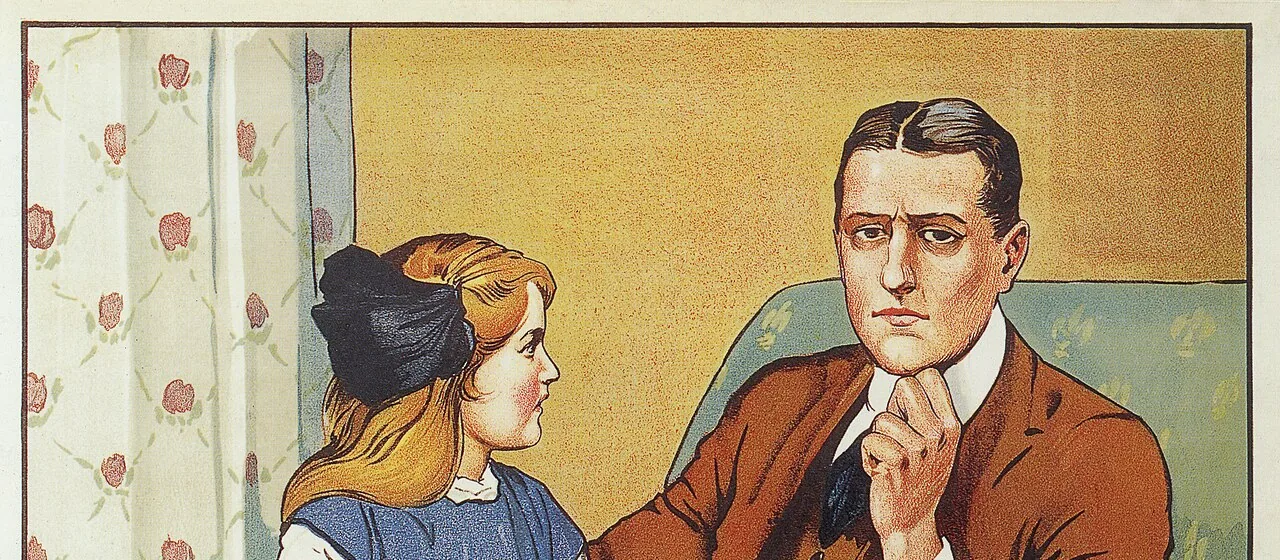
Savile Lumley / Johnson, Riddle & Co. Ltd. / Adam Cuerden · Wikimedia Commons · Public Domain
The paper trail
Most of the war over images must be reconstructed from art history, conciliar records, and philosophical texts. The modern layer requires no reconstruction. The architects of the modern image-environment wrote books about what they were doing, published them under their own names, and used them to attract clients.
This is the most documented layer of the war over images. It is also, remarkably, the layer that most educated people have not read.
Walter Lippmann published Public Opinion in 1922. Edward Bernays published Propaganda in 1928 and delivered the technique’s formal name — “the engineering of consent” — in a 1947 essay that left nothing unstated. Roland Barthes published Mythologies in 1957 and provided the semiotic anatomy that explains why the technique works even when the audience knows it exists.
The mechanism is the same mechanism Plato identified in the Republic. It now has a published methodology, a professional association, and a century of practice behind it.
Lippmann: the picture and the world
Walter Lippmann was a journalist and political theorist — the most influential American commentator of his era. Public Opinion is his argument about how democratic citizens actually form their views of the world.
The core observation is precise. Lippmann distinguishes between the world as it is — vast, complex, and largely inaccessible to any individual — and the “pseudo-environment” that each person carries in their head. This internal picture, Lippmann argues, is not a direct representation of reality. It is constructed from images, reports, stories, and representations. The citizen acts on the pseudo-environment, not on the world. The pseudo-environment is made of symbols.
The implication runs directly to the politics of the image. If citizens act on internal pictures constructed from mediated images, then whoever controls the supply of mediated images controls the pictures citizens carry — and therefore controls, in a functional sense, what citizens are capable of believing, wanting, and deciding. Lippmann called this “the manufacture of consent,” in a phrase that crystallized what he saw as the central problem of modern democracy.
Lippmann drew no sinister conclusion from this. He thought expert management of public opinion was probably necessary and perhaps benign. What matters for this archive is the diagnosis, not the prescription: the pseudo-environment is the real political environment, it is made of symbols, and it is manufactured.
Bernays: the technique named
Edward Bernays was Lippmann’s contemporary and, by his own account, the founder of the public relations industry. He was also Sigmund Freud’s nephew — a biographical fact he was not shy about deploying, and one that matters because his understanding of persuasion drew directly on the psychoanalytic model of the unconscious.
Propaganda opens with a sentence that deserves to be read in full: “The conscious and intelligent manipulation of the organized habits and opinions of the masses is an important element in democratic society.”
Not a secret. Not a confession extracted under pressure. An opening statement, published in 1928, in a book written to attract clients.
Bernays’s argument throughout Propaganda is that modern society requires the engineering of consent because the complexity of modern decisions exceeds the informed capacity of most citizens. The solution is a class of practitioners who understand how opinion is formed and can shape it deliberately. Bernays called this class “the invisible government” — not in accusation but in description. He considered himself a member of it and considered the work legitimate.
In 1947, writing in the Annals of the American Academy of Political and Social Science, Bernays formalized the practice and gave it its name: “the engineering of consent.” The essay lays out the methodology systematically — define the objective, identify the audience, design the symbols and messages that will move the audience toward the objective, plant those symbols in the channels through which the audience receives its picture of the world. The technique is not subliminal. It does not depend on the audience being unaware that media exists. It depends on the audience being unable to recognize which symbols have been placed there deliberately and what they are designed to produce.
The Torches of Freedom: symbol transplantation in practice
In 1929, Bernays received a commission from the American Tobacco Company. The problem was this: women did not smoke cigarettes in public. The taboo was strong enough to represent a significant market constraint.
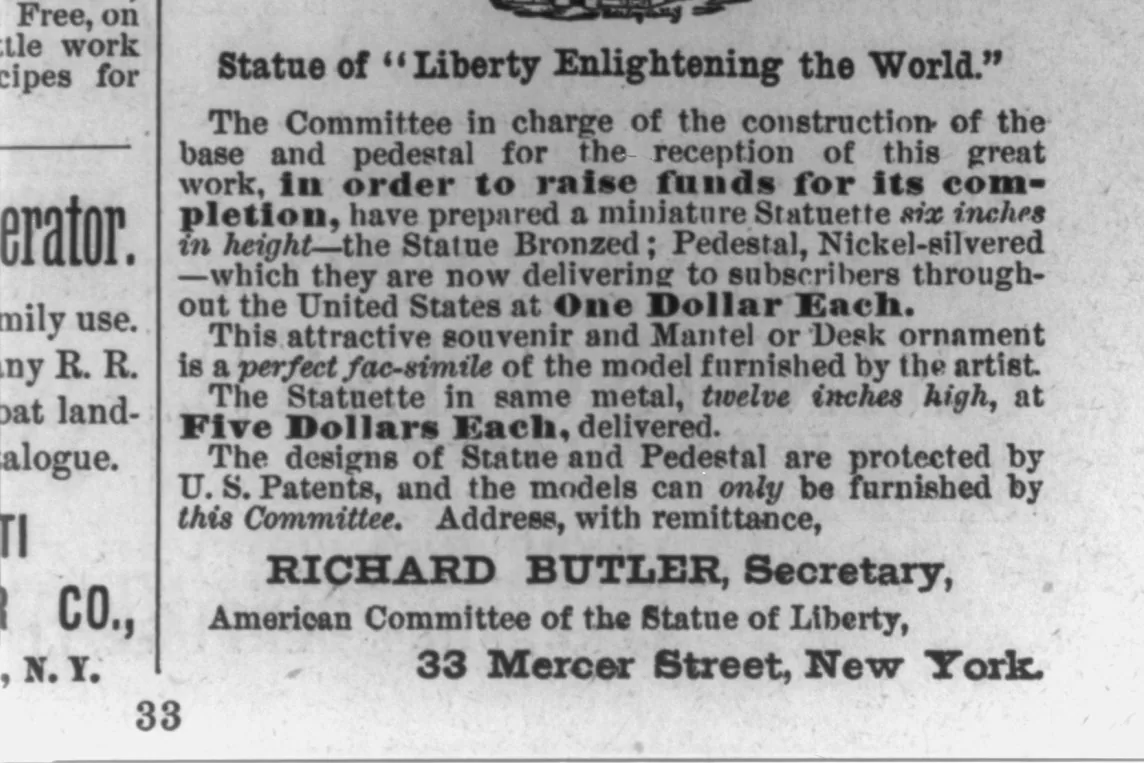
Bernays’s solution was to transplant a symbol. He recruited a group of women to march in the New York Easter Sunday parade smoking Lucky Strike cigarettes. He briefed the press in advance, framing the cigarettes as “torches of freedom” — connecting the act of public smoking to the iconography of women’s liberation and, behind that iconography, to the most prominent civic symbol of liberty in the American visual vocabulary: the torch of the Statue of Liberty.
The coverage was extensive. The symbol transplantation worked. The taboo against women smoking in public weakened measurably in the years that followed.
What Bernays had done was precisely what the tradition of image-control documented across this archive does: take a symbol already loaded with meaning in the interior life of an audience, attach it to a new object, and allow the meaning to transfer. The liberty torch belonged, in the American symbolic vocabulary, to the Statue of Liberty — a civic image of immense emotional charge, publicly displayed in one of the world’s most prominent harbors. Bernays did not invent the torch. He borrowed it, redeployed it, and filed a client invoice.
The Statue of Liberty is in the Casebook. The Columbia Pictures decode is in the Casebook. The CBS Eye is in the Dictionary. Each one is a variation on the same operation: a symbol with a loaded history, placed into mass circulation in a new context, transferring its charge to whatever it now adorns.
Barthes: the anatomy of the second sign
The semiotic account of why this technique works — and why it works especially well when the audience knows advertising exists — was provided by Roland Barthes in Mythologies (1957).
Barthes’s analysis begins from a simple observation: in advertising and in what he calls the “mythologies” of everyday bourgeois culture, signs do not only mean what they first appear to mean. They carry a second layer. A photograph of a Black soldier saluting the French flag is, at the first level, a photograph. At the second level, it is an argument about empire and loyalty — an argument that presents itself not as argument but as simple fact, a picture of the way things naturally are.
This second-order operation is what Barthes means by “myth”: the process by which a constructed, ideologically-loaded meaning is naturalized into apparent common sense. The technique does not say “empire is good.” It shows the soldier saluting and allows the viewer’s interior to do the rest. The image carries the argument without appearing to make one.
Barthes’s anatomy is the theoretical complement to Bernays’s practice. Bernays designs the image. Barthes explains the mechanism by which the image bypasses the critical faculty — not by hiding from it but by arriving in a form that looks like evidence rather than argument. The symbol does not persuade. It shows. The persuasion happens in the interior, below the level at which the audience examines its own responses.
This is, again, the mechanism Plato describes in the Republic: the image enters the soul and shapes it before reason can evaluate the transaction.
The industrial scale
What changed between Plato and Bernays was not the mechanism. What changed was the scale and the delivery infrastructure.
In the Republic, the image-control apparatus is the state, operating through education, public performance, and the design of civic ritual. In the Byzantine Empire, it is the throne and the church, operating through ecclesiastical architecture and the canon of sacred imagery. In the Reformation, it is the reformed church, operating through the deliberate destruction of one image-environment and its replacement with another.
In the twentieth century, the delivery infrastructure is the press, the cinema, the radio, the television, the advertising industry, and the public relations firm. The scale expands from the city-state to the continent. The speed of delivery expands from the annual festival cycle to the daily newspaper and eventually to the second-by-second feed.
The images that move through this infrastructure are not random. They are selected. They carry the interests of whoever commissions their creation and distribution. The selection process is largely invisible to the audience, not because it is hidden in any crude sense but because the audience receives the images as picture-of-the-world rather than as editorial decision.
Robert Cialdini’s work on the psychology of persuasion documents the specific cognitive mechanisms — reciprocity, social proof, authority, scarcity, liking, commitment — through which the symbols and framings of the modern image-environment achieve their effects. These mechanisms are not new. They are the operational implementation, in a commercial context, of the soul-forming power that Plato identified as the reason to control images in the first place.
The invitation
The difference between the Platonic legislator and the Bernays practitioner is transparency of a paradoxical kind. Bernays published his methods. The books exist. The client lists are documented. The “Torches of Freedom” campaign is in the historical record. The engineering of consent is not hidden in any strong sense.
What it depends on is not secrecy but symbol-illiteracy. The audience that cannot read the CBS Eye as an image with a history, the audience that receives the Columbia torch as natural rather than constructed, the audience that does not ask which symbols have been borrowed from where and loaded with what — that audience is available to be shaped. The shape it is given is determined by whoever is doing the engineering.
This is not conspiracy. It is industry. It has a literature, a professional trade, and a century of case studies. It is the most openly documented layer of the war over images.
The Dictionary exists to make the symbols readable. The Casebook decodes the operations. The only thing required of the reader is the decision to look.
Into the AI age
P4 establishes that the engineering of consent is documented, practiced, and continuous. P5 — Symbolic Illiteracy & the AI Image Age — brings the account to the present, where the image-generation infrastructure has been privatized at a scale Bernays could not have imagined, and where the gap between the volume of engineered images and the population’s ability to read them has never been wider.
The All-Seeing Eye is in the Dictionary. The Statue of Liberty is in the Casebook. The technique is documented. The question now is who holds the machines.
The claims
- Walter Lippmann's Public Opinion (1922) established the theory: citizens act on 'pseudo-environments' — internal pictures of the world constructed from mediated images, not direct experience.
- Edward Bernays, Lippmann's contemporary and the founder of modern public relations, named the practice 'the engineering of consent' and described it as the intelligent manipulation of organized habit.
- Bernays's Propaganda (1928) opens with the explicit claim that the conscious manipulation of mass opinion is not merely possible but essential to the functioning of modern democracy.
- Bernays's 'Torches of Freedom' campaign (1929) grafted the symbol of the Statue of Liberty's torch onto cigarettes for the American Tobacco Company — one of the first documented corporate symbol-transplantation operations.
- Roland Barthes's Mythologies (1957) provides the semiotic anatomy of how advertising naturalizes ideology: the second-order sign system that makes constructed meaning appear inevitable.
- The same mechanism Plato theorized — images conditioning the soul beneath reason — now operates at industrial scale, backed by a published methodology and a century of practice.
The citable spine
- Walter Lippmann, Public Opinion (1922): the 'pictures in our heads,' the pseudo-environment, and the manufactured consent of mass democracy.
- Edward Bernays, Propaganda (1928): 'the conscious and intelligent manipulation of the organized habits and opinions of the masses is an important element in democratic society.'
- Edward Bernays, 'The Engineering of Consent,' Annals of the American Academy of Political and Social Science (1947): the technique named and systematized.
- Bernays, 'Torches of Freedom' campaign (1929): commissioned by American Tobacco Company; recruited women to smoke Lucky Strike cigarettes publicly as a gesture of liberation, explicitly grafting the liberty-torch symbol onto the product.
- Roland Barthes, Mythologies (1957): the semiotic analysis of advertising and everyday culture as a second-order sign system; myth as depoliticized speech.
Symbols in this argument
-
corporate
The Columbia Pictures Torch-Bearer
A draped goddess lifting a torch above every Hollywood film since 1924.
In the dictionary
Attributed Civic-Solar -
civic-national
The Statue of Liberty
The goddess in the harbor — Isis wearing a different name.
In the dictionary
Attributed Astro-Theology -
corporate
The CBS Eye
A broadcaster's eye, open and unblinking, watching forty million households since 1951.
In the dictionary
Attributed Civic-Solar