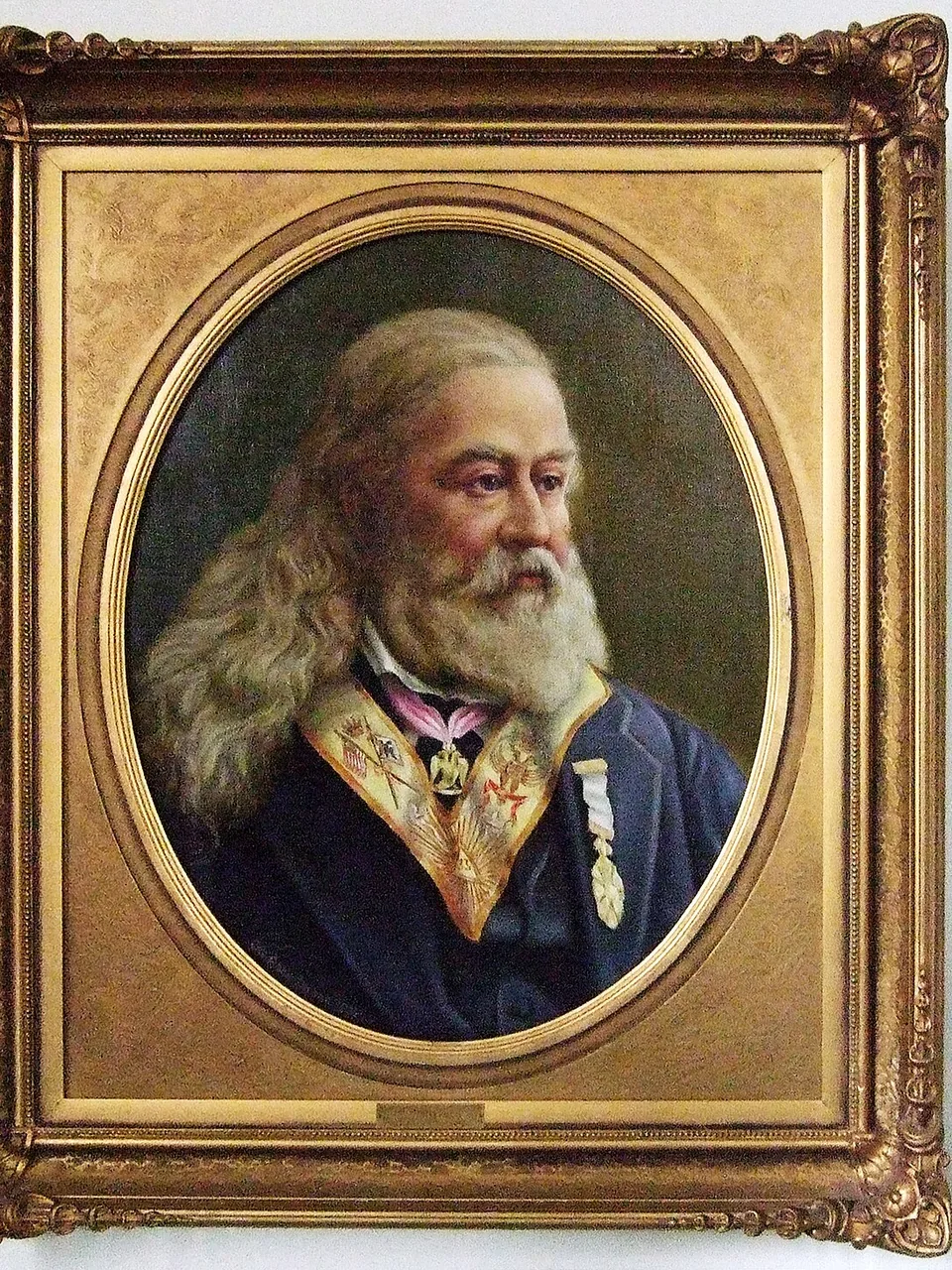
painting: unknown; file: James Steakley · Wikimedia Commons · Public Domain
Ancestor · 1809–1891
Albert Pike
Scottish Rite Freemason whose Morals and Dogma is the scene's primary Masonic source.
Primary insider source for the tradition's analysis of Masonic symbolism and the doctrine that all language and religion is encoded symbol.
Albert Pike was a lawyer, poet, and Confederate general who also became Sovereign Grand Commander of the Scottish Rite’s Southern Jurisdiction from 1859 until his death. His lasting contribution to the tradition is Morals and Dogma (1871) — a 900-page commentary on the 33 degrees of the Scottish Rite that Pike wrote and revised over decades and which was given to candidates receiving the 14th degree for over a century. Pike taught that all religious expression is symbolism, that the symbols of Masonry encode the wisdom of the ancient Mystery schools, and that each degree of initiation unveils a deeper layer of meaning kept from the outer world. That explicit architecture of graded, concealed knowledge is the source text the modern symbol-control tradition returns to most. When Jordan Maxwell, William Cooper, or Mark Passio argue that elites communicate through symbols the public cannot read, they cite Pike as the insider who said so in print.
Core claims
- Pike taught that 'all religious expression is symbolism' and that the earliest instruments of human education were symbols — before writing, before theology.
- In Pike's work, the symbols and allegories of Masonry carry 'other and profounder meanings that may at some time be unveiled' to the initiate across graded degrees.
- Pike taught a hierarchy of degrees in which deeper symbolic meanings are reserved for higher initiates — a model the modern scene reads as the template for institutional symbol-control.
- Pike argued that Masonic symbolism descends from the ancient Mystery schools of Egypt, Greece, and the East, encoding the same perennial wisdom under new forms.
Key works
- Morals and Dogma of the Ancient and Accepted Scottish Rite of Freemasonry · 1871
Signature decodes
- 'All religious expression is symbolism': Pike's opening declaration in Morals and Dogma is the single most-quoted line in the scene's argument that religion is encoded, not literal.
- The graded unveiling of meaning across Masonic degrees: Pike's architecture of 33 degrees, each disclosing more, is read by Maxwell, Cooper, and Passio as the model for all elite knowledge-hoarding.
- The symbolism of the first three degrees — Apprentice, Fellow-Craft, Master Mason — decoded by Pike as an allegory of the soul's progress from ignorance through labor to illumination.
Influenced by
Sources
Status Deceased (1809–1891). Morals and Dogma was traditionally given to candidates receiving the 14th degree until the practice was discontinued in the 1970s; the text is in the public domain and held at archive.org and the Supreme Council library in Washington, D.C.