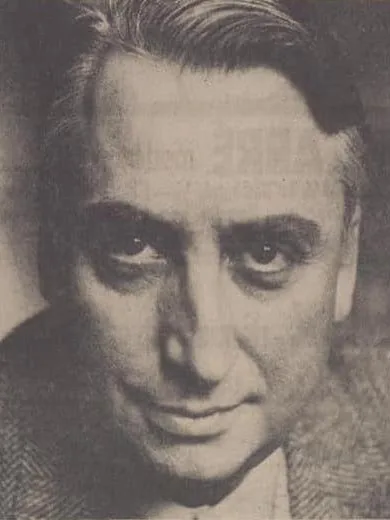
Wikimedia Commons · Public Domain
Scholarly backbone · 1915–1980
Roland Barthes
French semiologist who proved everyday images carry hidden ideological orders.
Academic source — his theory of myth as a second-order semiological system gave the symbol-decode tradition a rigorous framework for arguing that logos, ads, and media imagery carry a deliberate hidden layer of meaning.
Roland Barthes trained his eye on the ordinary and found it was never innocent. In Mythologies he dismantled the everyday — a wrestling match, a magazine cover, a plate of steak — revealing each as a myth: a sign that has been hollowed out and refilled with ideology until the historical looks natural. His technical apparatus was precise: myth operates on a second semiological level, hijacking an existing sign and bending its form to carry a new, politically loaded content. The symbol-decode scene adopts this architecture wholesale. Where Barthes aimed to expose bourgeois ideology, the tradition applies the same logic to corporate logos, Hollywood spectacle, and news media, reading them as deliberate elite encoding — a more intentional, conspiratorial reading than Barthes himself advanced, but one that his framework makes structurally available.
Core claims
- Barthes argued that 'myth is a type of speech' — a second-order semiological system in which an already-complete sign is emptied and reloaded with ideology.
- In Mythologies, Barthes showed how mass culture — advertising, wrestling, food, cars — 'naturalizes' bourgeois ideology, making the contingent appear self-evident and eternal.
- Barthes argued that anything in culture can become a myth if it carries an ideological message, and that the mythologist's task is to expose the hidden politics inside everyday signs.
- In 'The Death of the Author,' Barthes argued that a text's meaning is not fixed by authorial intention but opens into the reader — shifting authority from sender to receiver.
Key works
- Mythologies · 1957
- Elements of Semiology · 1964
- S/Z · 1970
- The Death of the Author · 1967
Signature decodes
- The Paris Match cover of a Black soldier saluting the French flag: Barthes showed how a single photograph could 'naturalize' empire as noble patriotism.
- Wine, steak-frites, and the Citroën DS decoded as bourgeois myths — objects whose cultural loading makes a class ideology feel like nature itself.
- Wrestling analyzed as pure spectacle: not sport but a legible display of signs — suffering, justice, grandeur — performed for a crowd that reads them instantly.
Sources
Status Deceased (1915–1980). His works are published in French by Éditions du Seuil and in English by Hill and Wang / Farrar, Straus and Giroux.