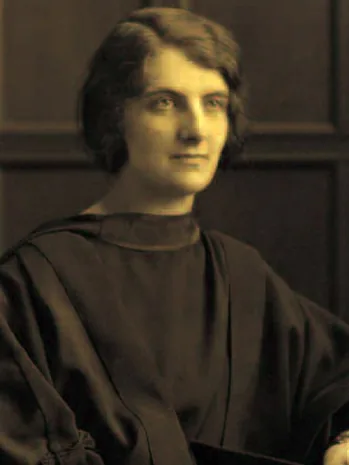
Wikimedia Commons · Public Domain
Scholarly backbone · 1899–1981
Frances Yates
Frances Amelia Yates
British historian who recovered the Hermetic underground beneath the Renaissance.
Academic source — her documented proof of a continuous Hermetic-Rosicrucian current in Western high culture is cited by the tradition as credentialed confirmation that a real initiatic wisdom-stream has always existed within elite institutions.
Frances Yates worked in the Warburg Institute’s shadow-library of images and ideas, and what she found there overturned the standard story of the Renaissance. The recovery of classical reason, she showed, arrived hand-in-hand with a revival of Hermetic magic — and figures like Marsilio Ficino and Giordano Bruno were not aberrations but central carriers of a living initiatic tradition. Her most consequential claim concerned Bruno’s death: he was not burned for heliocentrism but for his Hermetic religion. The symbol-decode tradition reads Yates as the credentialed establishment scholar who proved their foundational premise — that a continuous, initiatic underground stream of esoteric knowledge has always threaded through Western high culture, shaping elite institutions from within. That is a stronger, more conspiratorial argument than Yates herself made; she was a historian of ideas, not a theorist of hidden control.
Core claims
- Yates demonstrated the central role of Hermeticism and magic in Renaissance thought — the 'Yates thesis' — showing that figures from Ficino to Bruno operated inside a living magical-philosophical tradition.
- Yates argued that Giordano Bruno was steeped in the Hermetic tradition; she wrote that the case for burning him could no longer rest on his astronomy but must be located in his Hermetic and magical religion.
- Yates traced the 'art of memory' — the classical and Renaissance practice of imprinting images on imagined architectural spaces — as a technology for structuring and storing knowledge.
- Yates documented the Rosicrucian manifestos and their current, linking Renaissance mysticism to the birth of modern science through a now-suppressed esoteric substrate.
Key works
- Giordano Bruno and the Hermetic Tradition · 1964
- The Art of Memory · 1966
- The Rosicrucian Enlightenment · 1972
Signature decodes
- Hermes Trismegistus entering the Renaissance — Yates showed that the Corpus Hermeticum, mistakenly dated to deep antiquity, was treated as older than Moses and shaped an entire intellectual generation.
- Bruno as Hermetic magus: the magician-philosopher who carried an animate, symbolically saturated cosmos to the courts of Europe — and to the stake.
- The art of memory as a hidden architecture: orators and mages alike populated imagined buildings with charged images to encode vast systems of knowledge.
Sources
Status Deceased (1899–1981). Her papers are held at the Warburg Institute, London; her books remain in print through Routledge and University of Chicago Press.