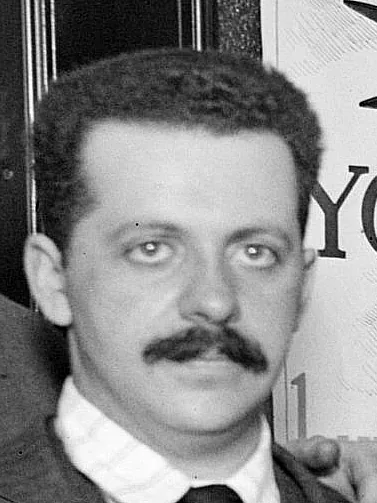
Bain News Service · Wikimedia Commons · Public Domain
Scholarly backbone · 1891–1995
Edward Bernays
Edward Louis Bernays
He called it 'the engineering of consent' — and he meant it literally.
Practitioner-source — Bernays is the tradition's closest thing to a documented insider: a self-described manipulator of mass opinion who used his own words ('invisible government,' 'engineering of consent') to name what the symbol-control scene argues is always happening.
Edward Bernays is the tradition’s most uncomfortable exhibit. He did not need to be decoded: he wrote it down. In Propaganda (1928) he named the “invisible government” of opinion-shapers who run democratic society; in The Engineering of Consent (1947) he turned that government into a profession. Nephew to Freud, Bernays understood that desire, not reason, is the lever of public behavior — and he spent a career pulling it, staging cigarette marches, inventing breakfast habits, manufacturing consensus for corporations and governments alike. Jordan Maxwell and Mark Passio invoke Bernays as documentary proof that consent is manufactured and the public mind is managed: his own books confirm the thesis without needing interpretation. No other figure in the scholarly backbone sits this close to what the tradition claims.
Core claims
- Bernays argued that the masses are irrational and that an 'invisible government' of PR experts must shape public opinion to maintain social order.
- Bernays applied his uncle Sigmund Freud's psychoanalysis to mass persuasion, engineering desire and consensus rather than addressing rational argument.
- Bernays coined 'the engineering of consent' — the systematic, professional management of public opinion as a branch of governance and commerce.
- Bernays held that propaganda could 'regiment the collective mind' across government, politics, art, and education simultaneously.
Key works
- Crystallizing Public Opinion · 1923
- Propaganda · 1928
- The Engineering of Consent · 1947
Signature decodes
- The 'Torches of Freedom' campaign (Easter Sunday, March 31, 1929): Bernays staged women smoking Lucky Strikes in New York's Fifth Avenue Easter Parade, generating front-page coverage and linking cigarettes to suffragette symbolism.
- Bacon and eggs as the 'hearty American breakfast': Bernays manufactured a dietary norm for a pork client by soliciting physician endorsements, making a commercial preference look like medical wisdom.
- United Fruit Company PR: Bernays shaped American public and government opinion to support intervention in Guatemala — a case study in corporate symbol-management at the level of geopolitics.
Influenced
Sources
Status Deceased (1891–1995). His papers are held at the Library of Congress; his books remain in print through Ig Publishing and Liveright.