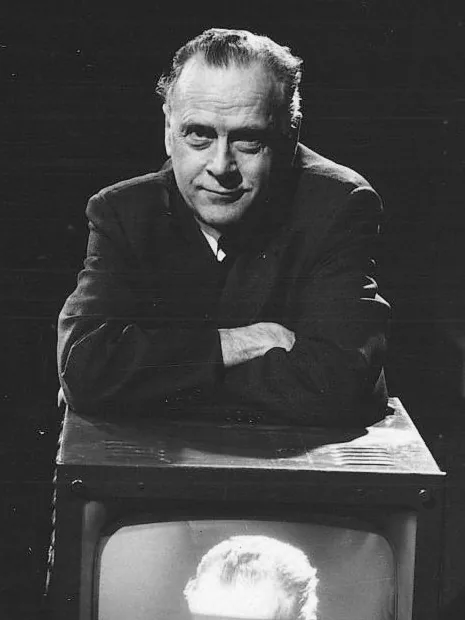
Gotfryd, Bernard, photographer · Wikimedia Commons · Public Domain
Scholarly backbone · 1911–1980
Marshall McLuhan
Herbert Marshall McLuhan
Canadian media theorist who proved the medium reshapes the mind, not the message.
Academic source — his thesis that media operates below conscious awareness runs thematically parallel to the tradition's claim that television and logos 'program' the public, though direct textual citation of McLuhan by the scene's named figures is not documented.
Marshall McLuhan saw something his contemporaries missed: it is not what the television says that matters, but what watching television does. The medium reshapes the nervous system, restructures perception, and reorganizes social life — independent of any content it carries. His formulation “the medium is the message” landed in 1964 like a provocation, but it was precise: every extension of the human body through technology amputates something in return, and the net effect is a new mode of consciousness. The symbol-control tradition runs on a McLuhanesque intuition — that mass media operates below awareness, “programming” the collective mind — though direct, named citation of McLuhan by Jordan Maxwell, Mark Passio, or Freeman Fly is not documented in available sources. The debt is thematic rather than textual: the ideas travel without the byline.
Core claims
- McLuhan argued 'the medium is the message': the form of a medium shapes perception and society more profoundly than any content it carries.
- McLuhan coined 'the global village' — electronic media collapse space and time, folding the world into one interconnected, simultaneity-saturated consciousness.
- McLuhan distinguished 'hot' media (high definition, low participation) from 'cool' media (low definition, high participation) and showed how each medium restructures its users.
- McLuhan wrote that a medium's content distracts the conscious mind 'like a juicy piece of meat carried by the burglar to distract the watchdog of the mind,' leaving the subconscious open to the medium's structural effects.
Key works
- The Gutenberg Galaxy · 1962
- Understanding Media: The Extensions of Man · 1964
- The Medium is the Massage · 1967
- Laws of Media · 1988
Signature decodes
- 'The medium is the message' — television's effects on society have nothing to do with what is broadcast and everything to do with what the act of watching does to the nervous system.
- Every medium as an 'extension of man': the wheel extends the foot, the book extends the eye — and every extension also amputates the faculty it replaces.
- The 'global village': electronic simultaneity reverses the fragmented, linear logic of print and retrieves the all-at-once awareness of oral culture — at planetary scale.
Sources
Status Deceased (1911–1980). His papers are held at Library and Archives Canada; major works published by MIT Press and Gingko Press.