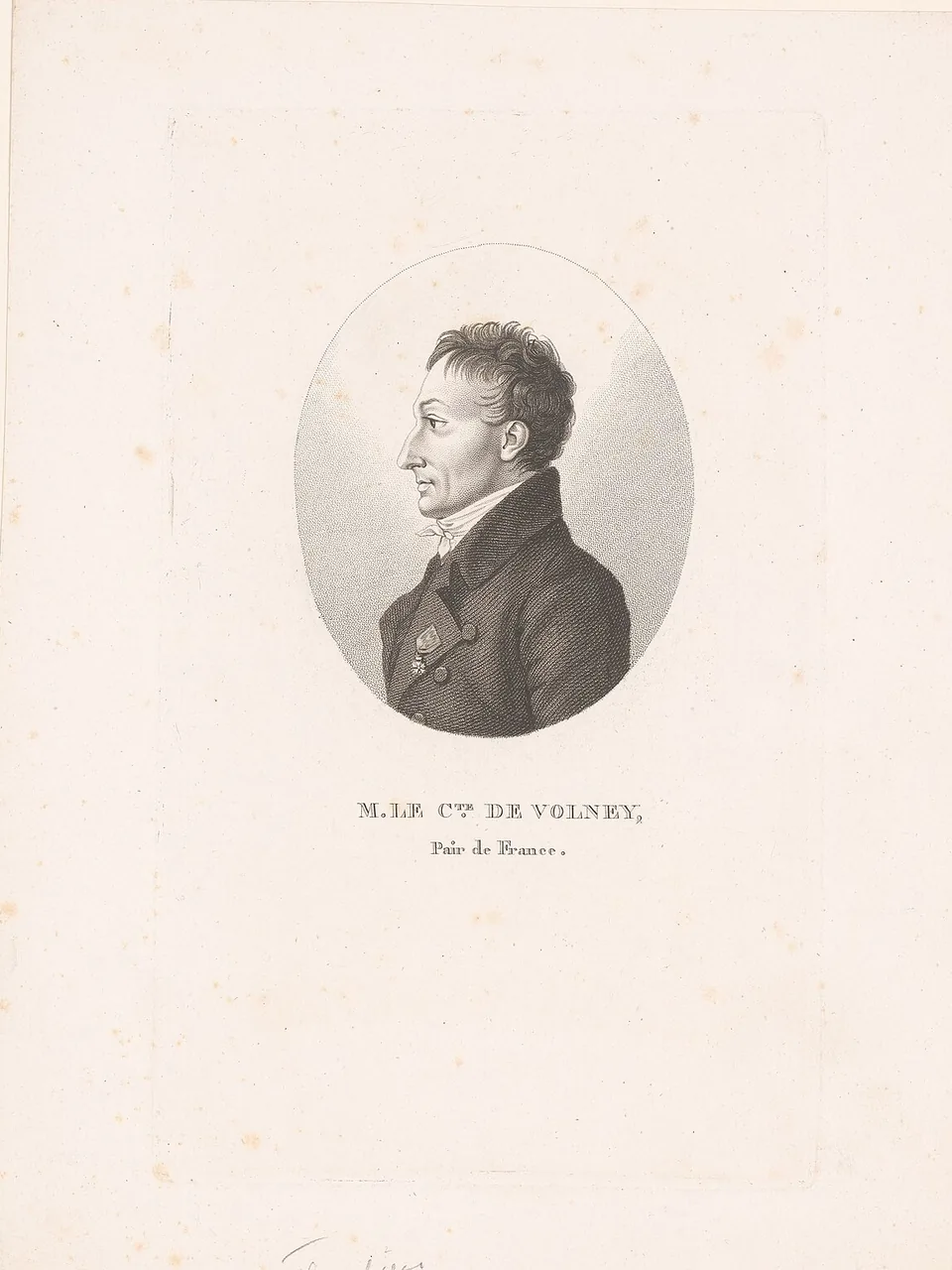
Rijksmuseum · Wikimedia Commons · CC0
Ancestor · 1757–1820
Constantin-François Volney
Volney · Comte de Volney
French philosopher who traced all religion to star-worship in The Ruins.
Co-founder with Dupuis of the astral origin-of-religion school; widely cited as an originating astrotheology source across the modern tradition.
In 1783, Constantin-François Volney travelled alone through Egypt and Syria for three years. He returned with a field naturalist’s eye for ruins and a philosopher’s conviction that those ruins told one story: every religion built on them had been made by human beings looking at the sky. His 1791 meditation The Ruins gave that conviction its most eloquent form — a long dialogue in which an angelic figure walks the author through the astral genealogy of all religion, from Sabeism (star-worship) through Egypt and Persia to Rome and Christianity. Volney taught that the Christ-figure is the Sun: born at the winter solstice, dying at the spring equinox, resurrected into summer. He had read a draft of Dupuis’s great work and The Ruins bears its mark throughout. Thomas Jefferson found the book important enough to begin translating it himself. Godfrey Higgins and Gerald Massey carried Volney’s argument into English esoteric scholarship, and through them it entered every corner of the modern tradition.
Core claims
- Volney taught that worship originated in reverence for the elements and forces of nature, evolving into 'worship of the stars,' which he called Sabeism.
- In The Ruins, Volney presented Christianity as 'the allegorical worship of the Sun' under cabalistic names — the Son of God read as the Sun of God.
- Volney taught that all religions share one object: the personification of natural and celestial cycles, expressed through local symbols and stories.
- Volney argued that a universal natural religion, stripped of priestly distortion, could be recovered by tracing all cults back to their astronomical origin.
Key works
- Voyage en Syrie et en Égypte · 1787
- Les Ruines, ou Méditations sur les révolutions des empires · 1791
Signature decodes
- 'Worship of the Stars, or Sabeism': Volney's chapter in The Ruins names the specific moment when human beings first treated the heavens as divine — and argues that moment generated every subsequent religion.
- Christianity as solar allegory: Volney assembled a comparative table showing the Christ-figure's biography tracking the solar year — a method Dupuis had pioneered and the entire subsequent tradition would repeat.
- The natural-religion genealogy: Volney traced a direct descent from star-worship through Egyptian, Persian, Greek, and Roman religion to Christianity — the first explicit astrotheology lineage chart.
Influenced by
Influenced
Sources
Status Deceased (1757–1820). The Ruins is in the public domain; the original French text is held at the Bibliothèque nationale de France and Project Gutenberg; Thomas Jefferson's unfinished English translation exists in the Library of Congress.