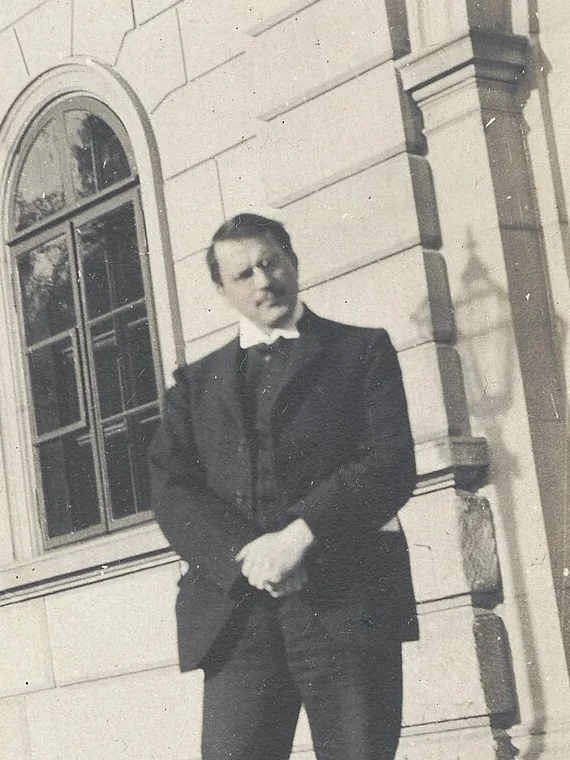
Wikimedia Commons · Public Domain
Scholarly backbone · 1875–1961
Carl Jung
C.G. Jung
Swiss psychiatrist who mapped the archetypes living inside every myth.
Academic source — his theory of archetypes and the collective unconscious is the psychological backbone the symbol-decode tradition cites to argue that ancient symbols carry objective, trans-personal power.
Carl Jung founded analytical psychology on a single, startling claim: beneath the personal unconscious lies a collective layer, shared by all humans, populated by inherited psychic patterns he called archetypes. These are not learned; they are structural — the Hero, the Shadow, the Great Mother — erupting identically in the dreams of a Swiss patient and the myths of ancient Egypt. Jung spent decades tracing them through alchemy, Gnosticism, and world mythology, arguing that the symbolic imagination is doing real psychological work, not primitive error. The symbol-control scene cites Jung’s archetypes to argue that whoever understands these patterns — as Mark Passio frames it — can manipulate the mass psyche through ritual imagery and media; a strong externalizing of what Jung designed as a map toward individual wholeness.
Core claims
- Jung proposed the 'collective unconscious,' an inherited layer of the psyche shared by all humans beneath the personal unconscious.
- Jung held that 'archetypes' — the Shadow, Anima/Animus, Wise Old Man, Mother, Hero — are universal psychic patterns expressed across myth, dream, and religion.
- Jung studied alchemy, mythology, and Gnosticism as symbolic maps of psychological transformation — the process he called 'individuation.'
- Jung argued that mandala imagery, spontaneously produced across cultures, points to an innate drive toward psychic wholeness.
Key works
- The Archetypes and the Collective Unconscious · 1959
- Psychology and Alchemy · 1944
- Man and His Symbols · 1964
Signature decodes
- The Shadow archetype — the repressed, dark side of the self — appearing as the villain, monster, or trickster in myths worldwide.
- Alchemy decoded not as proto-chemistry but as a symbolic drama of the soul's transformation, mapping the individuation process stage by stage.
- The mandala as a universal symbol of psychic wholeness, produced spontaneously in dreams and across unconnected cultures.
Influenced
Sources
Status Deceased (1875–1961). His collected works, letters, and seminars are published by Princeton University Press (Bollingen Series) and the Philemon Foundation.